
Claris, Apple’s software subsidiary, is privately testing Harbor, an app that turns a Mac with Apple silicon into an inference server for open-weight AI models, and that can link several Macs over Thunderbolt 5 to pool their unified memory. The app came to light on November 10, 2026, through a leak from Aaron Perris; Apple later pulled the App Store listing and hasn’t announced it. For AI infrastructure, the news is the idea behind it: private inference, on your own hardware, without building a GPU cluster.
Harbor as a private AI server, in 30 seconds
- What it is: a Claris app that runs open models locally on a Mac with Apple silicon.
- Cluster: detects Macs connected over Thunderbolt 5 and pools their unified memory for larger models or more simultaneous requests.
- Status: private testing, with no date, price or model list; Apple hasn’t confirmed it.
- Why it matters: it brings private inference within reach of companies without AI infrastructure teams.
According to the leaked listing, Harbor lets you search for, download and load open-weight models from within the app itself, handles their management, and promises that no manual configuration, command line or infrastructure knowledge is needed. As noticias.ai details in its analysis of Harbor, the tool is entering a space where LM Studio, Ollama and the open-source project Exo already compete, but with Apple’s name behind it and the cluster built in.
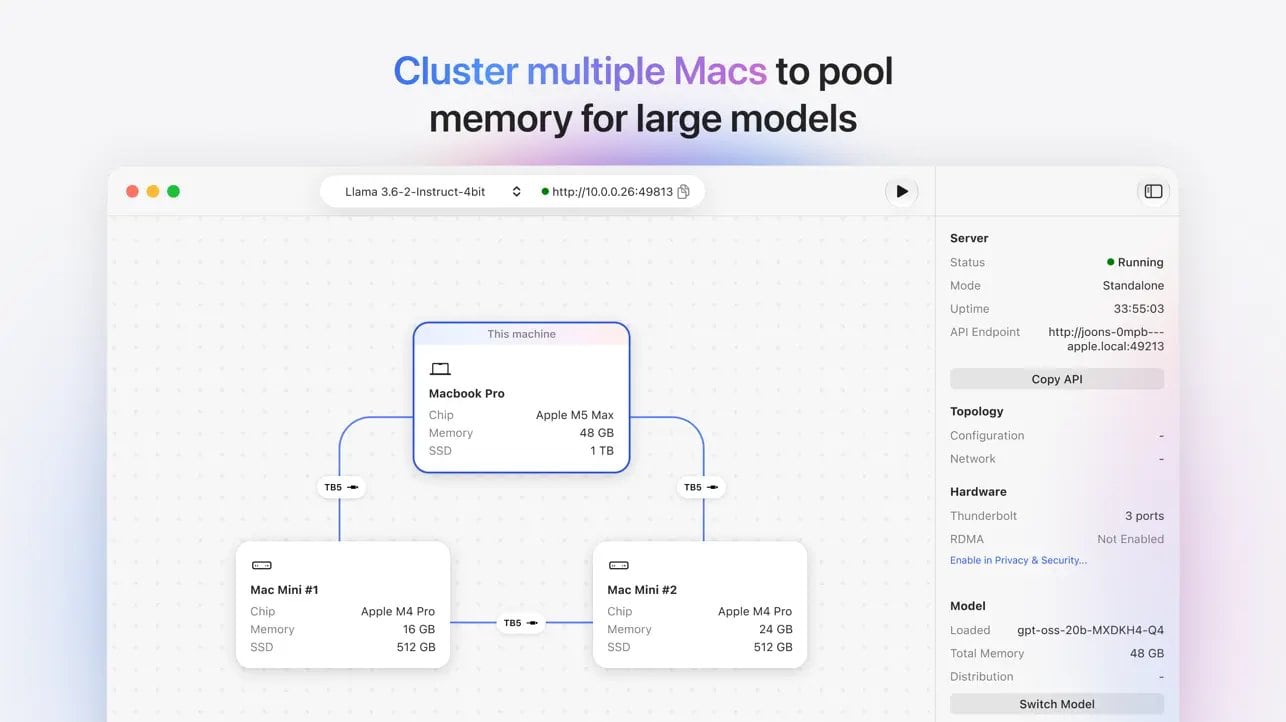
How the Mac cluster works
The technical foundation is Apple silicon’s unified memory, shared by the CPU, GPU and Neural Engine — the same architecture behind Apple’s 512GB Mac Studio AI workstation. A large model can be loaded entirely into that memory without depending on the VRAM of a dedicated card, which on an x86 server means stacking several expensive GPUs for models with tens of billions of parameters. The ceiling is each machine’s memory, and the cluster raises it: Harbor splits the model across several Macs and treats them as a single inference resource.
For that to work, the network between machines has to be very fast. Harbor requires Thunderbolt 5 and relies on the RDMA (remote direct memory access) over Thunderbolt 5 that Apple added in macOS Tahoe 26.2, the same technique computing clusters use to move data between nodes without going through the CPU. Apple’s MLX framework already distributed work across Macs over Thunderbolt; Harbor would wrap that in a ready-to-use application.
On-premises inference versus cloud inference
Today, most companies consume language models as a cloud service: pay-per-use, data that travels to an outside provider, and dependence on that provider’s availability and terms. The local alternative keeps data on your own machines, with a fixed hardware cost and no variable billing per query. For organizations handling sensitive data or data subject to GDPR, that matters as much as price.
A Mac cluster doesn’t replace a GPU data center for training models or serving thousands of users, but it can comfortably cover inference for a department or a small business: internal assistants, document summarization, or search over a company’s own knowledge base. Claris’s involvement — the company best known for FileMaker — and an early-access form that asks for the company’s name both point to that professional use case, though Apple hasn’t explained it. For anyone who’d rather build their own infrastructure without a Mac, the classic route of GPU servers in a private cloud or on-premises, managed with open platforms such as those we’ve covered in our comparison of VMware, Nutanix and Proxmox VE, still applies.
What’s not confirmed
Everything known so far comes from the leaked listing. There’s no price, date, list of supported models, or performance data comparing a cluster to a single Mac, and it’s also unclear whether Harbor will offer an API compatible with the major providers’, which would be key to connecting it to other applications. The Thunderbolt 5 requirement rules out a large share of the existing Apple silicon Mac fleet. 9to5Mac considers a launch within weeks or months likely, but that’s the outlet’s own estimate, not an announcement from Apple.
Frequently asked questions
What is Harbor?
An app from Claris, Apple’s subsidiary, that turns one or more Macs with Apple silicon into a private inference server for open-weight AI models.
What do you need to build a cluster?
Two or more Macs with Apple silicon and Thunderbolt 5. Harbor detects them and automatically pools their unified memory.
Does it replace a GPU server?
Not for training models or for large volumes of users, but it can cover inference for a team or a small business, keeping the data on its own hardware.
When will it be available?
There’s no date. It’s in private testing, and Apple hasn’t announced it.
Sources:
This article is also available in Spanish: «Harbor: Apple prueba un servidor de IA privado con Mac en clúster», on revistacloud.com.
