
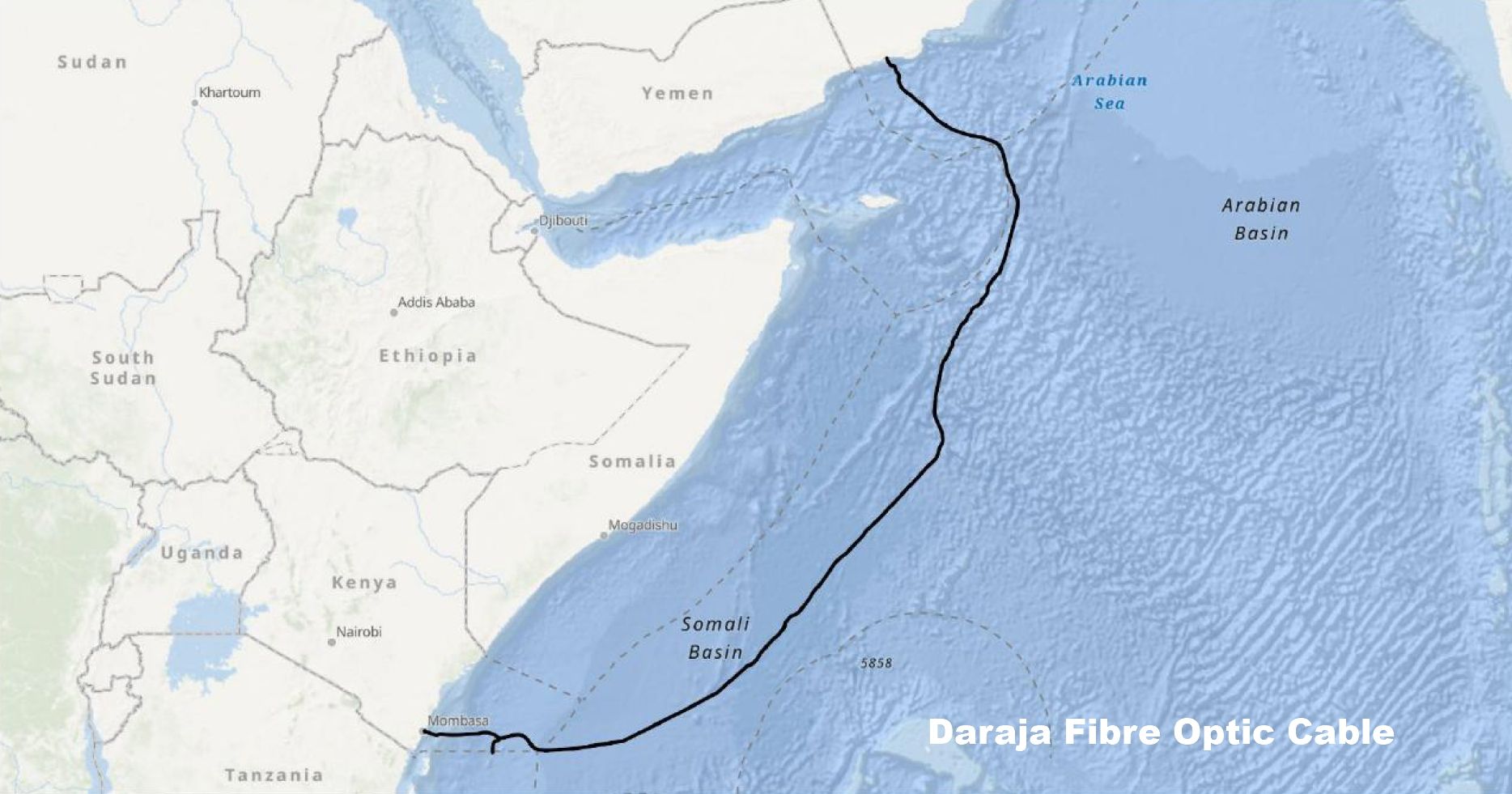
The Daraja submarine cable will connect Mombasa, Kenya, with Salalah, Oman, through a 4,108-kilometer fiber-optic system with 24 fiber pairs. The project is financed by Meta through its subsidiary Edge Network Services, with Safaricom as the partner for the landing and operation of the Kenyan segment. Alcatel Submarine Networks (ASN) is the supplier building the system, which is expected to enter service in 2026.
Key facts about the Daraja cable in 20 seconds
- Daraja will link Kenya and Oman along a 4,108-kilometer submarine route.
- The system will have 24 fiber pairs, though its final commercial capacity has not been published.
- Meta is financing the project, and Safaricom will manage the segment within Kenyan territorial waters.
- ASN is the cable supplier; in Mombasa, the project is linked to iColo’s landing infrastructure.
- Oman is strengthening its role as an international connection point thanks to its location and new investments in landing stations.
The name Daraja means “bridge” in Swahili and describes the connection the project aims to establish between East Africa and the Middle East. Besides adding international capacity, the new route could bring geographic diversity to Kenya’s communications, a relevant factor when damage to submarine cables affects several systems in the same region.
Published information about the project puts its length at around 4,108 kilometers and confirms the 24 fiber pairs. However, the number of pairs should not be confused with actual transmission capacity, which also depends on the optical equipment, the technology used, and the commercial configuration. The estimate of half a petabit per second circulating in industry commentary does not appear as confirmed capacity in the public sources consulted.
Meta finances the system, and Safaricom handles the Kenyan landing
Meta, through Edge Network Services Limited, is financing the Daraja cable and has contracted Safaricom to manage the infrastructure associated with the Kenyan segment. The agreement was publicly announced in October 2025, after the project appeared in environmental documentation filed in Kenya.
Safaricom’s involvement is of interest beyond its mobile market. The company, one of the country’s leading telecom operators, will be able to take part directly in the international infrastructure connecting its networks with other markets. The agreement includes operating the segment within Kenyan territorial waters and the associated domestic facilities, according to the information published about the project.
The system’s manufacturer and supplier is Alcatel Submarine Networks, known as ASN. The company is responsible for supplying the submarine infrastructure. On the Kenyan side, the landing point is located in the Nyali area of Mombasa, a location that already hosts several international connections.
The landing facility and the terminal equipment are just as important as the submarine cable itself. Submarine Line Terminal Equipment, known as SLTE, is used to manage the optical signal carried through the fibers. According to the industry analysis accompanying the project, iColo 2 would be the facility associated with Daraja in Mombasa. This location fits with the presence of data centers and interconnection networks on the Kenyan coast, although the full operational details should be checked against announcements from the parties involved.
Daraja also fits a broader trend: major mobile operators are increasingly taking part in submarine cable systems, whether as investors, landing partners, or capacity buyers. Groups that have been active in this market include Vodafone, Bharti, Ooredoo, and Axiata. For operators, controlling or securing international capacity can help diversify routes, expand enterprise services, and manage the cost of voice and data traffic. The pressure on existing routes is also drawing attention, as providers warn of a looming capacity crunch on cables serving Africa.
Oman gains weight as a submarine cable connection point
The Omani end of the cable will be in Salalah, a city on the Arabian Sea coast. Its position offers direct access to the Indian Ocean and facilitates connections between East Africa, the Middle East, and routes toward Asia. Oman has been developing landing facilities and data centers for some time to capture more international traffic.
Ooredoo Oman announced an agreement in May 2024 to host the 2Africa system in Barka and Salalah. The company also opened a data center and submarine cable landing station in Salalah in August 2025, with capacity designed to grow as demand increases. These investments help explain why the country is seeking to attract international operators and digital service providers.
In Daraja’s case, industry analysis suggests the Omani landing would rely on a station linked to Omantel. One possible advantage of having separate landing facilities is physical diversity: a localized incident at one station or its terrestrial connection would not necessarily affect every system reaching the country. How useful that separation actually is depends on backhaul routes, interconnection agreements, and each network’s architecture.
Some analysts consider Oman more attractive to international operators than other Gulf markets because of its access conditions and location. Criticism of interconnection costs in the United Arab Emirates and the structure of its telecom market is part of that debate, but it should not be presented as an official explanation for choosing Salalah. The public sources consulted do not confirm that those factors were decisive for Daraja.
Regulation matters too. In 2025, Oman’s Telecommunications Regulatory Authority published a specific framework for international cables that sets out procedures for their installation, maintenance, repair, and survey in Omani waters. Having clear rules in place can provide more predictability for projects, although commercial conditions and costs still need to be assessed case by case.
Route and redundancy matter as much as capacity
Submarine cables must balance distance, cost, latency, and physical security. A shorter route is not always the most convenient option if it crosses areas exposed to anchors, fishing, underwater landslides, or turbidity currents. That is why routes are designed based on seabed surveys and the risks identified along the way. The Gulf region overall has drawn growing attention over cable security, including debates about the risks concentrated around the Strait of Hormuz.
The map released by SubmarineNetworks.com shows a route that avoids shallow waters where possible. The usual goal of this kind of routing is to reduce exposure to damage, although the final path depends on the project’s technical studies and permits. The industry source also points to a possible branching unit to extend the system southward. That extension should be treated as a technical possibility, not as a confirmed additional connection.
Route diversification matters for digital services, data centers, and mobile networks. A new connection between Kenya and Oman could provide an alternative for carrying international traffic and reduce reliance on certain existing routes. It does not by itself guarantee an automatic improvement in speed for end users: the outcome will depend on the capacity activated, agreements between operators, and how traffic is routed.
Frequently asked questions
Which countries does the Daraja cable connect?
It connects Kenya and Oman, with landing points in Mombasa and Salalah, respectively. The system is designed to cover about 4,108 kilometers.
Who owns the Daraja cable?
Published information indicates that Meta is financing the project through its subsidiary Edge Network Services Limited. Safaricom is involved as the landing partner and operator of the segment within Kenyan territorial waters.
How many fiber pairs does Daraja have?
The system is designed with 24 fiber pairs. Its final transmission capacity has not been publicly confirmed in the sources consulted.
Why does the landing in Oman matter?
Salalah offers access to the Indian Ocean and could strengthen connections between East Africa, the Middle East, and Asia. The presence of other stations and cables in Oman also makes it possible to plan physically diverse routes.
