
Major cloud providers fear that Africa will run short of submarine capacity within two or three years, because no major new projects are in the pipeline. That’s one of the takeaways attendees at ITW Africa, the wholesale telecom industry’s gathering, have been sharing on professional networks. The rundown covers more ground: the 2Africa cable is studying routes through the northeast of the continent to bypass the southern Red Sea, the Mombasa–Marseille segment should enter service next summer, and the Africa-1 cable is running into trouble.
Africa’s submarine capacity in 30 seconds
- According to discussions at ITW Africa, hyperscalers expect a capacity shortage within two to three years.
- 2Africa is weighing whether to connect to its Sudan landing station from Mombasa or from Djibouti, with no firm decision yet.
- The Mombasa–Marseille segment is expected by summer 2027.
- Africa-1 may have run out of funding, something its consortium has not confirmed.
- Equiano and 2Africa currently have spare capacity, and operators are being advised to lock it in.
These takeaways are worth reading for what they are: impressions and hallway comments from an industry conference, not official announcements from the consortiums. Neither Meta nor the other 2Africa partners have published a decision on the new route, and Africa-1’s owners have not reported any funding problems. Even so, several of these points line up with what is already known about the state of submarine networks in the region since the 2024 outages.
The Red Sea remains the bottleneck
The Bab el-Mandeb Strait, between Yemen and the Horn of Africa, carries a large share of the cables linking Europe with Asia and East Africa. An analysis by the Istituto Affari Internazionali (IAI), published in December 2025, estimates that around 90% of Europe-Asia communications and roughly 17% of global internet traffic pass through the area.
The risk stopped being theoretical in February 2024. That month, the AAE-1, Seacom, EIG, and TGN cables were cut, affecting a quarter of the traffic between Asia and Europe, according to the same report. Ethiopia lost around 90% of its connectivity and Somalia about 85%. Repairing AAE-1 took months because obtaining permits in a fragmented Yemen took nearly five months, and only two to four repair ships operate across the entire Europe, Middle East, and Africa region. In September 2025, further cuts near Jeddah, Saudi Arabia, affected SMW4 and IMEWE, and Microsoft warned of added latency on Azure.
That track record explains the option discussed at ITW Africa. 2Africa, the roughly 45,000-kilometer cable that circles the continent, is reportedly studying ways to connect its eastern segment to its Sudan landing station via routes through northeast Africa, so it doesn’t have to rely on the southern Red Sea crossing. The two alternatives mentioned run out of Mombasa (Kenya) or Djibouti. According to attendees, there’s no firm decision yet.
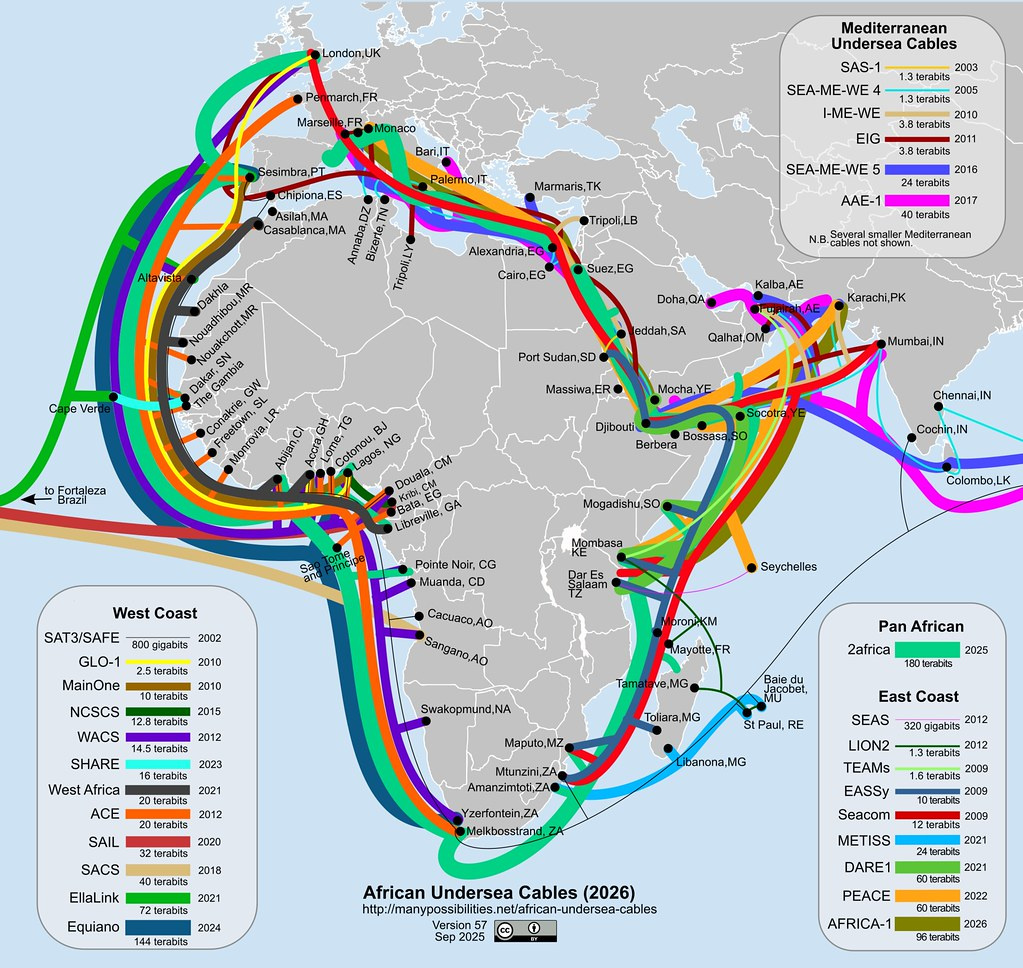
Abdoul-Aziz A. Elmi, a projects operations and logistics coordinator at Wingu Africa, has argued on LinkedIn that Djibouti could play a dual role: as a Red Sea gateway to Europe and the Middle East, with a possible overland route to Europe through Sudan, and as a southward link to Kenya. That’s the view of a professional at a data center operator with a presence in the country, not an approved route.
2Africa reaches Marseille while Africa-1 stalls
2Africa is backed by a consortium that includes Meta, China Mobile International, Bayobab (MTN), Orange, center3 (stc), Telecom Egypt, Vodafone, and WIOCC, and was laid by Alcatel Submarine Networks (ASN). It spans 33 countries and 46 landing points, with a design capacity of 180 Tbps across 16 fiber pairs. The consortium completed the main ring in November 2025, and the extension toward the Persian Gulf, known as 2Africa Pearls, is still being deployed in 2026. At ITW Africa, attendees said the Mombasa-to-Marseille connection should be operational next summer — a forecast, with no official date published.
Africa-1 is the other major project meant to strengthen the route between East Africa, the Middle East, and Europe. Behind it are e&, G42, Mobily, PTCL, and Telecom Egypt, also using ASN as the supplier, with eight fiber pairs. It was originally due to enter service by the end of 2023, and the landings in Egypt, Saudi Arabia, and Pakistan were completed between late 2024 and early 2025. At the conference, attendees said the project is running into trouble and may have run out of funding. No public confirmation of that situation has been found, so for now it remains unverified.
On the Atlantic coast, Equiano, Google’s cable, connects Portugal with Togo, Nigeria, Saint Helena, Namibia, and South Africa over roughly 15,000 km, with 12 fiber pairs and a design capacity of 144 Tbps. It entered commercial service in 2023.
Mombasa for cables, Nairobi for data centers
The split described at ITW Africa for Kenya matches the public data. More than 95% of the country’s international traffic enters through Mombasa, where at least eight cables land or are planned to land, including PEACE and 2Africa, according to Dawan Africa. Nairobi, by contrast, is where the data centers are concentrated, including those run by iXAfrica.
The constraint isn’t just fiber — it’s power, too. Microsoft and G42 announced a $1 billion geothermal-powered data center in Olkaria in May 2024 that has stalled for lack of electricity supply. Kenyan President William Ruto summed it up this way: “To switch on that one data centre, we would need to shut off power for half the country.” In Mombasa, the company Amaco Energy has proposed an AI data center valued at 194 billion Kenyan shillings, tied to a liquefied natural gas project.
ITW Africa’s final takeaway is a piece of commercial advice. According to attendees, Equiano and 2Africa currently have spare capacity, and internet providers should lock it in now, ahead of what some called the coming “telecom winter.” If the shortage hyperscalers fear arrives in two or three years, whoever has secured long-term capacity will be better positioned. It’s not an official forecast, but it fits what’s already playing out in other corridors, from the Medusa cable toward North Africa to Egypt’s push into AI infrastructure.
Frequently asked questions
Why does 2Africa want to avoid the Red Sea?
The southern Red Sea, near the Bab el-Mandeb Strait, has suffered cable cuts in 2024 and 2025, and repairs there are slow due to permitting and a shortage of repair ships. According to discussions at ITW Africa, 2Africa is studying routes through northeast Africa to reach its Sudan landing station, with no firm decision yet.
When will 2Africa’s Mombasa–Marseille segment be ready?
The conference mentioned next summer. That’s a forecast from attendees, not an official date from the consortium.
What’s happening with the Africa-1 cable?
It’s running behind its original end-of-2023 target. Attendees at ITW Africa said it may have run out of funding, but the consortium hasn’t confirmed this.
Why is Mombasa key to Kenya’s connectivity?
Because more than 95% of the country’s international traffic enters through it, and it’s the landing point for cables like PEACE and 2Africa. Data centers, by contrast, are concentrated in Nairobi.
Sources:
- Istituto Affari Internazionali (IAI): IAI Brief 25/08 (December 2025)
- 2Africa (Wikipedia)
- Submarine Networks: PTCL Lands Africa-1 Subsea Cable in Karachi
- Dawan Africa: Mombasa tech hub, cables, and AI data center
- TechTrendsKE: Kenya’s Microsoft-G42 Data Centre Ambitions Meet Power Constraints
- Steve Song: map of African submarine cables, version 57
- Abdoul-Aziz A. Elmi (Wingu Africa), LinkedIn post about Djibouti
