
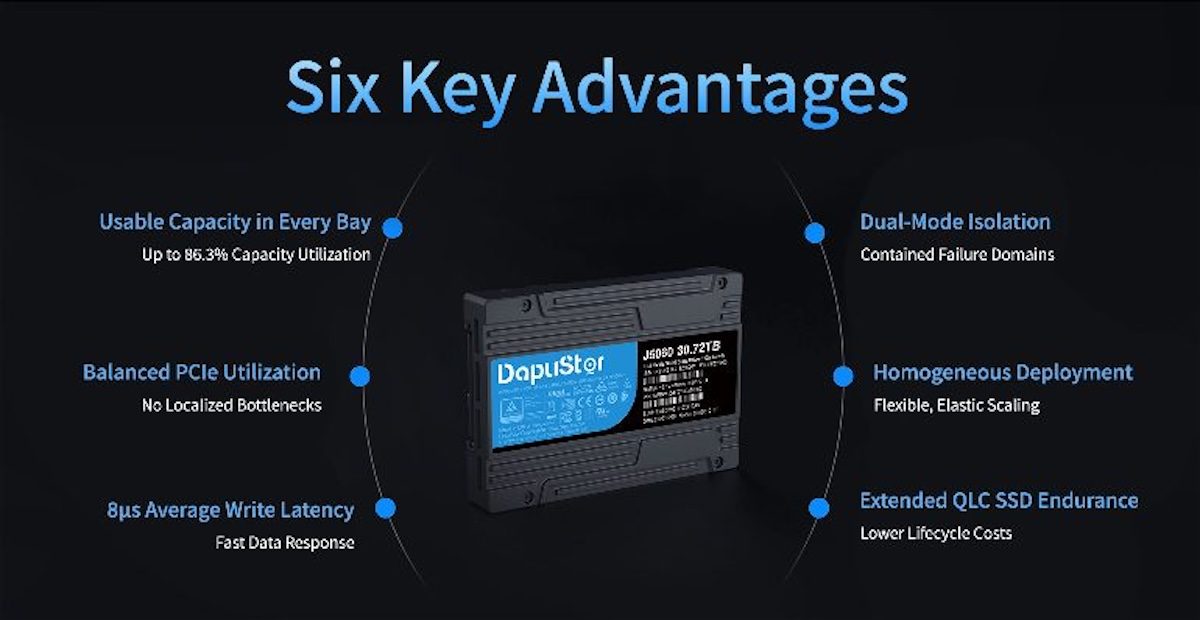
DapuStor is testing a storage architecture that combines pSLC and QLC memory inside the same SSD to tackle one of the toughest problems in AI infrastructure: reaching high capacity without giving up the speed that intensive writes and latency-sensitive workloads demand. The approach uses QLC cells configured through firmware to work partly in pSLC mode, without adding dedicated SLC NAND.
DapuStor’s SLC+QLC SSDs in 30 seconds
- A single SSD combines a high-speed pSLC zone with a high-capacity QLC zone.
- A 24-drive example delivers 19.2 TB of pSLC capacity if each drive reserves 800 GB.
- DapuStor measures more than 7 times the random write IOPS versus its pure-QLC baseline.
- 4 KB random write tests put average pSLC latency below 8 μs.
- The solution is in customer validation, with initial deployments already running real workloads.
DapuStor’s idea starts from a limitation common to systems that mix different types of NAND. SLC (Single-Level Cell) memory offers higher write speed and endurance, while QLC (Quad-Level Cell) stores far more data per memory unit and lowers the cost per capacity.
Traditionally, an infrastructure can use different SSDs for each job: higher-performance drives for hot data and high-capacity drives for large datasets. DapuStor proposes moving both functions inside each individual drive, a shift that lines up with the broader push toward denser QLC memory built for the AI era.
The manufacturer unveiled this architecture on August 12, 2026, and says it is currently in a phased validation process with customers, with initial deployments already running on real workloads.
An SSD that switches between QLC and pSLC in software
The key difference is that DapuStor does not install a separate SLC NAND inside the SSD. Instead, certain QLC cells run in pSLC (pseudo-SLC) mode through a combination of firmware and controller optimizations.
The drive can reserve a region for operations that need more performance and use the rest to store large volumes of data in QLC. According to DapuStor, the ratio between the two regions can be configured based on the workload’s needs.
| Feature | DapuStor’s SLC + QLC architecture |
|---|---|
| Reference capacity | 30.72 TB QLC |
| SSDs per server in the example | 24 |
| pSLC capacity per SSD | 800 GB |
| Total pSLC capacity | 19.2 TB |
| High-capacity memory | QLC |
| High-performance memory | pSLC |
| Configuration | Set via firmware/controller |
| Reference interface | Enterprise NVMe SSD |
The 19.2 TB of pSLC is a figure derived directly from the example DapuStor published: 24 drives multiplied by 800 GB of pSLC on each SSD. The company uses this scenario to compare its proposal with a conventional architecture in which only a portion of the bays is reserved for SLC SSDs.
The manufacturer already offers high-capacity QLC SSDs in its catalog. For example, the R6060 uses PCIe 5.0 x4 and is available in capacities of 15.36, 30.72, 61.44, and 122.88 TB according to the documentation reviewed. DapuStor lists up to 14,000 MB/s of sequential read and 4,000 MB/s of sequential write for these configurations.
24 SSDs, each with its own fast zone
One of the scenarios DapuStor lays out uses a server with 24 bays filled with dual-mode SSDs.
The difference versus a conventional setup lies in how the work is distributed. In an architecture where several QLC SSDs depend on one dedicated SLC drive, that fast drive can end up absorbing most of the writes. DapuStor argues that its dual design spreads traffic across the pSLC regions of every drive.
| Configuration | Dedicated SLC SSDs | QLC SSDs | Dual-mode SSDs | pSLC capacity in the example |
|---|---|---|---|---|
| Conventional architecture cited | 4 | 20 | 0 | Depends on the SLC SSDs |
| DapuStor dual-mode | 0 | 0 separate | 24 | 19.2 TB |
The company says that, under balanced conditions, each of the 24 SSDs can handle roughly 1/24 of the aggregate write traffic. The goal is to keep a small number of PCIe links from absorbing all the operations while others sit underused.
This distribution matters especially for write-bursty workloads, like the ones that can appear during certain phases of AI model training.
DapuStor also claims that each dual-mode SSD achieves more than seven times the random write IOPS of a QLC SSD used purely in QLC mode. The comparison comes from tests and conditions defined by the manufacturer, so it shouldn’t be read as a universal advantage over any QLC SSD on the market.
Under 8 microseconds on 4 KB random writes
The second figure DapuStor highlights is latency.
In 4 KB random write tests, the pSLC region achieved an average latency below 8 μs, according to the manufacturer. The company points this performance at workloads such as database journals, write-ahead logs (WAL), and metadata caches.
| Metric | DapuStor’s dual-mode SSD |
|---|---|
| Operation size | 4 KB |
| Region tested | pSLC |
| Average write latency | < 8 μs |
| Target use cases | WAL, DB journals, metadata cache |
DapuStor attributes this result to three firmware mechanisms: die-level isolation to reduce interference between QLC and pSLC, an optimized pSLC space reservation to limit write amplification, and region-aware I/O scheduling that prioritizes latency-sensitive data.
The architecture also incorporates Flexible Data Placement (FDP) with host-side support and wear-leveling mechanisms to spread out memory wear.
A failure affects a single drive instead of several
DapuStor also uses the dual architecture to address failure recovery.
In the conventional 1:5 scenario the company presents, one SLC SSD can serve five QLC drives. If that SLC drive fails, the failure domain can exceed 150 TB when using 30.72 TB QLC SSDs.
In its proposal, the manufacturer says the affected capacity is limited to the single drive that fails. By its calculations, the volume that needs to be rebuilt drops by almost 80% compared with that 1:5 architecture.
| Scenario | SLC ratio | Stated failure domain | Reduction in rebuild volume |
|---|---|---|---|
| Conventional architecture | 1:5 | >150 TB | — |
| Dual-mode | SLC inside each SSD | One drive affected | Almost 80% |
The potential benefit relates to how much data must be rebuilt after a failure. Less data implies, in principle, a smaller recovery, though the actual time will still depend on the storage system, the network, cluster load, and the rebuild mechanism used.
Write endurance is the other part of the equation
The choice between SLC and QLC doesn’t depend only on performance. It’s also tied to memory endurance across program/erase cycles.
DapuStor says its pSLC region supports more than 25 times the P/E cycles of QLC operation. By routing high-frequency random writes to that zone, the manufacturer aims to reduce the pressure on the QLC region.
| Parameter | Figure reported by DapuStor |
|---|---|
| pSLC capacity per drive in the example | 800 GB |
| pSLC across 24 drives | 19.2 TB |
| pSLC endurance vs. QLC | >25× P/E cycles |
| pSLC latency on 4 KB writes | <8 μs |
| Write IOPS vs. QLC-only | >7× |
These figures come from DapuStor and correspond to its own architecture and test conditions. The company doesn’t publish an independent table of third-party lab results in the article that would allow a direct comparison of these values against enterprise SSDs from other manufacturers.
The same idea works for AI, databases, and the cloud
The manufacturer positions the design especially for AI infrastructure. During training, the QLC region can store large datasets while pSLC absorbs hot data and intensive write operations.
During inference, where latency can affect metrics like Time to First Token (TTFT), having a lower-latency storage region can be useful for certain data and metadata.
DapuStor also proposes applications in databases like MySQL and Oracle, where pSLC can be used for write logs while QLC provides storage capacity. In cloud and virtualization environments, the company suggests a single drive could simultaneously handle virtual machine boot operations and bulk storage.
The proposal also targets HDD-based architectures that rely on a separate TLC SSD as a cache. In that scenario, the manufacturer suggests that combining QLC and pSLC acceleration inside the same drive could eliminate an extra caching layer.
DapuStor doesn’t yet present this technology as a widely deployed product. The company says the solution is in phased validation with customers, with initial deployments already on real workloads. That currently puts the technology in an evaluation phase, not widespread adoption.
Still, the idea is representative of where AI storage is heading: increasing capacity without giving up performance on critical operations, while avoiding a server architecture that has to reserve entire blocks of drives for each type of workload.
Frequently Asked Questions
What is a dual-mode SLC + QLC SSD?
It’s an SSD that combines a high-performance pSLC region with a higher-capacity QLC region inside the same drive. DapuStor achieves the pSLC region by running certain QLC cells through firmware and controller optimizations.
How much pSLC capacity does DapuStor’s example offer?
The scenario uses 24 SSDs with 800 GB of pSLC per drive, adding up to 19.2 TB of pSLC capacity in the server.
What latency does the pSLC achieve?
DapuStor says the pSLC region achieved an average write latency below 8 microseconds in 4 KB random write tests.
Is this technology already available for enterprise deployments?
DapuStor says the solution is in a customer validation phase and that there are initial deployments running real workloads. The published information doesn’t indicate it’s yet a widely adopted technology.
via: en.dapustor
