
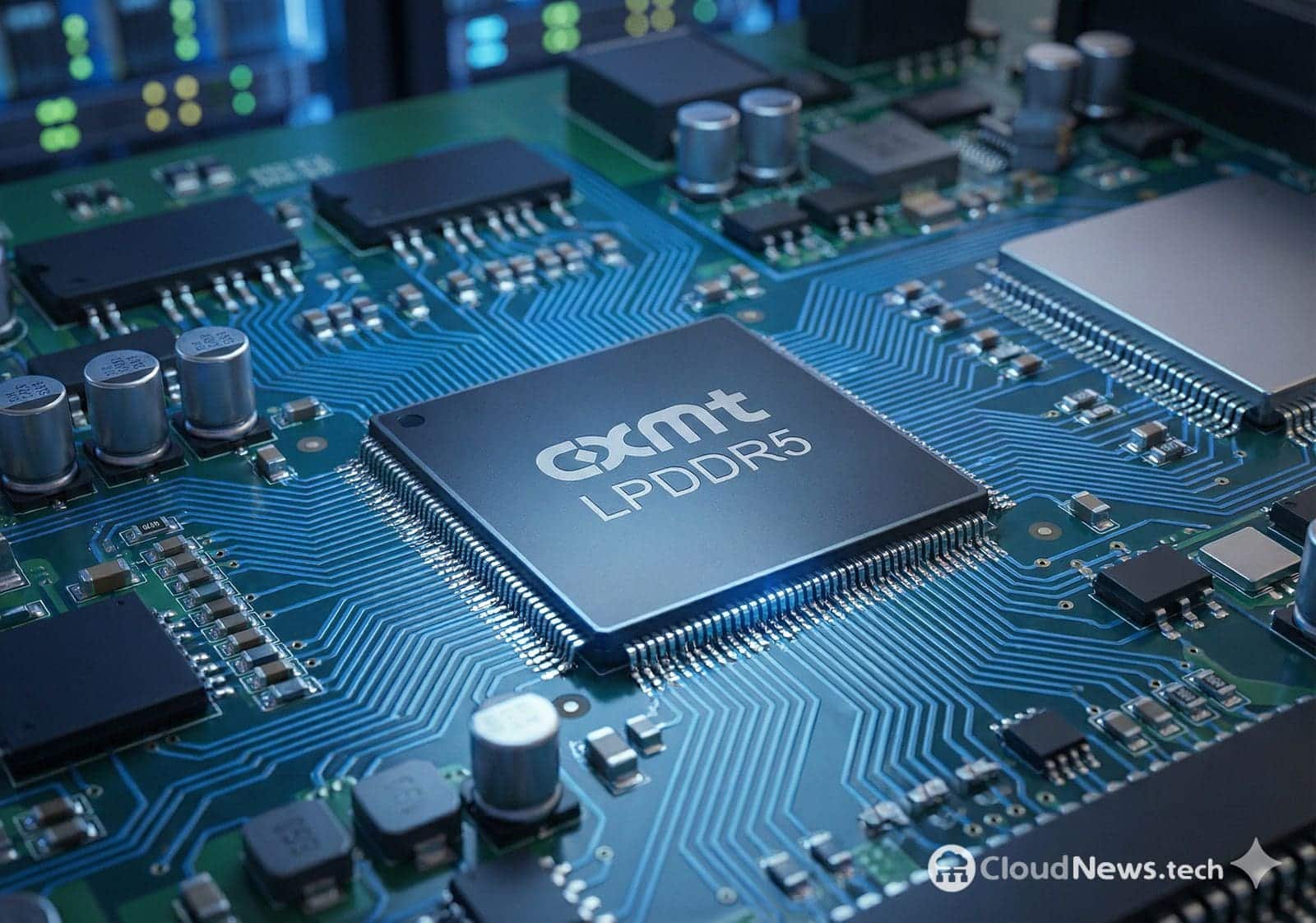
ChangXin Memory Technologies (CXMT) is preparing a 34.9 billion yuan investment, about $5.2 billion, to expand its research, manufacturing, and testing capacity for memory chips. The move comes just days after the Chinese manufacturer announced mass production of its fifth-generation DRAM, a G5 platform featuring an 11.95-nanometer half-pitch design and new 24Gb LPDDR5X chips.
CXMT’s expansion in 20 seconds
- CXMT will put 24.1 billion yuan into a new R&D project and 10.8 billion yuan into the second phase of a wafer testing facility.
- About 22.4 billion yuan of the R&D project will go toward equipment purchases, according to documentation cited by the South China Morning Post.
- The company has just moved its G5 DRAM platform into mass production, with an active-area half-pitch of 11.95 nm.
- Two new 24Gb LPDDR5X chips based on G5 are already in mass production and offer 50% more capacity per die than the equivalent previous generation.
- CXMT also claims G5 delivers at least 50% more gross dies per wafer than its previous platform.
The new investment comes at a particularly significant moment for CXMT. The Chinese company is trying to increase its DRAM manufacturing capacity while reducing its reliance on foreign semiconductor equipment suppliers. According to a source cited by the South China Morning Post, a significant share of the new equipment purchases would go to Chinese manufacturers. That claim of a preference for domestic suppliers comes from the newspaper’s source; the financial documentation confirms the budget and the heavy weighting toward equipment, but doesn’t by itself allow every purchase to be attributed to a specific supplier.
34.9 billion yuan for R&D and testing
The plan covers two major items. CXMT plans to invest 24.1 billion yuan in a new R&D technology project, while another 10.8 billion yuan will go toward the second phase of a facility dedicated to testing memory wafers.
The breakdown shows just how much manufacturing advanced DRAM depends on specialized machinery. According to information published by the South China Morning Post, about 22.4 billion yuan, roughly 93% of the R&D project’s budget, corresponds to equipment acquisition — a reminder of how closely China’s memory makers, which have also been stockpiling ASML machines to lock in years of expansion, are tracking their access to lithography tools.
CXMT will also use part of the funds raised in its recent stock market debut. The company listed on Shanghai’s STAR Market in July 2026, and the offering raised at least 57.9 billion yuan, about $8.6 billion, according to Reuters. The capital raise came at a time of strong memory demand tied to artificial intelligence.
Available financial documentation further puts at 18 billion yuan the amount of surplus proceeds from the public offering that would be used for these new projects, with 13 billion yuan earmarked for the R&D project and 5 billion yuan for the second phase of the testing facility.
The plan, then, isn’t only a capacity expansion. CXMT is putting a sizeable share of its capital into developing new technologies and expanding the infrastructure needed to test and validate the chips it produces.
G5 is already in mass production
The financial announcement coincides with another technological milestone. On September 20, CXMT announced at the World Manufacturing Convention in Hefei that its fifth-generation DRAM technology, called the G5 Platform, had entered mass production. The company also unveiled two new LPDDR5X products built on that platform.
One of the most notable technical figures is the 11.95-nanometer active-area half-pitch. CXMT says it reached that figure using self-aligned quadruple patterning (SAQP), a multiple-patterning technique used to create smaller structures within memory arrays.
The company also reports a 45:1 aspect ratio for the array capacitors and a cell core-array height of 6,762 nanometers, using a high-k metal gate (HKMG) process optimized for DRAM.
These figures need careful reading. The 11.95 nm value describes the half-pitch of the memory array’s active area — it doesn’t mean the entire G5 technology can simply be defined as an 11.95 nm manufacturing node. Nor does it alone establish a full equivalence with Samsung’s, SK hynix’s, or Micron’s processes, since comparable public data on performance, power consumption, manufacturing yield, and cost is missing.
CXMT also claims G5 achieves at least 50% more gross dies per wafer than its previous platform, using an equivalent density of 8Gb as the reference point. This refers to gross dies per wafer, not the final number of functional chips after discarding defective units. That’s why the figure shouldn’t automatically be read as an equivalent 50% increase in sellable chips.
24Gb LPDDR5X and a more local supply chain
The G5 platform also comes with two 24Gb-per-die LPDDR5X products. CXMT says both are already in mass production and use 496-ball and 245-ball packages, respectively, aimed at smartphones and other portable electronic devices.
The 24Gb capacity is 50% more than CXMT’s equivalent 16Gb products from the previous generation. In capacity terms, 24Gb equals 3GB per die, though the commercial figure is expressed in gigabits since it’s semiconductor memory. CXMT’s LPDDR6, meanwhile, has already debuted in Xiaomi’s next foldable phone, part of the same broader push to move up the memory ladder.
G5’s production and the new investment are part of a broader CXMT strategy to expand its position in the global memory market. Reuters placed the company as the world’s fourth-largest DRAM manufacturer, behind Samsung Electronics, SK hynix, and Micron, with a 7.7% global share at the time of its July 2026 analysis.
The company is also expanding its catalog beyond conventional DRAM. In September it announced mass production of LPDDR6, which debuted in the Xiaomi 18 Fold, while Reuters reported on its plans to develop a NAND research and production line in Beijing.
The international backdrop adds another layer to this expansion. China’s access to certain advanced semiconductor manufacturing equipment is constrained by US export restrictions. CXMT is trying to advance more sophisticated memory technologies while building a domestic supply chain capable of providing a larger share of the tools needed to manufacture those products. Reuters explicitly linked G5’s development to collaboration with Chinese equipment makers.
The new investment doesn’t by itself prove that CXMT can replace all foreign equipment in its most advanced processes. What it does show is the amount of capital the company is willing to commit to expanding its technological capacity and its production and testing infrastructure.
The combination of G5, 24Gb LPDDR5X, new facilities, and a bigger push toward domestic suppliers puts CXMT in a different phase of its expansion. The manufacturer is no longer focused solely on growing existing DRAM volume: it’s trying to develop new process generations while building an industrial chain around them with greater participation from Chinese suppliers.
Frequently Asked Questions
How much will CXMT invest in its new expansion?
CXMT plans to invest 34.9 billion yuan, approximately $5.2 billion, split between a 24.1 billion yuan R&D technology project and a 10.8 billion yuan second phase of wafer testing facilities.
What is CXMT’s G5 platform?
It’s CXMT’s fifth-generation DRAM technology, which the company announced as entering mass production in September 2026. It uses SAQP to reach an 11.95 nm active-area half-pitch and adds other process improvements aimed at increasing memory density.
What capacity do the new LPDDR5X chips have?
The two new G5-based LPDDR5X products offer 24Gb per die and use 496-ball and 245-ball packages. CXMT says both are in mass production for smartphones and portable electronic devices.
Will CXMT source all its equipment from Chinese suppliers?
Available information indicates the company is looking to give domestic suppliers a significant role. The source cited by the South China Morning Post points to a preference for Chinese equipment makers, while the financial documentation confirms the enormous budget earmarked for machinery, but doesn’t publicly identify every supplier or show that the replacement of foreign equipment is complete.
