
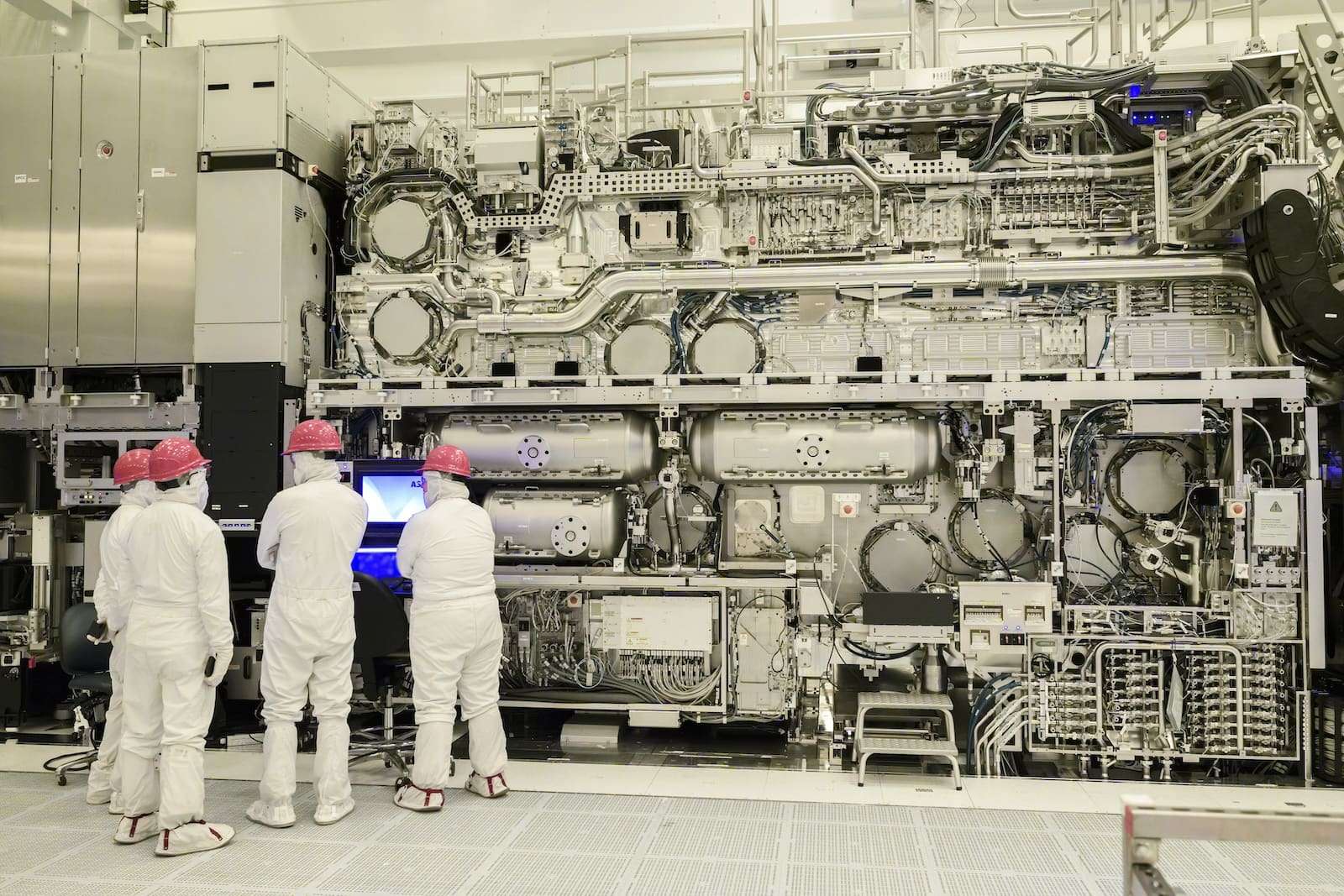
Chinese companies have reportedly built up a stockpile of hundreds of ASML deep ultraviolet (DUV) lithography machines, a fleet of equipment that could help sustain advanced chip production as Beijing accelerates the development of its own technology. According to data cited by Global Sources, China had around 343 immersion DUV systems at the start of 2026, roughly 270 of which are ASML Twinscan NXT:1980i units.
China’s ASML DUV stockpile in 30 seconds
- China had amassed around 343 immersion DUV systems by early 2026, including roughly 270 ASML NXT:1980i units.
- Purchases accelerated in 2024 and 2025, with about 90 and 89 systems acquired respectively.
- DUV lithography, combined with multi-patterning techniques, can be used to make certain 7nm chips and HBM2e memory.
- Dutch restrictions make new purchases harder, though some systems can still receive authorization in specific cases.
- The stockpile buys China time to develop domestic alternatives as international restrictions keep tightening.
The scale of the equipment fleet matters because manufacturing advanced semiconductors doesn’t depend on lithography technology alone. Fabs need to maintain an entire chain of processes, from etching and deposition to inspection, packaging, and design tools. Even so, having a large number of DUV machines can provide additional capacity for years.
Why DUV lithography still matters for 7nm
Extreme ultraviolet (EUV) lithography gets most of the attention when the conversation turns to the most advanced processes, but immersion DUV systems remain capable tools for certain chip generations.
The principle involves using more complex manufacturing techniques to achieve smaller patterns from equipment that, on its own, doesn’t reach the dimensions of the most advanced processes. Multi-patterning allows exposure steps to be repeated and combined to build structures that need greater precision.
According to the information gathered by Global Sources, systems such as the ASML NXT:1980i can take part in processes aimed at 7nm logic chips and HBM2e memory. That doesn’t mean one of these machines can produce a finished AI processor on its own. Manufacturing requires many other stages and pieces of equipment, along with an industrial process capable of maintaining good yields.
This distinction matters because the availability of a lithography machine doesn’t automatically translate into mass-production capacity. Wafer yields, memory availability, advanced packaging, and other stages can become bottlenecks even when there’s enough exposure capacity.
China sped up purchases before restrictions tightened further
The cited report points to a sharp acceleration in purchases before new international restrictions further limited access to this equipment. The pattern echoes what Chinese memory makers CXMT and YMTC have been doing in parallel, stockpiling ASML equipment to lock in years of expansion.
Chinese companies reportedly bought around 90 systems during 2024 and another 89 in 2025. Cumulative spending on those purchases is said to have topped $13 billion.
That figure helps put the scale of the strategy in perspective. This isn’t just about stockpiling machines for a single fab — it’s about having a reserve of equipment that can be distributed across different facilities and processes as production needs shift.
The Netherlands began requiring licenses for certain exports of immersion DUV equipment in 2023 and later expanded the restrictions to other models. However, the control regime hasn’t blocked every transaction. Some shipments of NXT:1970i and NXT:1980i systems can still receive authorization under certain circumstances.
That raises one of the issues that most concerns the authors of the cited analysis: equipment originally acquired for less advanced processes could end up being used on more sophisticated production lines. The ability to reassign machines within an industrial network means the number of units sold doesn’t necessarily reflect where they’ll end up running over their entire service life.
Domestic manufacturing could reduce reliance on ASML
Stockpiling foreign equipment isn’t the only path China is pursuing. The country is also trying to build a domestic industry capable of manufacturing lithography systems and other equipment that semiconductor fabs need, following on from an earlier push in which China began mass-producing its first domestically developed DUV lithography machines, with early units scheduled for SMIC, CXMT, and Hua Hong.
According to the information gathered in the original report, SMIC has reportedly been testing a Chinese-developed immersion DUV system, while other domestic manufacturers are moving toward producing their own equipment.
There’s still a technology gap with ASML on various performance parameters, but even a partially equivalent domestic alternative could have industrial value. A homegrown system could help replace certain imported equipment, keep part of the production lines running, or reduce dependence on suppliers subject to international restrictions.
The process, moreover, doesn’t just depend on building the machine. Manufacturing lithography equipment requires solving problems of mechanical and optical precision, software, specialized components, and process control. Those machines then need to be integrated into fabs that run hundreds of interdependent operations.
That’s why a domestic alternative can advance a great deal without yet offering a full substitute for ASML’s most advanced systems.
ASML’s sales figures show the effect of the restrictions
ASML’s own sales data reflect the shift in the Chinese market. China accounted for 41% of the company’s net system sales in 2024 and 33% in 2025. That share reportedly dropped to 19% in the first quarter of 2026 and to 14% in the second quarter, according to figures cited by Global Sources.
That trend fits a market where restrictions are starting to limit new transactions, while purchases made before the controls continue to affect industrial capacity.
The analysis by the Center for Technology and Statecraft cited in the report also lays out different future capacity scenarios. In one of them, the installed equipment base could represent a theoretical ceiling of up to 434 million H100-equivalent AI accelerators per year by 2035 if imports were to continue. If imports stopped starting in 2027, that theoretical ceiling would drop to 153 million.
These figures aren’t a forecast of actual production. The exercise itself assumes scenarios in which other bottlenecks stop limiting manufacturing. They’re meant instead to show how much access to manufacturing equipment can shape the potential capacity of a semiconductor industry.
The number of machines also doesn’t solve problems such as manufacturing yield, advanced packaging, memory supply, or access to chip design tools. All of these can limit how many processors ultimately reach the market.
The stockpile could buy years for China’s industry
The main strategic value of the DUV stockpile may lie precisely in the time it buys. If Chinese companies have hundreds of systems that can keep running for years, they can sustain production capacity while working on domestic technologies.
That also changes the effect of export restrictions. Blocking new purchases can hinder the growth of Chinese capacity, but it doesn’t immediately remove the machines already installed in its fabs.
At the same time, tighter controls can increase the incentive to develop domestic alternatives. The outcome will depend on how quickly China manages to improve its own equipment and on its manufacturers’ ability to integrate it into competitive production lines.
For the AI industry, the question goes beyond the 7nm label. Building an accelerator requires coordinating lithography, materials, manufacturing processes, memory, packaging, and design. A DUV stockpile doesn’t eliminate those constraints, but it can give Chinese manufacturers more room to work on them.
The battle over chip manufacturing capacity, then, doesn’t depend only on who has access to the most advanced technology. It also matters who has enough equipment, how long they can keep it running, and how far they can get while searching for alternatives.
FAQ
How many DUV systems does China reportedly have?
The cited analysis puts the number of immersion DUV systems in Chinese hands at around 343 as of early 2026. About 270 of those are said to be ASML Twinscan NXT:1980i units.
Can a DUV system make 7nm chips?
Immersion DUV systems can take part in certain 7nm manufacturing processes through techniques such as multi-patterning. However, the lithography machine is only one part of a much larger industrial chain.
Why is China stockpiling ASML equipment?
The stockpile can provide manufacturing capacity for years while Chinese companies develop domestic alternatives and deal with international restrictions on importing advanced equipment.
Have the restrictions stopped ASML’s sales to China?
Not entirely. Dutch controls have expanded the licensing requirements for certain equipment, but some systems can still receive authorization under specific circumstances. ASML’s sales of systems to China, according to the cited figures, have shrunk as a share of the total since 2024.
