
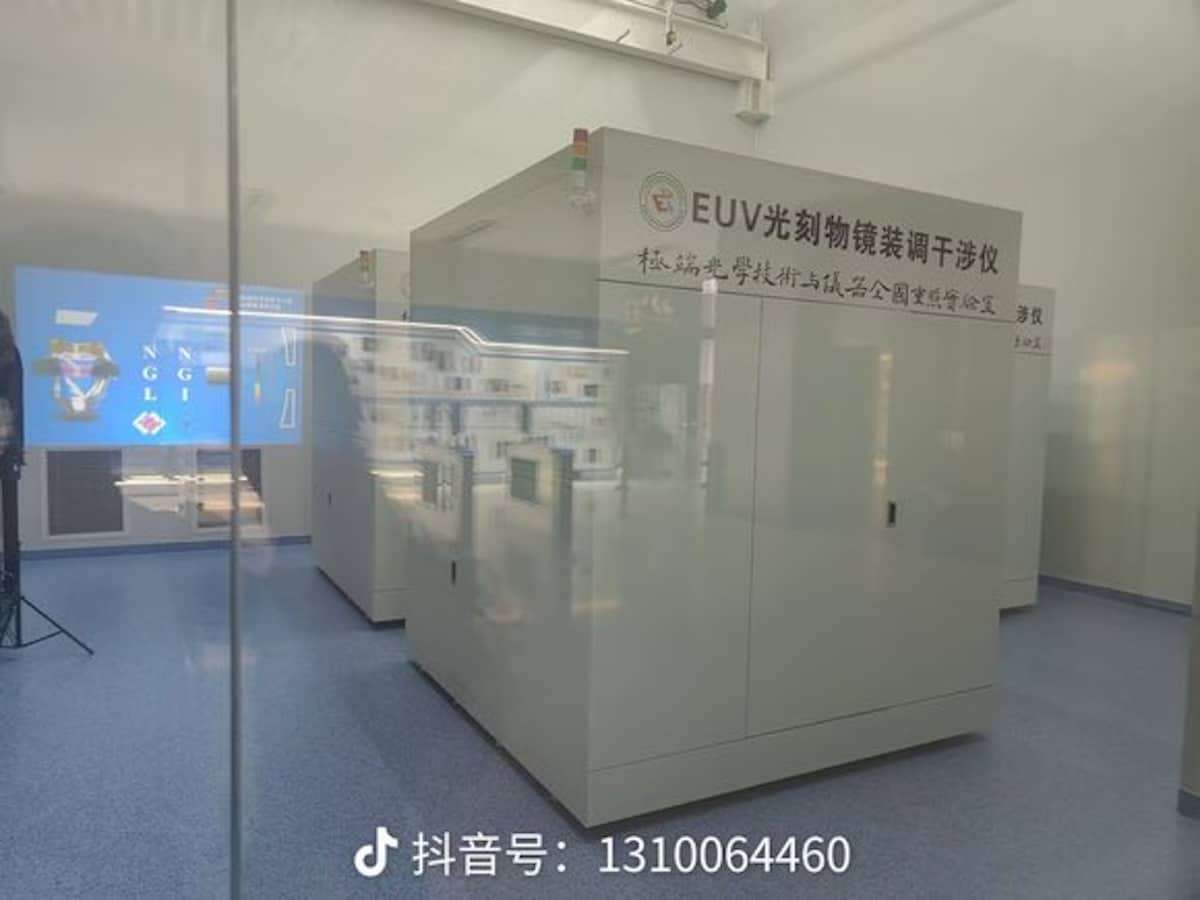
China has reportedly begun mass production of its first domestically developed deep immersion ultraviolet (DUV) lithography machines, known as DUV, aimed at delivering around five units in 2026 to SMIC, Hua Hong Semiconductor, and memory manufacturer CXMT. This information comes from sources familiar with the program cited by tech media but has not yet been publicly confirmed by the involved companies, nor is it officially known who is manufacturing the equipment.
The key points of China’s DUV lithography in 30 seconds
- An state-backed manufacturer has reportedly started producing immersion DUV scanners in Shanghai.
- The first five units are expected to be allocated to SMIC, Hua Hong, and CXMT during 2026, with an additional 20 units planned for 2027.
- The manufacturer’s identity has not been confirmed, although Shanghai Yuliangsheng Technology appears linked to the program.
- The equipment mainly incorporates Chinese components but still depends on some Japanese parts.
- The arrival of these machines does not mean they can immediately match the productivity, precision, and performance of ASML’s machines.
If confirmed and passing industrial qualification tests, this development would be a significant step in China’s strategy to reduce reliance on foreign suppliers. However, it does not mean the country has closed the gap with ASML or that it can quickly replace existing machines in its major fabs.
Manufacturing a functional lithography tool is only part of the process. To enable commercial production, the machine must demonstrate stability, inter-layer precision, availability, per-hour throughput, and the capacity to operate long-term without introducing defects that reduce the number of good chips per wafer.
Five machines in 2026 and still limited production
The program is reportedly being developed by a state-owned or backed company based in Shanghai. Known forecasts suggest an initial production of about five machines in 2026 and around 20 more in 2027.
This scale is small compared to ASML’s industrial capacity. The Dutch company expects to ship about 130 immersion systems in 2026 and aims to increase capacity by approximately 30% in 2027. China is expected to account for roughly 20% of ASML’s net sales this year, as stated by the company’s management during its Q2 earnings presentation.
While this comparison highlights the Chinese effort, it underscores its actual scale. The initial units are likely meant to validate technology, identify issues, refine processes, and explore integration into existing manufacturing lines.
The three potential first customers are significant players in China’s semiconductor industry: Semiconductor Manufacturing International Corporation (SMIC), the country’s leading chip foundry; Hua Hong, which specializes in mature and specialized processes; and CXMT, which competes in the DRAM memory market.
Their needs differ. A machine might deliver acceptable results for some mature processes but not meet the requirements for fabricating advanced nodes with multiple patterning steps.
What can China make with DUV lithography?
Deep immersion DUV lithography uses 193-nanometer wavelength light, with a liquid layer between the lens and the wafer to enhance resolution. It remains essential in semiconductor manufacturing even within fabs that also utilize extreme ultraviolet (EUV) lithography.
An advanced DUV scanner can pattern certain layers close to 28 nanometers with a single exposure. Achieving smaller geometries requires multiple patterning steps, dividing the pattern into several exposures and processing stages.
This approach, known as multipatterning, enabled the production of 7nm chips before EUV technology became widely available. It also explains how SMIC has managed to produce advanced processors without the most modern EUV equipment.
However, each additional exposure increases process complexity, fabrication time, and the risk of errors. Masks must be aligned with extreme precision, as even minimal deviations can impact circuit structure and reduce yield.
Therefore, DUV should not be viewed merely as a cheaper, simpler alternative to EUV. While potentially cost-effective for mature processes, intensive multiple patterning for advanced nodes raises costs, complicates manufacturing, and consumes more capacity.
ASML CEO Christophe Fouquet has noted that much of the increased lithography demand in DRAM production has been driven by replacing complex multi-pattern sequences with simpler EUV exposures. DUV and EUV are not mutually exclusive; advanced fabs use both depending on the layer being patterned.
Manufacturers remain unconfirmed
The company responsible for the new equipment has not been officially identified. Reports mention that the project involves technical teams from various Chinese firms, including the state-backed startup Shanghai Yuliangsheng Technology.
SMIC has reportedly been testing a Yuliangsheng-developed immersion DUV machine since September 2025. This relationship makes Yuliangsheng a plausible candidate, but it does not guarantee it is the sole manufacturer or that the final design is exclusive to them.
It is also suggested that most of the system’s components are of Chinese origin, though some critical parts still originate from Japan. This indicates that full autonomy has not yet been achieved.
A lithography machine comprises numerous technologies: light sources, high-precision optics, wafer and mask movement systems, sensors, thermal control, metrology, and software. Replacing the whole system requires developing a complete supply chain, not just assembling the main unit.
Furthermore, potential delays among domestic suppliers could limit expected production rates in 2026. This highlights the difference between building a few prototype units and maintaining steady industrial manufacturing.
Restrictions accelerate the search for alternatives
The push for domestic equipment has intensified due to export controls imposed by the US and allies. These restrictions affect not only EUV systems but also certain advanced DUV equipment, components, and technical services.
Companies like SMIC, Huawei, Hua Hong, CXMT, and YMTC are potentially impacted by new US legislative restrictions. The proposed MATCH Act, currently in legislative review, aims to broaden limits on sales, maintenance, and technical support related to semiconductor manufacturing equipment.
It is important to distinguish between legislative proposals and enacted regulations. The details may change, and final rules won’t be finalized until the legislative process concludes.
Maintaining equipment is particularly critical. Chinese fabs already operate extensive fleets of foreign systems, which require spare parts, upgrades, and technical assistance throughout their lifespan. Restricting service capabilities could impact operational capacity even if the physical equipment remains installed.
For Beijing, a domestically produced DUV machine offers value beyond its initial capabilities. It provides a platform to improve optical systems, movement control, and integration with production lines over the coming years.
Producing machines does not yet mean large-scale chip production
Deliveries of the first units will be just the beginning of a lengthy process. SMIC, CXMT, and Hua Hong will need to verify if the equipment meets their requirements and decide which layers or nodes they can process without excessively impacting output.
Testing may take months. Having a machine that can pattern a wafer in controlled settings does not guarantee it can operate continuously at production scale in a factory handling thousands of wafers.
ASML maintains a decades-long advantage supported by a broad network of specialized suppliers. Its Q2 2026 results show net sales of €9.3 billion, with the company raising its full-year forecast to between €43 billion and €45 billion.
China’s efforts shouldn’t be viewed as an immediate threat to ASML’s dominance. Instead, they signal that restrictions are accelerating investments in domestic alternatives and that technological dependence could gradually diminish.
The key question is not how many machines are delivered in 2026, but what performance they achieve within fabs. If the machines attain sufficient availability and can be used for critical layers, China will have established its own industrial base. If accuracy, productivity, or maintenance issues surface during testing, the program may take several generations before becoming a viable commercial alternative.
Frequently Asked Questions
Is China already mass-producing immersion DUV machines?
Multiple sources claim that series production has begun, but there is no public confirmation from the manufacturers or customers yet. The known forecast is about five units in 2026 and roughly 20 in 2027.
Which companies will receive the first machines?
Initial deliveries are expected to go to SMIC, Hua Hong Semiconductor, and CXMT.
Can DUV lithography produce 7nm or 5nm chips?
It can be used for advanced processes involving multiple exposures, but this increases complexity, cost, and error risk. The node’s commercial name doesn’t automatically specify the physical size of all its features.
Are these machines already competitive with ASML?
There isn’t enough public data to confirm that yet. They must first demonstrate accuracy, productivity, reliability, and manufacturability in commercial production lines.
via: tomshardware
