
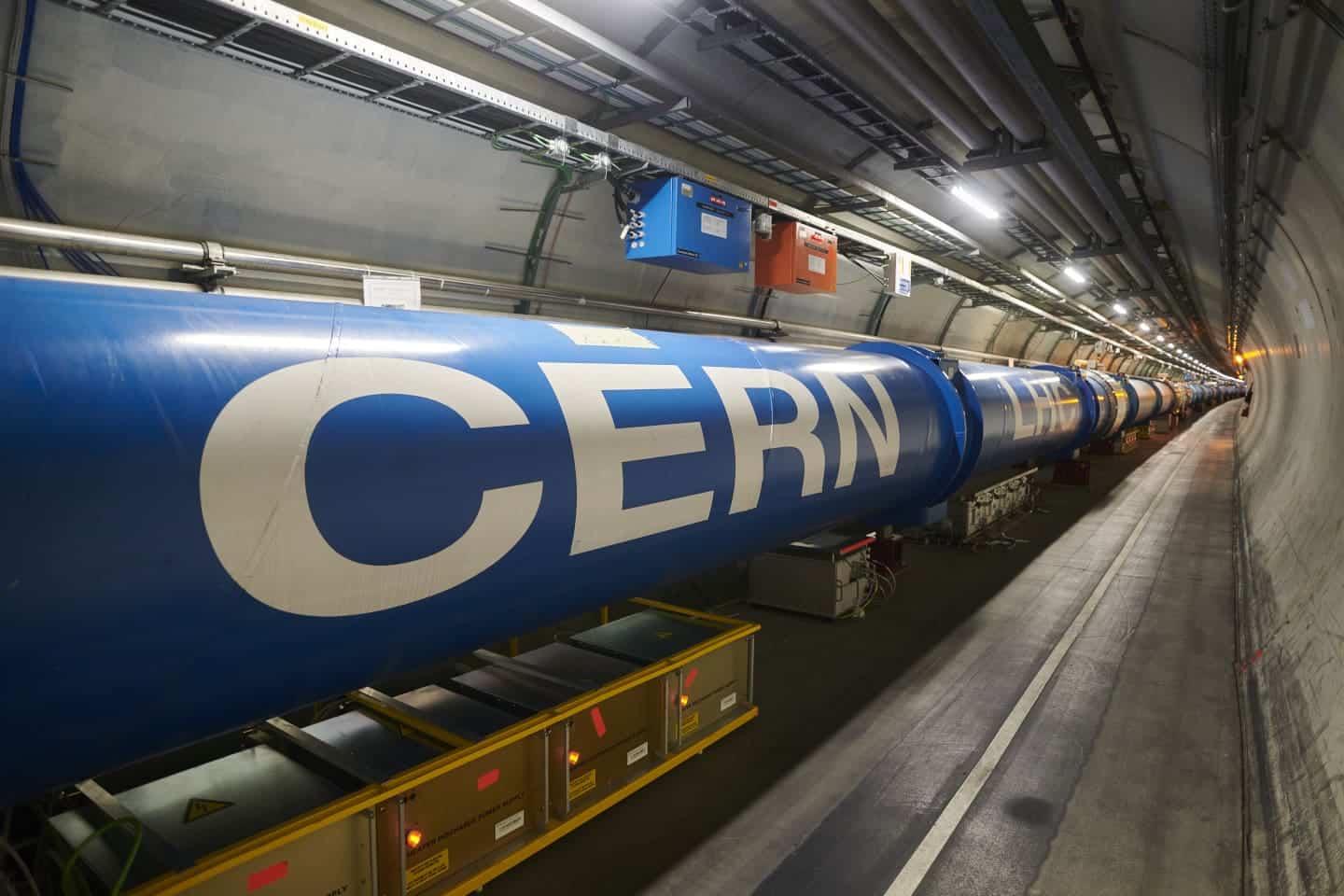
CERN and Mistral want to train a foundation model on one of the largest volumes of scientific data in the world: the data generated by collisions at the Large Hadron Collider (LHC). The European particle physics laboratory and the French artificial intelligence (AI) company signed a letter of intent on October 15, 2026, for a long-term strategic alliance, whose first project is a Large Physics Model trained on billions of simulated collisions.
The CERN-Mistral deal in 30 seconds
- It’s a letter of intent; no amounts, timelines, or specific compute resources have been published.
- The first project is a single model for collider physics, the Large Physics Model.
- CERN brings large-scale computing; Mistral brings its expertise in training large models.
- The lab stores roughly one exabyte of experimental data from the LHC.
- With the High-Luminosity LHC, expected around 2030, the number of collisions will multiply tenfold.
Behind the announcement lies, above all, an infrastructure problem. CERN already operates one of the largest scientific computing networks in the world, and the accelerator’s next phase is going to multiply the volume of data that needs processing. Betting on foundation models is, in large part, a way to get more out of those resources without the cost of analysis growing at the same rate.
A network of 170 centers that will have to grow
LHC data isn’t analyzed only in Geneva. It’s distributed across the Worldwide LHC Computing Grid (WLCG), a network that, according to CERN, brings together more than 170 centers in 42 countries, around 1.4 million computing cores, and roughly 1.5 exabytes of storage. More than two million tasks run through it every day, and more than 12,000 physicists use it. CERN itself contributes roughly 20% of those resources.
The challenge arrives with the High-Luminosity LHC (HL-LHC), the accelerator upgrade CERN expects to bring online around 2030, which will multiply the number of collisions tenfold. More collisions mean more data to reconstruct, filter, and simulate. Today that work is split across many machine-learning models, each trained for a single task. CERN and Mistral’s proposal is to concentrate it in a single pretrained model that can reconstruct collisions, identify particles, detect unexpected signals, and evaluate designs for future detectors.
The announcement doesn’t explain where the model will be trained, on what hardware, or how much capacity it will need. Nor does it say whether WLCG resources will be used, Mistral’s own infrastructure, or a combination of both. It only states that the two sides will combine capabilities and resources.
What Mistral gains
For Mistral, CERN is a showcase that’s hard to match. The French company has spent months expanding its catalog with larger models, such as Mistral Large 4, and sector-specific deals that bring its models into industrial settings, such as Samsung’s chip fabs or Cloudera’s data platform. A model for particle physics lets it show that its technology works for data that isn’t text, in a highly demanding research setting.
The deal also fits the broader debate over technological sovereignty in Europe: an intergovernmental European lab and a European AI company working on European scientific data. The announcement, though, doesn’t frame it in those terms.
Enrica Porcari, CERN’s chief information officer, says “high-energy physics offers a unique environment in which artificial intelligence can be developed and tested.” Johannes Brandstetter, Mistral’s vice president of AI for engineering, says the company is proud to explore with CERN what large-scale models can deliver. It remains to be seen whether the resulting model will be released with open weights: CERN talks about capabilities that could be “shared” with the physics community, but doesn’t specify a license or timeline.
Frequently asked questions
What have CERN and Mistral agreed to?
They’ve signed a letter of intent for a long-term strategic alliance in AI for science. Their first project is a foundation model for collider physics.
How much data does CERN handle?
CERN stores roughly one exabyte of experimental LHC data, and the WLCG network adds up to about 1.5 exabytes of storage across more than 170 centers in 42 countries.
Where will the Large Physics Model be trained?
That hasn’t been detailed. The announcement only says CERN will provide large-scale computing and Mistral its expertise in training large models.
When does the High-Luminosity LHC arrive?
CERN expects to bring it online around 2030, multiplying the accelerator’s number of collisions tenfold.
Sources:
