
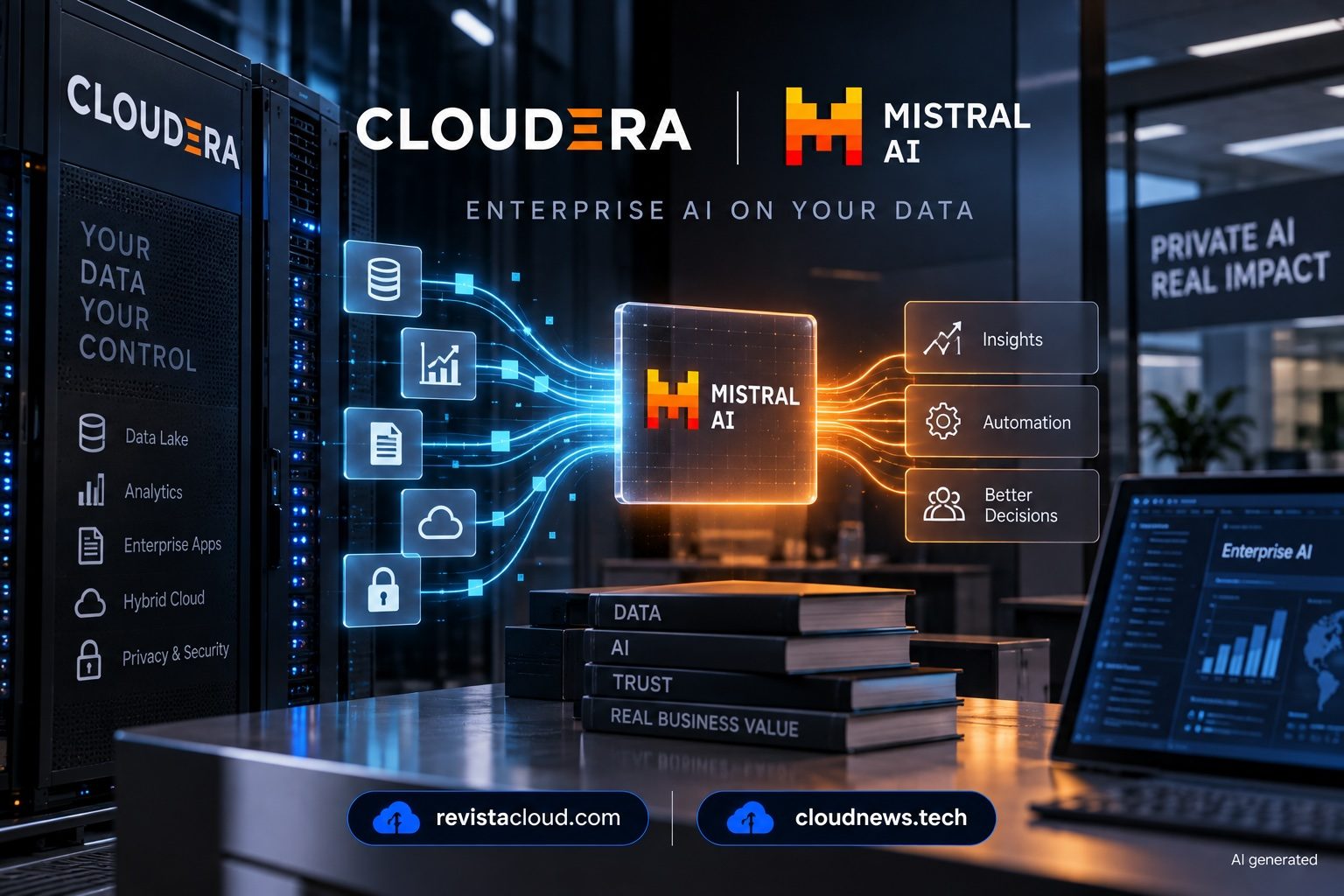
Cloudera and Mistral have signed a strategic alliance to integrate the French company’s models and tools into Cloudera’s hybrid data and artificial intelligence platform. The goal is for enterprises to be able to run, customize, and deploy AI on private data without necessarily moving it out of their own environments, including data centers, private clouds, edge locations, and facilities isolated from the Internet.
The Cloudera-Mistral alliance in 20 seconds
- Mistral will integrate reasoning, chat, code, document, and voice models into Cloudera’s platform.
- Workloads will be able to run in the cloud, on-premises, at the edge, and in air-gapped environments.
- The collaboration includes Mistral Forge for training and adapting models with private data.
- Cloudera says it manages more than 30 exabytes of customer data.
- The deal aims to reduce exclusive reliance on public AI APIs.
The proposal addresses one of the problems that is showing up more and more often in enterprise AI projects: the model can live in the cloud, but the data it needs cannot always leave the infrastructure where it resides.
That is especially true in banking, public administration, telecommunications, healthcare, defense, and industry, where information can be subject to residency, confidentiality, regulatory, or physical isolation requirements.
Cloudera and Mistral want to cover that scenario by bringing the model to the data instead of forcing the data to move to an external service.
Mistral will be able to run on data governed by Cloudera
The integration will cover various Mistral models and tools, with reasoning, conversation, coding, document intelligence, and voice capabilities.
Cloudera will provide the data, security, and governance layer it already uses in hybrid deployments.
The combination will allow inference to run across different types of infrastructure:
| Environment | Announced capability |
|---|---|
| Public cloud | Yes |
| Private cloud | Yes |
| On-premises data center | Yes |
| Edge | Yes |
| Sovereign cloud | Yes |
| Air-gapped environment | Yes |
The ability to work in air-gapped systems, completely disconnected from external networks, is especially relevant for public agencies, critical infrastructure, or certain industrial facilities.
In those cases, choosing a European region from a cloud provider isn’t enough. The requirement may be that neither the data nor the processing ever leaves infrastructure controlled by the organization itself.
Cloudera says its platform currently manages around 30 exabytes of data in production across its customers. That is a company figure, not the volume that will automatically start using Mistral models as a result of the deal.
The alliance also doesn’t mean those 30 exabytes will be used to train models.
Each customer will decide which data to use, with which model, and under what governance policy.
Mistral Forge will enable models tailored to internal knowledge
One of the more interesting pieces of the deal is Mistral Forge, unveiled by Mistral in March 2026.
Forge is designed for organizations that don’t want to limit themselves to using a general-purpose model through prompts or document retrieval, but need to adapt the model itself to their domain.
The platform supports several stages of the process:
- pretraining with specialized datasets;
- synthetic data generation;
- supervised fine-tuning;
- Low-Rank Adaptation (LoRA);
- Direct Preference Optimization (DPO);
- reinforcement learning;
- evaluation and version tracking.
That makes it possible to go well beyond a conventional RAG system.
In a Retrieval-Augmented Generation (RAG) system, enterprise knowledge is normally retrieved at runtime and fed in as context so the model can generate a response.
With Forge, part of that knowledge or behavior can instead be built into the model through training or post-training.
The two approaches aren’t mutually exclusive.
A company can use a model adapted to its own terminology and internal processes while also connecting it via RAG to up-to-date information that wouldn’t make sense to bake permanently into its weights.
Mistral says Forge supports both dense and Mixture of Experts (MoE) architectures, and that it can also work with multimodal information when needed.
Among the examples it gives are models trained on private code, technical documentation, internal procedures, regulations, or operational records.
The appeal also lies in controlling where you pay for inference
The deal has a second, less visible dimension: cost.
Many companies started their AI projects by consuming public APIs, since that lets them experiment quickly without deploying their own infrastructure.
The problem shows up once pilots move into production and the number of users, agents, or queries grows.
At that point, it can become worthwhile to compare the per-token cost of an API against running the model on your own GPUs, private infrastructure, or already-contracted cloud capacity.
Cloudera and Mistral don’t claim that running models locally is always cheaper. Owning your own infrastructure comes with hardware, electricity, operations, upgrade, and staffing costs.
What they offer is the ability to choose.
The same organization could keep certain workloads in a public cloud, run others in its own data center, and reserve isolated infrastructure for especially sensitive information.
That approach also avoids tying an entire AI strategy to a single external API.
For organizations with technological sovereignty needs, that factor can matter as much as privacy.
AI sovereignty doesn’t depend solely on where the model is installed
Cloudera and Mistral make prominent use of the concept of sovereign AI, but it’s worth separating the marketing pitch from the actual technical requirements.
Running a model inside your own data center can give you much more control over the information, but it doesn’t automatically make a system sovereign.
Other things matter too, such as:
- who controls the hardware;
- where logs are stored;
- how updates are distributed;
- who manages the keys;
- what external dependencies the software has;
- where the observability systems are located;
- what licenses govern the models;
- which staff can access the infrastructure.
A fully isolated deployment makes some of those points easier to address, though it also increases operational complexity.
The advantage of the announced architecture is that it doesn’t force every customer into a single deployment model.
Cloudera expands its hybrid AI strategy
The alliance with Mistral fits with Cloudera’s recent moves to extend its platform beyond traditional data processing and governance — moves that already include Cloudera Anywhere Cloud, a platform built to run AI and data applications on hybrid infrastructure without moving the data.
Throughout 2026, the company has strengthened its tools for agents, AI execution, and operations across different pieces of infrastructure.
Its pitch is to maintain a common management and governance layer even when data is spread across public cloud, on-premises facilities, and the edge.
The integration with Mistral adds to that layer a European model provider that is itself reinforcing its strategy around private deployments.
Mistral currently offers several consumption modes: from its own infrastructure, through cloud providers, and as models deployed in environments controlled by the customer. It’s a strategy Mistral has been pursuing elsewhere too — Samsung recently agreed to run Mistral’s models inside its own chip fabs using a similar on-premises approach.
Forge reinforces that last option by adding tools to build specialized models on top of corporate knowledge.
The French company cites applications in software development, cybersecurity, industry, public administration, and financial services.
Not all of those uses require training a model from scratch.
In many cases, adaptation, post-training, or integration with internal systems will be enough.
The deal announces capabilities, but no customers or specific dates yet
Cloudera says the joint solutions will be made available through its sales team and partner network, with new integrations rolling out progressively.
The announcement doesn’t name any customers already running this specific integration in production.
Nor does it specify which Mistral models will be available first, which GPU configurations will be certified, what the minimum requirements for an air-gapped deployment will be, or how pricing will be structured.
Those details will matter for judging the real scope of the alliance.
Running models close to the data is technically appealing, but taking a private AI system into production requires solving a lot more than where the model sits: compute capacity, storage, inference, observability, updates, security, and governance.
The Cloudera-Mistral collaboration is precisely an attempt to bring together two pieces that have largely evolved independently during the early years of generative AI: the models and the infrastructure where enterprise data actually lives.
If the integration delivers on what’s been announced, organizations will be able to choose between consuming AI as a service or keeping models, data, and processing within their own technical boundaries. For regulated industries and large hybrid environments, that flexibility may matter more than simply having another API-connected model.
