
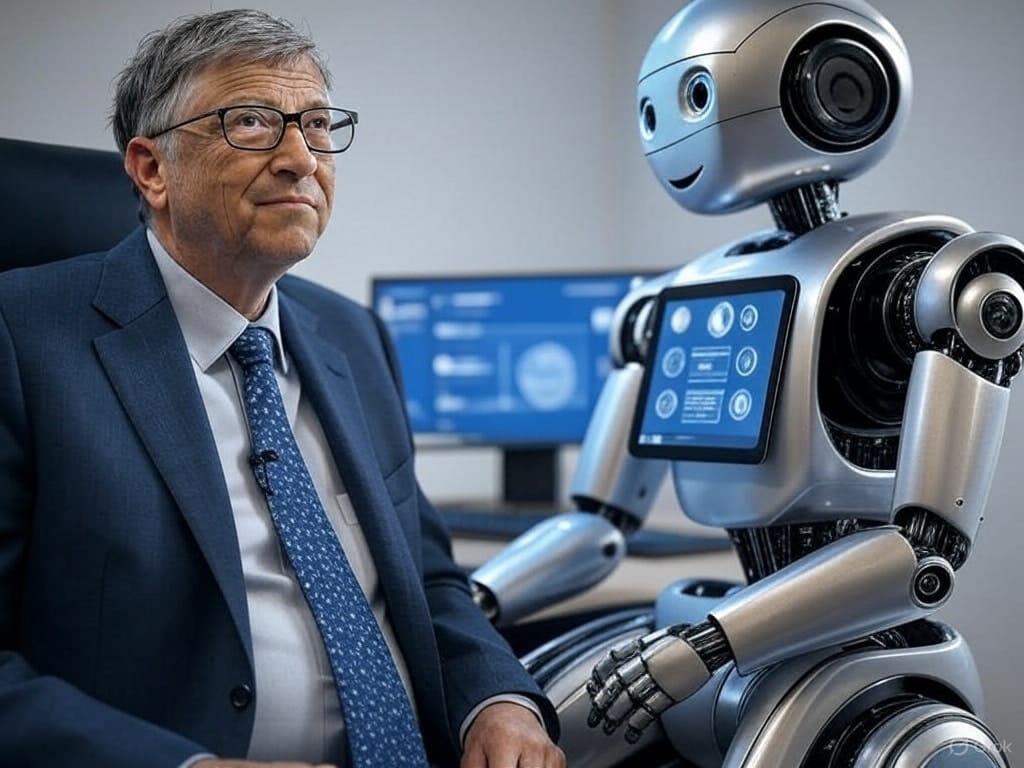
Bill Gates believes artificial intelligence could push the world toward an era of abundance, but he doesn’t trust the labor market to adapt without major intervention. His proposal includes reserving certain activities exclusively for humans and taxing AI tokens and robots. Elon Musk shares part of that diagnosis — that machines could end up doing practically all the work — but reaches a radically different conclusion: he expects automation to generate so much abundance that working eventually becomes optional, requiring some form of high universal income.
The AI-and-jobs debate in 30 seconds
- Bill Gates believes AI can replace cognitive work, and later physical work, at a pace that’s hard to absorb.
- He proposes “Human Reserved” jobs and studying taxes on tokens and robots.
- Elon Musk envisions an even more extreme scenario: practically no jobs would be necessary, and a “universal high income” would exist.
- Jensen Huang expects AI to create enough economic activity to offset the jobs it eliminates.
- Zuckerberg is betting on smaller companies, with people multiplied by AI agents.
The differences among the leading tech executives are especially interesting because they’re no longer debating whether AI will be able to handle a substantial share of human work. The debate is shifting toward what will happen economically once that capability becomes cheap and reliable enough.
Gates wants to intervene before reaching that point. Musk imagines a post-employment economy. Jensen Huang is counting on the growth generated by productivity. Mark Zuckerberg expects agents to let small teams build companies that today would need hundreds of workers.
Four different answers to the same technological problem.
Gates: AI could break the mechanism that created new jobs in the past
The central thesis of Gates’s new essay is that comparing artificial intelligence to previous industrial revolutions can lead to the wrong conclusions.
Agricultural mechanization displaced workers, but the transition took generations. The economy created factories and later millions of administrative and service jobs that still required human intellectual capacity.
AI is moving into precisely that territory.
Gates points to sales, customer service, programming, and legal work as some of the activities initially exposed. Later, tasks such as analyzing loans, studying data, or performing certain healthcare assessments could be affected.
Robotics would later extend the transformation to physical labor. Gates expects sufficiently capable robots to start competing with people in certain construction and hospitality tasks before the end of this decade.
The problem would also be cumulative.
A company that cuts costs through AI can lower prices. Its competitors will then have incentives to automate too, while new companies built directly around agents will have different labor structures from the start.
For Gates, expecting every displaced worker to quickly find another job isn’t realistic.
And he pays particular attention to young people.
If agents start out handling the simple tasks that traditionally fall to junior workers, AI could affect not just the number of available jobs, but also the very mechanism through which someone learns a profession.
Gates proposes a labor reserve for human beings
His first response has a deliberately simple name: Human Reserved.
Society could decide that certain tasks continue to be performed by people even when a machine is technically capable of doing them.
Gates uses elder care as an example and recalls the care his father received during his battle with Alzheimer’s. He also raises medical situations where a robot could perfectly well deliver a terminal diagnosis, but argues it shouldn’t be the one to do it.
Education and mental health could adopt hybrid models where AI expands what a professional can do, but responsibility stays with a person.
The approach is technologically interesting because it breaks with a common Silicon Valley premise: the fact that a task can be automated doesn’t necessarily mean it should be.
Gates even accepts that keeping certain jobs in human hands can introduce economic inefficiencies.
The problem shows up when deciding which ones.
Reserving jobs for people would require determining who sets those categories, for how long, and how a company in a country with those restrictions would compete against one operating where automation is unrestricted.
Gates himself admits he still doesn’t have answers to many of these questions.
The strangest tax of the AI era: paying by the token
His second proposal goes straight into the economics of compute.
Gates proposes taxing the tokens processed by artificial intelligence systems and the robots that replace workers.
His reasoning starts from the different tax treatment of capital and labor.
Hiring a person generates taxes and payroll contributions tied to employment. Buying technology that replaces that person can be booked as a business investment and receive different tax treatment.
Automation can therefore end up partially favored by the tax system itself.
The new taxes would have two goals: slow down labor substitution and fund retraining and social protection.
But applying a tax on tokens would be technically complicated.
A token doesn’t represent a constant amount of work. Different models use different architectures, tokenizers, and inference processes. Nor would it necessarily make sense to tax a million tokens used to generate ad copy the same as a million used to research a protein.
On top of that, a company could run an open model on its own servers.
That would force regulators to decide whether the tax falls on API providers, infrastructure owners, model developers, or end users.
Gates’s proposal opens up an important discussion, even though the token can hardly be considered a tax unit ready to be used directly just yet.
Elon Musk goes much further: maybe no job will be necessary
Elon Musk shares Gates’s view that labor substitution could run extraordinarily deep. What changes is the solution.
During VivaTech in 2024, he already described his favorable scenario with a line that’s hard to interpret any other way: probably none of us would have a job.
Musk argued there would be a “universal high income,” which he explicitly distinguishes from a universal basic income, and that there would be no shortage of goods and services.
He has kept defending the idea since.
In 2026 he again suggested that AI and robotics could lead toward an economy where work is optional and, in the long run, even money loses much of its importance.
The difference with Gates is considerable.
Gates tries to preserve human employment because he attributes economic and social value to work.
Musk asks what happens once preserving it stops being economically necessary.
His vision depends on one enormous condition: that AI and robots manage to produce enough wealth for that abundance to be distributed widely. Musk has argued that a government-funded universal high income could respond to the unemployment caused by AI.
The open question is how it would be funded and distributed.
If a handful of companies own the models, robots, data centers, and energy systems capable of generating that output, technological abundance doesn’t automatically translate into economic abundance for the whole population.
That’s precisely where Musk’s and Gates’s proposals end up converging again: both scenarios require political mechanisms to redistribute part of the wealth generated by the machines.
Jensen Huang doesn’t buy the mass tech unemployment thesis
Jensen Huang holds a different view.
NVIDIA’s CEO has dismissed the most extreme forecasts of massive job destruction and argues that boosting productivity can create new demand.
The logic is well known in tech economics.
If AI drastically cuts the cost of building software, for example, that doesn’t have to translate only into fewer programmers. It can also mean much more software gets built, because projects that used to be too expensive become viable.
The question is which effect ends up dominating.
Huang’s argument is especially relevant because NVIDIA sells precisely the infrastructure that runs much of this automation. The more agents, models, and robots there are, the greater the potential demand for compute.
But that doesn’t automatically invalidate his economic thesis, either.
The internet, personal computers, and smartphones eliminated certain roles while creating entire industries that didn’t exist before.
Gates introduces one difference: AI doesn’t just automate a tool — it automates the very cognitive capacity needed to use many tools.
Zuckerberg imagines small companies with enormous capabilities
Mark Zuckerberg places the debate somewhere else entirely.
His vision of personal superintelligence is about giving every individual agents capable of massively expanding what they can do.
That could produce companies with very different structures.
A startup that today needs designers, engineers, marketing specialists, support staff, and administrators could operate with a much smaller team if every worker has several specialized agents at their disposal.
The immediate consequence might look bad for employment: fewer people per company.
The optimistic bet is that lower costs will let so many new companies get created that the total number of opportunities actually grows.
This point is especially relevant for the tech sector.
For years, getting a startup to reach millions of users required raising capital and hiring dozens or hundreds of professionals. Agents could considerably lower that bar.
The economy could end up made up of far more organizations, but much smaller ones.
That wouldn’t prove Zuckerberg right over Gates. It would simply shift the question from “how many workers does a company need?” to “how many new companies can an economy create when building them costs so much less?”
Oracle shows what real enterprise automation looks like
While Gates, Musk, and Zuckerberg describe possible futures, companies like Oracle are turning part of the debate into product.
Oracle is adding agents to its enterprise applications for HR, finance, sales, marketing, and customer service.
The difference compared with early copilots matters.
A traditional chatbot answers a question. An agent can query enterprise systems, reason over information, use tools, and execute actions within established permissions.
That brings the technology closer to the concept of a digital worker.
A company can use an agent to prepare briefing material before a meeting, screen candidates, process documents, research business opportunities, or run parts of an administrative process.
There are still limitations, errors, and a need for oversight. But the technological direction matches precisely the scenario that worries Gates: each new generation needs less human intervention to complete a full workflow.
Apple represents a less aggressive approach
So far, Apple has built much of its AI strategy around personal intelligence and processing built directly into its devices.
Its public approach is less focused on replacing workers than that of companies selling enterprise agents directly.
But the same underlying components can still end up affecting employment.
A model that summarizes emails, analyzes documents, writes code, or executes actions cuts working time regardless of whether the maker calls it a “copilot,” an “agent,” or personal intelligence.
The line between helping a worker and eliminating part of their job is far less clear than tech marketing suggests.
The real indicator will be how much work AI can complete without supervision
There’s one variable that will likely determine which of these visions ends up closest to reality: autonomy.
As long as a person has to constantly review what a model produces, AI mainly works as a productivity multiplier.
When an agent can take a goal and work for hours or days producing reliable results without supervision, the economic calculation changes.
Gates identifies exactly that moment as one of the decisive points of the transition: once AI produces work that’s practically error-free, companies will have much stronger incentives to let it run autonomously.
The tech industry is already working in that direction. AI is already reshaping the job market in visible ways — nearly 143,000 tech workers have already been affected by layoffs tied to AI-driven restructuring in 2026 alone, even before agents reach that level of unsupervised reliability.
Models now have web browsing, terminals, code execution, memory, access to enterprise applications, and the ability to coordinate multiple agents. Robotics is trying to bring a similar architecture into the physical world.
That’s why the discussion between Gates, Musk, Huang, and Zuckerberg can sound philosophical, but it’s closely tied to how agents evolve technically over the next few years.
If models keep needing constant supervision, Huang’s productivity-growth thesis gains strength.
If they let one person manage the work that used to take ten, Zuckerberg’s small-company model looks more plausible.
If they end up replacing practically the entire intellectual-work chain and, later, a growing share of physical work, the debate moves much closer to Gates and, eventually, to Musk’s scenario.
From taxing tokens to sharing what the machines produce
The differences among the big tech names can be summed up in four answers.
Gates wants to manage the transition. He accepts that AI will replace work and proposes intervening to preserve certain human activities and redistribute part of the value through taxes.
Huang is counting on productivity. He expects cheaper production to generate enough new demand to sustain a job-intensive economy.
Zuckerberg is betting on multiplying the individual. Fewer workers could build much bigger companies, and new activities would emerge thanks to agents.
Musk is picturing a post-work economy outright. If machines and software can produce practically every good and service, working would stop being a necessity, and the problem would shift to how to distribute that output and find personal meaning.
What’s interesting is that none of these hypotheses require science fiction in their first stage anymore.
Real companies are already using agents to write code, handle customer service, analyze documents, design products, and automate operations. At the same time, NVIDIA, AMD, Google, Amazon, Microsoft, Meta, and other groups are pouring enormous amounts of capital into building the infrastructure needed to run many more models — and the strain that’s putting on engineers and workers is already visible, as burnout among tech workers keeps climbing in the AI era.
The technological question is gradually shifting from what AI can do to how long it can do it alone.
The economic question will be even harder.
If a company can produce ten times more with half the workers, it will have created an enormous productivity gain. What’s still unwritten is who ends up capturing it: the owners of the technology, consumers through lower prices, workers through better wages and shorter hours, the state through taxes, or some combination of all of them.
That’s why Gates’s token tax may end up mattering less than the discussion it just opened up. AI is forcing a rethink of a tax system designed for an era when creating wealth and hiring workers were much more tightly linked.
Elon Musk takes the hypothesis to its most extreme conclusion: if that link nearly disappears, maybe the idea that income necessarily depends on having a job will have to change too.
Frequently Asked Questions
What does Bill Gates propose for jobs threatened by AI?
Gates proposes studying a “Human Reserved” category to keep certain activities exclusively in human hands, along with taxing AI tokens and robots to help fund training and social protection.
Does Elon Musk believe AI will eliminate all jobs?
Musk has suggested that, in a favorable scenario, work could become optional because AI and robotics would produce enough goods and services. He has also argued for a “universal high income” for that scenario.
Why is Jensen Huang more optimistic?
His argument rests on the idea that higher productivity lowers costs and creates new demand. From that perspective, some jobs would disappear or change, but enough new activities would emerge to offset them.
What will be the decisive factor in figuring out who’s right?
The autonomy of AI systems will be one of them. There’s a huge economic difference between an AI that helps a person and one able to run complete processes reliably for hours without supervision.
Source: Noticias Inteligencia Artificial
