
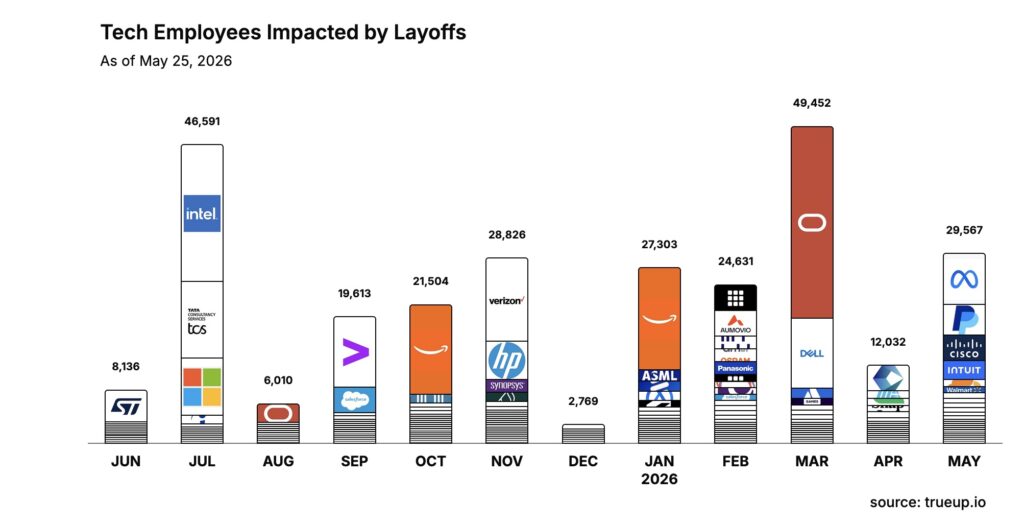
Technology employment is once again entering an uncomfortable zone. In just the first five months of 2026, the TrueUp tracker reports 340 rounds of layoffs in tech companies and 142,985 workers affected, averaging 986 people per day. While still below the total for 2025, which saw 245,953 layoffs across 783 rounds, the daily pace is much higher: 674 people per day last year versus nearly 1,000 so far in 2026.
A quick interpretation would be to attribute this entirely to artificial intelligence. That would be convenient but incomplete. Not all layoffs tracked by TrueUp have a single verifiable cause linked to AI. Some companies cut jobs due to declining revenue, margin pressures, redundancies after years of accelerated hiring, internal reorganizations, or strategic shifts. However, it’s also clear that AI has become a central argument for many restructuring efforts: some firms cut jobs to fund investments in models, infrastructure, and automation; others reduce areas deemed less necessary after implementing AI tools.
2026 surpasses the daily rate of 2025
The comparison with 2025 explains why this data is concerning. Last year was very tough for the sector, but 2026 is advancing at a faster pace. If current TrueUp averages continue, the year could close with an extremely high volume of layoffs. However, linear projections are risky because layoffs tend to concentrate by quarter, financial results, and restructuring plans.
| Year | Layoff Rounds | Affected Workers | Daily Average |
|---|---|---|---|
| 2025 | 783 | 245,953 | 674 |
| 2026, until May 25 | 340 | 142,985 | 986 |
This jump cannot be understood without considering the shift in priorities among large tech companies. Meta has carried out a round of about 8,000 layoffs—roughly 10% of its workforce—in a reorganization linked to the need to finance AI investments. According to published reports, the company is also reassigning thousands of employees to AI initiatives and reducing open positions.
Another notable case is Intuit. The company announced cuts of about 3,000 jobs, 17% of its global workforce, as part of a restructuring to simplify operations and focus on its core bets, including AI. Reuters also notes that the company maintains multi-year agreements with Anthropic and OpenAI to integrate AI into its financial and tax services.
Cisco announced nearly 4,000 layoffs in a restructuring aimed at redirecting investments toward AI and growth areas, while also raising annual forecasts following a substantial increase in AI infrastructure orders. Walmart has also cut or relocated around 1,000 positions to reorganize its global technology and product teams.
The productivity paradox
The common corporate narrative is that AI will enable doing more with less, streamline management layers, automate repetitive tasks, and shift capital toward higher-growth products. The human translation of this story is immediate: thousands of technical, product, support, operations, marketing, data, management, or administrative profiles are leaving companies that, in many cases, still generate high revenues.
This paradox is especially visible in companies announcing layoffs while simultaneously celebrating AI-related orders, alliances with major labs, or investments in infrastructure. To the financial market, it may seem like operational discipline. To affected workers, it sounds like substitution, pressure, and loss of job security.
A new type of reduction is also emerging: employment isn’t always cut because an AI tool performs exactly the same task as a person. Sometimes jobs are cut because management expects each team to be more productive with AI, because they want to free budget for data center CAPEX, because they seek to reduce middle management, or because they need to show investors participation in the new tech wave.
| Company | Reported or Announced cuts | Main interpretation |
|---|---|---|
| Meta | Approximately 8,000 positions | Reorganization to fund and accelerate AI focus |
| Intuit | Approximately 3,000 positions | Operational simplification and focus on AI-native platform |
| Cisco | About 4,000 positions | Shift of investment toward AI and growth areas |
| Around 5% of workforce, according to Reuters | Restructuring amid sector adjustment | |
| Walmart | About 1,000 jobs cut or relocated | Integration of global tech and product teams |
Moreover, the debate is beginning to divide the sector itself. Jensen Huang, CEO of NVIDIA, has criticized executives who automatically blame AI for layoffs and called this explanation a “vague excuse.” His argument is that many companies were adjusting their staffs before generative AI reached its current utility, and blaming technology for everything fuels inaccurate fears.
He has a point. AI alone does not explain all technological layoffs of 2026. But it can’t be entirely separated from the current restructuring. Companies are using AI to justify smaller structures, more aggressive investments, and shifts in priority profiles.
Which jobs are most exposed
Not all tech profiles face the same risk. The pressure is strongest on roles where automation can handle repetitive tasks—or where companies believe a smaller team can keep pace with AI assistants. Support, manual QA, documentation, internal operations, basic analysis, middle management layers, low-value marketing, or highly routine development profiles are more vulnerable.
At the same time, new roles are emerging: AI platform engineering, security, cloud infrastructure, MLOps, data science, AI governance, model evaluation, agent integration, inference cost optimization, and system architecture. The challenge is that this transition isn’t automatic. A worker laid off from a role affected by automation doesn’t instantly become an AI infrastructure engineer.
This is one of the key tensions for 2026. Companies talk about reskilling, but many restructurings move faster than training programs. The productivity gains promised by AI arrive before a more orderly employment redistribution. This could increase inequality within the tech sector itself: profiles capable of working with AI gain value, while others become trapped in tasks companies want to reduce.
A warning for businesses, workers, and governments
The wave of layoffs doesn’t mean that technology will destroy all qualified jobs. It signals that the implicit employment contract in the sector has changed. For years, working at a large tech firm felt like a relatively safe bet. Now, even profitable companies cut thousands of jobs to fund AI, improve margins, or reorganize in this new phase.
For companies, the challenge is to avoid turning efficiency into loss of internal knowledge. Cutting too quickly can leave operational memory gaps that later make managing complex products difficult. For workers, the message is clear: learning to use AI within workflows is no longer optional, but knowing how to craft prompts isn’t enough. Product judgment, technical expertise, integration skills, and business understanding will be necessary.
For governments, the debate is expanding. If AI concentrates benefits in firms that reduce qualified employment, there will be pressure to review training, social protection, taxation, collective bargaining, and active employment policies. The AI industrial revolution will be measured not only by productivity growth but also by how its benefits are distributed.
The data from TrueUp aren’t a definitive verdict on the future of work. They serve as an alarm signal about the speed of adjustment. The tech sector is promising a new era of productivity, but the human cost of this transition is already visible. The question remains: will companies use AI to build more capable organizations or simply smaller ones?
Frequently Asked Questions
How many tech layoffs have been recorded in 2026?
According to TrueUp, up to May 25, 2026, there have been 340 layoffs in tech firms affecting 142,985 workers.
Are all these layoffs due to artificial intelligence?
No. While AI is a significant factor in many restructurings, other factors like costs, reorganizations, margin pressures, redundancies, and strategic shifts also play a role.
Which companies have announced recent cuts?
Notable examples include Meta, Intuit, Cisco, LinkedIn, and Walmart Tech, with significant layoffs or reassignments in May 2026.
Which tech roles are most at risk?
Roles most exposed are those related to repetitive tasks, support, internal operations, manual QA, basic documentation, or middle management layers that companies believe can be automated or reduced with AI.
