
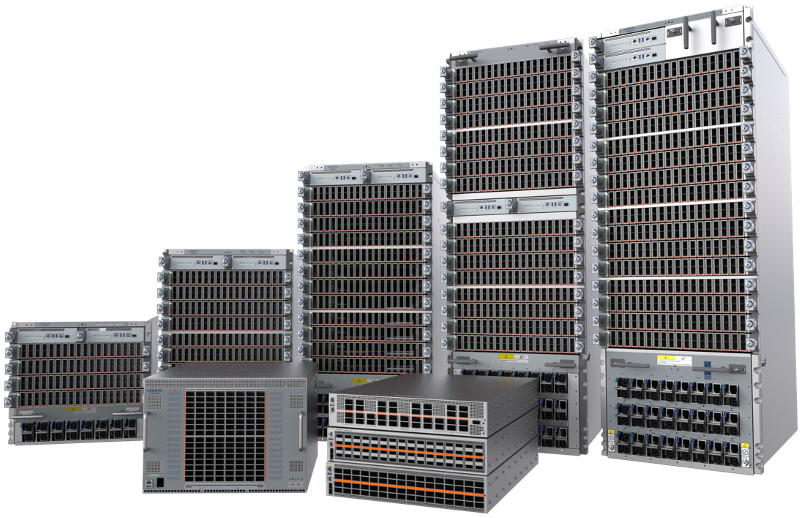
Arista Networks has unveiled a range of rack-scale network architectures for AI data centers, built on open Ethernet, that connect up to 144 accelerators in a single rack and up to 1,024 across multiple racks. The company announced the news on October 7, 2026 and says it designed the architectures with AMD, Arm, Broadcom, d-Matrix, Meta, Microsoft, and Qualcomm. The proposal is pitched as an open alternative to the proprietary interconnects that currently dominate inside the rack, with NVIDIA’s NVLink as the main benchmark.
Key facts about Arista’s AI racks in 20 seconds
- Etherlink SU-144 links up to 144 accelerators per rack over Ethernet in a single hop.
- Across racks, it scales up to 1,024 accelerators.
- It’s built on ESUN, the Open Compute Project’s open standard for scaling accelerators over Ethernet.
- Arista has not given pricing or an availability date.
The announcement comes days ahead of the OCP Global Summit, running October 12-15, where Arista will showcase the systems. Tyson Lamoreaux, Arista’s Senior Vice President of Cloud and AI Networking, argues that in the AI era the network is no longer a simple pipe between servers but a rack-scale motherboard that’s essential to getting the most out of compute, and that the idea is for large operators to scale with different accelerators without depending on proprietary technologies.
Ethernet moves inside the rack
To understand the announcement, it helps to distinguish two types of network in an AI cluster. The scale-out network connects servers and racks to each other, and Ethernet is already standard there. The scale-up network links accelerators within the same compute domain so they work almost like a single giant chip, with very low latency. That space is dominated by proprietary interconnects such as NVLink, which NVIDIA uses in its 72-GPU racks and which it also wants to open to third-party chips through NVLink Fusion.
Arista’s approach is built on ESUN (Ethernet for Scale-Up Networking), an Open Compute Project initiative launched in October 2025 by twelve companies, including AMD, Arista, Broadcom, Cisco, Meta, Microsoft, NVIDIA, and OpenAI, which published its 1.0 specification in March 2026. Its goal is to adapt Ethernet to the low latency and lossless behavior that communication between accelerators requires.
Arista’s new architecture, Etherlink SU-144, connects up to 144 accelerators (XPUs) with a single network hop and scales up to 1,024 through cross-rack topologies. It comes in three physical formats:
- Orthogonal chassis: a single rack and a single hop, for maximum density in training and inference, with liquid cooling rated from 100 to 400 kW.
- Cabled backplane: a high-density cable backplane in a modular rack, designed for signal integrity and simpler maintenance.
- Cross-rack system: an independent modular network that interconnects several racks and can adapt to future generations of accelerators.
Full racks for the scale-out network
On the scale-out side, Arista offers complete racks with several liquid-cooled 7060EX7 switches running at 102.4 Tbps each, fiber patch panels, integrated cooling manifolds, drip trays with active leak detection, rack management controllers, and power shelves with battery backup. The systems can run Arista’s EOS operating system or an open network operating system, on top of a common base called NetDL.
This network incorporates Ultra Ethernet Consortium standards, multi-path reliable connections (MRC), multi-plane routing, and dynamic load balancing to cut job completion time and improve efficiency in token generation. It’s a continuation of the line Arista already showed in June when it brought Ethernet to 1.6 Tbps for rack-scale AI networks.
More density with next-generation optics
The most striking figure in the announcement is density. According to Arista, today’s switches with OSFP optics reach 1.6 Pb/s per rack, and with next-generation optics such as XPO and co-packaged optics (CPO) or near-package optics (NPO), that could reach 6.5 Pb/s, four times more. The company estimates that could cut total data center floor space nearly in half, with corresponding savings.
Those figures are worth reading with some caution. The announcement doesn’t clarify when the systems will be available, what they will cost, or whether the next-generation optics are already production-ready, and it carries the usual caveat that the stated performance figures are projections. It also doesn’t detail the specific role of each partner named, since Arista points to their statements on a separate page. The battle over in-rack networking remains wide open: NVIDIA dominates with NVLink, AMD is backing open racks such as Helios, and some chipmakers, such as d-Matrix, are working with both camps at once.
Frequently asked questions
What is Arista Etherlink SU-144?
It’s Arista’s Ethernet-based scale-up architecture, which connects up to 144 accelerators in a rack with a single network hop and up to 1,024 across multiple racks.
What is ESUN?
Ethernet for Scale-Up Networking is an Open Compute Project initiative, launched in 2025, to adapt Ethernet for connecting AI accelerators within a single compute domain. Its 1.0 specification was published in March 2026.
What’s the difference between scale-up and scale-out?
Scale-up links accelerators within the same domain so they work almost as one, with very low latency. Scale-out connects servers and racks to each other to form larger clusters.
When will Arista’s racks be available?
Arista hasn’t given a date or pricing. It will show the systems at the OCP Global Summit, running October 12-15, 2026.
