
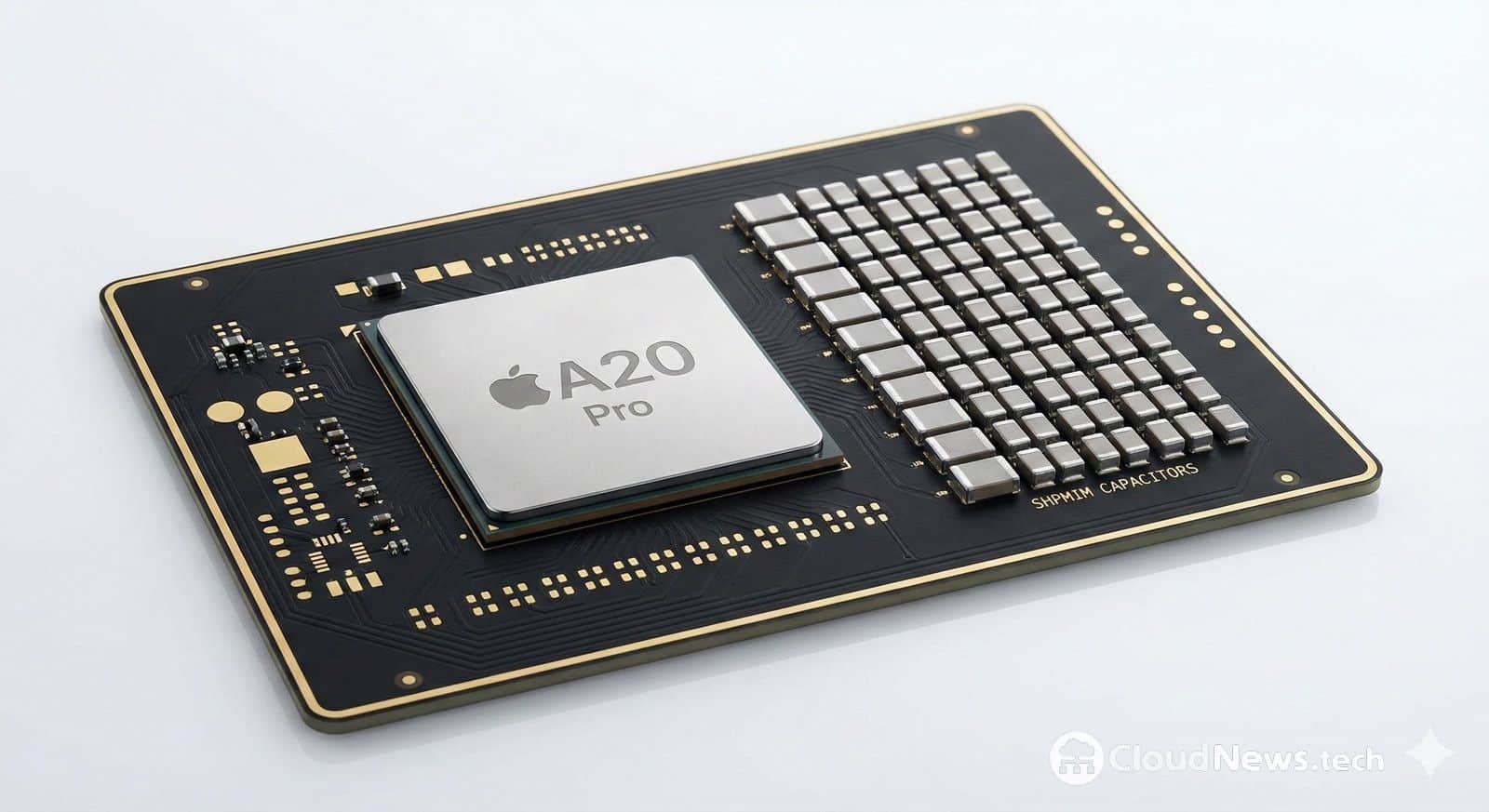
A new leak about the Apple A20 Pro points to significant architectural changes in the next processor for high-end iPhones. The alleged chip analysis shows a seven-core GPU, a 96-bit memory bus, and more cache for the efficiency cores. The figures are still unconfirmed by Apple and arrive just days before the event the company will hold on September 9.
Apple A20 Pro key facts in 20 seconds
- A leak attributes the A20 Pro a 7-core GPU, up from six on the A19 Pro.
- The memory bus would go from 64 to 96 bits, a 50% increase in width.
- The efficiency cores would share 8 MB of L2 cache, up from 6 MB.
- The chip is said to be paired with the new WMCM packaging.
- Apple will hold its next event on September 9, but has not yet confirmed these specs.
The information comes from a post on Weibo that partially reconstructs the A20 Pro’s layout based on package connections and images attributed to the chip. It’s worth separating what Apple has confirmed from what, as of September 3, remains part of the rumor mill.
Apple has officially announced an event for September 9 at 19:00, Spanish mainland time. The company has not yet detailed on its website which devices it will unveil or the A20 Pro’s specifications.
Leaks that have piled up over recent months, however, agree on two especially relevant changes: the move to a 2-nanometer manufacturing process and the adoption of WMCM (Wafer-Level Multi-Chip Module) as the new packaging system.
The information that has now surfaced adds a third piece: Apple could use those changes to give the GPU more resources and, above all, more memory bandwidth.
Seven GPU cores and a 96-bit memory bus
The alleged A20 Pro layout keeps a relatively familiar CPU configuration: two high-performance cores and four efficiency cores.
The most visible change would be in the GPU.
The A19 Pro has six GPU cores, while the leak attributes the A20 Pro seven GPU cores. In terms of unit count alone, that would be an increase of roughly 16.7%, though that doesn’t directly translate into an equivalent performance gain.
Clock speed, internal architecture, available memory, power draw, and thermal headroom also shape the final result.
The second change could turn out to be even more important.
The leak points to a 96-bit memory interface, up from the 64 bits attributed to the previous generation. That represents a 50% increase in bus width.
A wider bus allows more data to move between memory and processor per cycle, provided the rest of the architecture can take advantage of that capacity.
For a mobile GPU, that can be especially valuable.
Rendering graphics, running complex games, and processing artificial intelligence workloads all require continuously moving large amounts of data. Adding compute units without feeding them enough data can reduce the benefit gained.
That’s why the alleged seventh GPU core and the 96-bit bus need to be looked at together.
Apple could be increasing both compute capacity and the infrastructure needed to keep it fed.
The most recent leak also mentions LPDDR5X, a detail that contradicts some earlier rumors pointing to LPDDR6. That discrepancy is a reminder that these specs are still not official.
WMCM could matter as much as the 2-nanometer node
The A20 Pro’s evolution wouldn’t depend solely on the internal silicon design either.
Apple has used Package-on-Package (PoP) solutions for several generations, with DRAM memory placed on top of the processor. A20 Pro leaks point to a shift toward WMCM, which would allow different components to be integrated differently within the package.
One consequence would be placing the memory next to the SoC instead of stacking it directly on top.
The change could have thermal implications. The processor and memory would stop concentrating so much heat generation in the same area, which could be useful when the CPU, GPU, and AI engines sustain heavy loads for extended periods.
It also offers more freedom to design the memory connections.
That context helps explain why the alleged 96-bit bus is showing up now.
A 50% increase in width can deliver more bandwidth even without necessarily moving to a completely new generation of DRAM.
In mobile devices there is always a trade-off between performance, power consumption, temperature, size, and cost. Packaging is becoming an additional lever for tuning that balance.
This isn’t unique to Apple either. As manufacturing smaller transistors becomes more complex and expensive, packaging design is gaining importance in how processors evolve.
More cache for the efficiency cores
The alleged die analysis brings another, less flashy but still relevant change for the CPU.
The two high-performance cores would keep 16 MB of L2 cache, while the four efficiency cores would move to sharing 8 MB, up from the 6 MB attributed to the A19 Pro.
A larger cache keeps more data close to the cores and reduces certain trips to main memory.
That can improve both performance and power efficiency in some workloads.
In a smartphone, that last point matters especially. Efficiency cores handle much of the everyday workload precisely to avoid unnecessarily waking up the higher-power units.
The leak still doesn’t provide enough reliable information about other important blocks.
The size of the system-level shared cache is unclear, and there’s still no full description of the Neural Engine or the image signal processor (ISP).
Earlier leaks had suggested a physically larger Neural Engine, which would be consistent with the growing weight of on-device AI processing, but there’s still no official confirmation.
A chip that could mark Apple’s jump to 2nm in the iPhone
Another expectation around the A20 Pro is that it will be built on TSMC’s N2 process, though Apple still hasn’t publicly confirmed the specs of the processor it will unveil in September.
The move from 3 to 2 nanometers carries more implications than the nominal drop in a single figure.
TSMC credits N2 with performance and efficiency gains over its previous processes. The A20 Pro’s actual gain will depend, however, on how Apple uses the extra transistor and power budget available.
It could put that toward higher performance, lower power consumption, a larger GPU and Neural Engine, or a combination of those.
The alleged leaked configuration suggests a fairly deliberate allocation of resources.
Apple would keep six CPU cores, expand the GPU to seven, increase the efficiency cores’ cache, and provide more bandwidth to the whole system.
It doesn’t look, then, like a strategy based simply on adding more CPU cores.
Graphics and AI need more and more memory
The 96-bit bus could also have implications that go beyond gaming.
Artificial intelligence models run locally also depend on how fast the processor can access data and move it between different compute units.
CPU, GPU, and Neural Engine share memory resources within an extremely limited space.
With larger models and more complex AI features, bandwidth can become a bottleneck even as compute capacity increases.
That’s what makes the combination pointed to by these leaks especially interesting: a more advanced manufacturing process, new packaging, a bigger GPU, and a wider memory bus.
It could also help with computational photography, video processing, and more demanding games.
But it’s still too early to translate those changes into concrete performance percentages.
A GPU with one extra core doesn’t automatically mean 16.7% more frames per second. Likewise, a bus that’s 50% wider doesn’t guarantee a 50% improvement in any given app.
Clock speeds, power consumption, GPU architecture, and final memory specs still need to be known, along with testing on commercial devices.
The September 9 event should clear up at least some of these unknowns. Apple has confirmed the date, but until it officially unveils the hardware, the seven GPU cores, the 96 bits, and the specific features of the A20 Pro should still be treated as a leak.
Frequently Asked Questions
How many GPU cores will the Apple A20 Pro have?
The latest leak points to seven GPU cores, one more than the A19 Pro. Apple has not yet confirmed this spec.
Will the A20 Pro have a 96-bit memory bus?
The alleged chip analysis indicates a 96-bit interface, up from 64 bits in the previous generation. If confirmed, that would be a 50% increase in bus width, though that doesn’t automatically mean 50% more performance.
Will the Apple A20 Pro be built on a 2-nanometer process?
Available reports point to TSMC’s N2 process for the A20 Pro. The final specification should be considered pending Apple’s official presentation.
When will Apple unveil its new products?
Apple has confirmed an event for September 9, 2026, at 19:00, Spanish mainland time. The company has not yet officially detailed all the products it will announce.
