
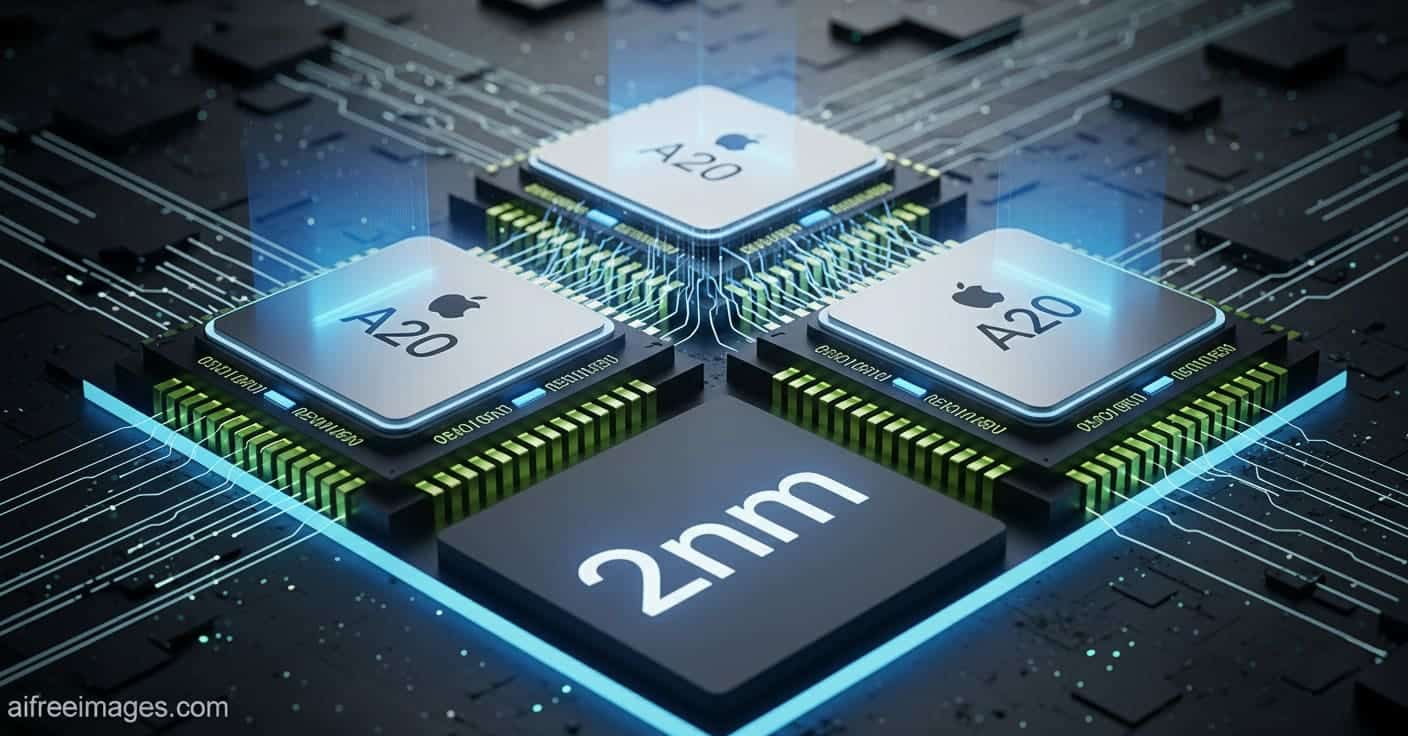
The future Apple A20 Pro is poised to become one of the most significant manufacturing shifts in iPhone chips in recent years. A leak from China places the processors of the upcoming iPhone 18 Pro at 2-nanometer TSMC technology, with estimates of up to an 18% performance boost or around 30% less power consumption. These figures have not yet been confirmed by Apple, and it’s advisable not to add them as fact: manufacturing process improvements typically suggest alternative enhancements at equal power usage or the same performance.
The key points of the Apple A20 Pro and 2 nm in 30 seconds
- The A20 Pro in upcoming iPhone 18 Pro models is expected to be made with 2 nm TSMC technology, according to still unconfirmed leaks from Apple.
- This leap introduces GAA nanosheet transistors into iPhone chips.
- TSMC attributes improvements of up to 15% in speed at the same power or up to 30% lower power consumption at the same speed when comparing N2 to N3E.
- N2P officially elevates these figures to approximately 18% and 36%, respectively.
- For smartphones, reducing power consumption can translate to longer battery life, less heat, and sustained better performance.
The confirmed part of this story comes from TSMC. Its N2 technology began volume production in Q4 2025 and marks a significant architectural change from the 3 nm family used previously. For the first time in this node, the company uses Gate-All-Around (GAA) nanosheet transistors, which mean the gate fully encircles the channel for better control.
What remains in the realm of leaks is which variant Apple will use, what the A20 Pro will look like, and what features it will finally offer in a commercial iPhone.
This distinction is important because some circulating figures more closely correspond to N2P than to the original N2.
N2 and N2P don’t deliver exactly the same figures
TSMC has been releasing specifications for its 2 nm family for years, and their data help contextualize leaks about the A20 Pro.
The official comparison looks roughly like this:
| TSMC Process | Comparison | Performance at same power | Power at same performance | Situation |
|---|---|---|---|---|
| N2 | Compared to N3E | +10-15% | -25-30% | Mass production from Q4 2025 |
| N2P | Compared to N3E | ~+18% | -36% | Scheduled production in 2H 2026 |
| A16 | Compared to N2P | +8-10% | -15-20% | Mainly aimed at HPC |
| A14 | Compared to N2 | +10-15% | -25-30% | Expected production in 2028 |
TSMC currently describes N2P as an evolution compatible with N2 design rules, indicating about an 18% performance boost at the same power or 36% lower power at the same speed compared to N3E. The company expects N2P to constitute the majority of its 2 nm family adoption.
This makes the 18% figure attributed to the future Apple chip especially interesting, but it does not guarantee that the A20 Pro will use N2P or exactly achieve that improvement.
TSMC’s percentages illustrate the potential of their manufacturing process relative to a baseline node. They are not a prediction of the final performance of a specific processor.
Apple could modify CPU and GPU architectures, caches, Neural Engine, frequencies, transistor counts, and power budgets. The final commercial outcome will depend on all these choices.
18% faster and 30% more efficient don’t mean the same
Here lies the nuance that’s easily lost when discussing new nodes.
When TSMC states that N2 can offer up to 15% higher speed at the same power or between 25% and 30% less power at the same speed compared to N3E, they are describing two different operating points.
It doesn’t mean a processor will automatically consume 30% less power while operating 15% faster simultaneously.
In simple terms, Apple could leverage part of the node’s margin to increase frequencies and performance, keep comparable capabilities by reducing consumption, or find an intermediate point.
For a smartphone, this third option can be especially appealing.
A mobile SoC is constrained by a relatively small battery and passive cooling system. High power draw can provide high scores for a few seconds but will also increase temperature and lead to frequency throttling later.
Efficiency can be just as important as maximum performance.
GAA nanosheet is the true technological leap
2 nm should not be taken literally as a specific physical dimension within the processor. Modern node names mainly serve as labels for generations of technology.
The major change in N2 lies in the transistors.
TSMC is using its first generation of nanosheet transistors in N2, replacing the FinFET architecture used in previous processes. The company attributes control, electrical, and efficiency improvements to this transition, along with an over 15% increase in chip density over N3E.
For Apple, this additional efficiency can be utilized in many ways beyond just boosting Geekbench scores.
The company must distribute the iPhone’s power budget across CPU, GPU, Neural Engine, photography processing, modem, memory, display, and other components.
Artificial intelligence adds another layer of demand.
Manufacturers are shifting more AI processing to the device itself, where higher performance with low power consumption is especially valuable. TSMC presents N2 as a technology aimed at smartphones, high-performance computing, and artificial intelligence.
The goal of over 10,000 points in Geekbench is unconfirmed
Another circulating figure is the possibility of surpassing 10,000 points in Geekbench 6 by a wide margin.
There is no official information from Apple confirming this target at present.
It also wouldn’t make sense to consider the chip a failure simply for scoring below a certain threshold. Benchmarks compare specific aspects like CPU performance but do not measure energy efficiency, GPU performance, neural processing, sustained performance, or thermal behavior on their own.
The move to N2 might make some of these variables more relevant than just hitting a specific synthetic score.
If Apple maintains high performance over longer periods before thermal throttling, the benefits can be seen in gaming, photo processing, video export, or prolonged AI workloads, even if the maximum CPU score isn’t as high as some expect.
Manufacturing at 2 nm will also be costly
A final variable with limited concrete info is cost.
Advanced processes require huge investments in fabs, lithography equipment, R&D, and production capacity. TSMC expects rapid adoption of N2: the company indicates that in its first two years, the number of new tape-outs should surpass those from 3 and 5 nm families at their respective starts.
Apple often ranks among TSMC’s earliest major clients for advanced manufacturing tech, but there are no official data yet on how much it will cost to produce the A20 Pro or the potential impact on the iPhone 18 Pro’s price.
Therefore, it’s useful to distinguish three levels of information:
TSMC has confirmed that N2 is in production, uses nanosheets, and offers the estimated improvements over N3E. It has also confirmed that N2P production is scheduled for the second half of 2026 and provides additional benefits.
It is plausible that Apple uses this family of processes for the A20 Pro and leaks point that way, but nothing has been officially announced yet.
The specific features of the upcoming iPhone 18 Pro are still uncertain.
If confirmed, the major change won’t just be having “2 nm” on the spec sheet. The real leap will be in how much performance Apple achieves per watt and how long it can sustain it within a smartphone’s thermal limits.
Frequently Asked Questions
Will the Apple A20 Pro be manufactured at 2 nm?
Leaks suggest Apple will utilize TSMC’s 2 nm process for the A20 Pro generation, but Apple has not officially confirmed the chip’s specifications yet.
Will the A20 Pro be 18% faster and consume 30% less?
Not necessarily. TSMC usually expresses improvements as higher performance at the same power or lower power at the same performance. The final capabilities will also depend on Apple’s design choices.
What is the difference between TSMC N2 and N2P?
N2 is TSMC’s first-generation 2 nm node utilizing nanosheet transistors. N2P is an evolved version that maintains the same design rules and is reportedly about an 18% performance increase at the same power or a 36% power reduction at equal performance compared to N3E.
When will the iPhone 18 Pro arrive?
Apple has not officially announced the iPhone 18 Pro or the A20 Pro yet, so their final features and specifications are still unconfirmed.
