
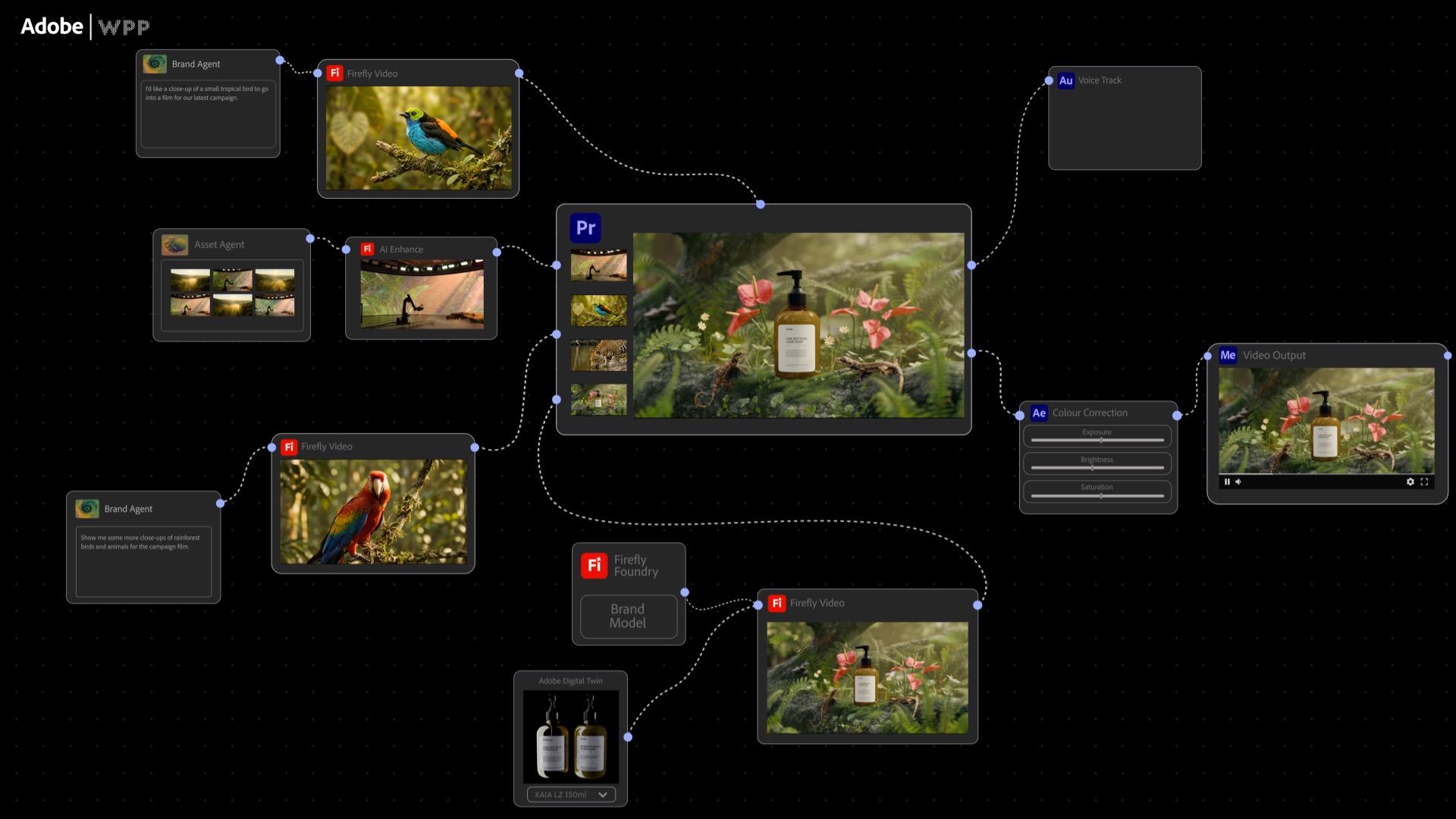
Adobe has announced that it’s integrating CX Enterprise Coworker into several of the market’s leading artificial intelligence (AI) platforms, including ChatGPT, Claude, Gemini for enterprise, Databricks Genie, and Microsoft Copilot. The company wants marketing teams to be able to manage campaigns, analyze data, and coordinate customer experiences from the AI tools they already use, without having to work in silos.
Adobe CX Enterprise Coworker in 20 seconds
- Adobe is integrating its enterprise agent into ChatGPT, Claude, Gemini for enterprise, Databricks Genie, and Microsoft Copilot.
- The tool coordinates tasks related to campaigns, audiences, customer journeys, and results analysis.
- The integrations use open standards such as Model Context Protocol (MCP) and Agent2Agent (A2A).
- AWS, IBM, and Snowflake are among the platforms planned next.
- Adobe is also adding ready-made connectors for advertising services, data, and enterprise tools.
The news, announced on November 4, 2026, expands Adobe’s presence in the market for enterprise-focused AI agents, a push the company had already previewed when it brought AI agents into the heart of marketing alongside NVIDIA and WPP. The idea is to bring the capabilities of its customer experience platform to the assistants employees already use, so they can look up information and carry out actions without constantly switching applications.
The integration also reflects a shift in how organizations use AI assistants. Rather than just answering questions or generating content, these systems can now access corporate tools, query data, and coordinate tasks with human oversight.
An agent for managing the full customer lifecycle
Adobe CX Enterprise Coworker is designed to work across different stages of the relationship between a company and its customers. Its scope ranges from attracting prospective buyers to conversion and growing the value of each business relationship over the long term.
Its capabilities include analyzing data and campaign performance, spotting trends, forecasting audiences, and optimizing customer journeys. It can also help resolve conflicts between tasks and improve project planning and management.
What sets it apart from a conventional assistant is its connection to the organization’s systems and information. Adobe’s pitch is that the agent can draw on customer data, brand information, and channel knowledge to coordinate actions across multiple tools.
The company says it works with more than 20,000 brands on content, customer engagement, and brand visibility. CX Enterprise Coworker builds on Adobe CX Enterprise, the agentic AI platform for marketing that Adobe unveiled at Adobe Summit 2026, to run customer experience workflows, with human oversight over the agents’ actions.
The integration with external platforms makes those capabilities available from different work environments. That means a marketing team will be able to use its organization’s AI tools to look up information or kick off tasks related to its campaigns.
MCP and A2A connect platforms and enterprise tools
One of the technical elements behind the announcement is the use of open standards. CX Enterprise Coworker is built on Model Context Protocol (MCP) and Agent2Agent (A2A), two technologies designed to make it easier for models, agents, and external tools to communicate with each other.
MCP lets AI assistants connect to data sources and services. In this case, Adobe is using it to offer integrations with systems that are part of the day-to-day work of marketing and customer experience teams.
A2A, for its part, is geared toward communication between agents. Its presence in Adobe’s architecture enables workflows in which different AI systems collaborate to complete tasks that require information or capabilities from several platforms.
The company has also announced new ready-made connectors for CX Enterprise Coworker. The services included are Amazon Ads, Databricks Genie, Demandbase, Meta’s MCP server for campaigns, Microsoft Work IQ, RainFocus, and Snowflake Cortex AI.
These connectors offer preconfigured integrations so companies can connect their tools without having to build every link between systems from scratch. Adobe explains that professionals will be able to make a single request and use it to pull data or run actions across several services.
The availability of these connectors could cut down on the work needed to connect enterprise applications, though the real-world impact will depend on the services used, the permissions granted, and each organization’s setup.
Consultancies and agencies are building on Adobe’s agent
The announcement also involves several technology consultancies and advertising agencies that are working with CX Enterprise Coworker to develop solutions tailored to different industries.
The systems integrators Adobe names include Accenture, Capgemini, Cognizant, Deloitte Digital, EY, IBM, Infosys, PwC, and Tata Consultancy Services (TCS). These companies are using the platform to connect Adobe’s capabilities with other enterprise systems and build AI solutions for their clients.
On the agency side, Adobe cites dentsu, Havas, Omnicom, Publicis, Stagwell, and WPP. These organizations are bringing their own intellectual property, agents, tools, and industry knowledge to CX Enterprise Coworker to build personalized experiences for their clients.
These partners’ involvement points to a model in which companies don’t rely solely on a platform’s standard features. Consultancies can tailor workflows to each organization’s applications and processes, while agencies can bring their own resources and tools.
Adobe presents this collaboration as a way to move AI agent projects from early-stage testing into use in enterprise processes. However, the announcement doesn’t detail adoption figures, specific customers already using these solutions, or financial results tied to the integrations.
For now, the announced availability covers ChatGPT, Claude, Databricks Genie, Gemini for enterprise, and Microsoft Copilot. Adobe also says integrations with Amazon Quick, IBM, and Snowflake are coming soon, without specifying a rollout date.
The strategy positions CX Enterprise Coworker across AI platforms rather than tied to one. Instead of requiring teams to adopt a single assistant, Adobe is trying to make its customer experience tools usable from several of them, while keeping access to connected enterprise data and services.
Frequently asked questions
What is Adobe CX Enterprise Coworker?
It’s an Adobe AI agent system designed to coordinate customer experience processes, from attracting users to conversion and long-term business relationships.
Which platforms is CX Enterprise Coworker available on?
Adobe announces availability on ChatGPT, Claude, Databricks Genie, Gemini for enterprise, and Microsoft Copilot. Integrations with Amazon Quick, IBM, and Snowflake are planned for later.
What tasks can Adobe’s agent perform?
It can analyze campaigns, spot trends, forecast audiences, optimize customer journeys, and coordinate project planning and management tasks.
What technologies does Adobe use to connect its agents?
CX Enterprise Coworker is built on Model Context Protocol (MCP) and Agent2Agent (A2A), standards that let agents connect to tools, data, and other AI systems.
This article is also available in Spanish: «Adobe lleva su agente de IA empresarial a ChatGPT, Claude, Gemini y Copilot», on revistacloud.com.
