
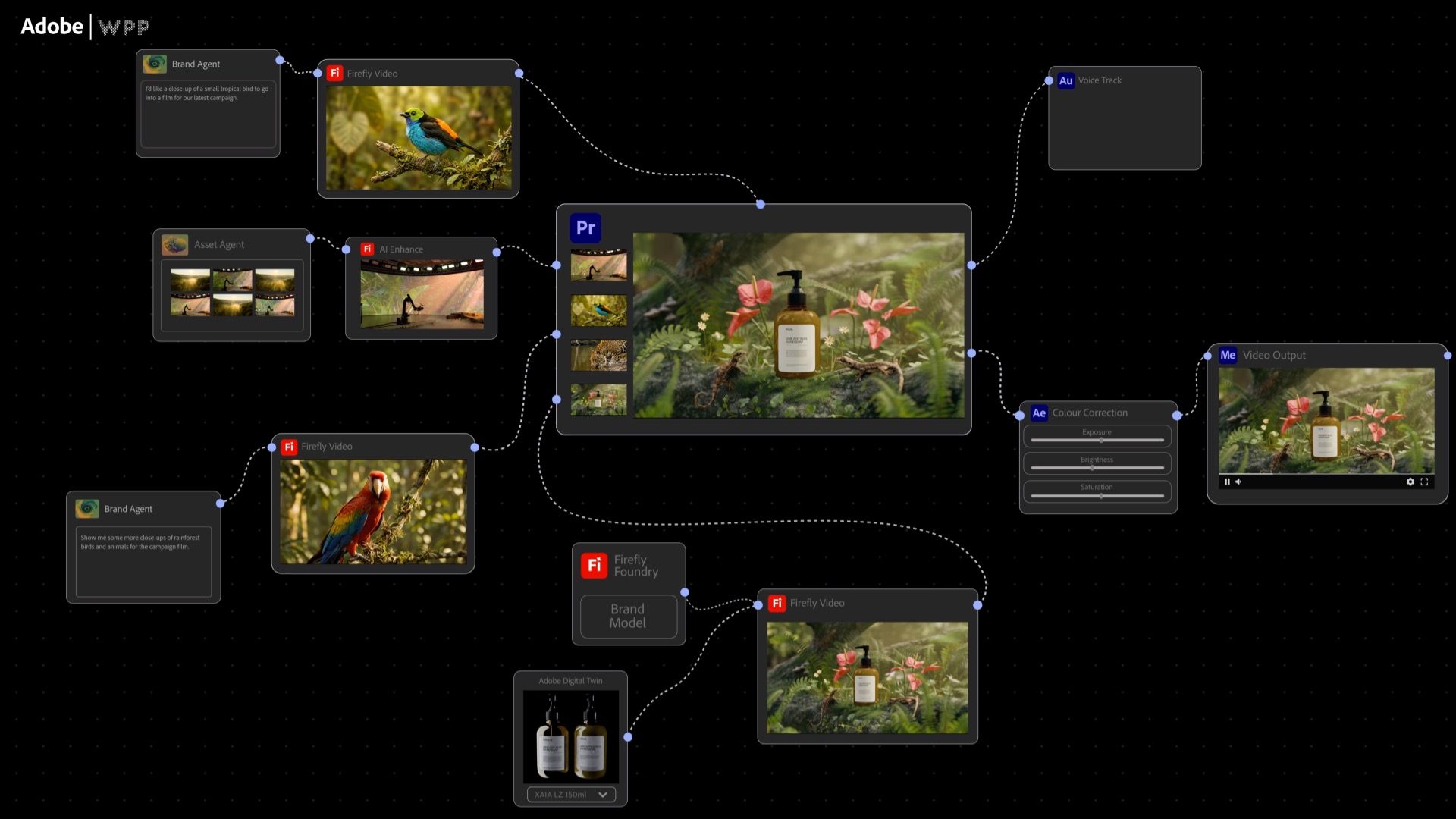
Generative artificial intelligence is no longer being marketed just as a tool for writing texts or creating images. In the corporate world, the next step is something much more ambitious: using agents capable of planning, producing, adapting, and activating entire campaigns continuously, with access to data, workflows, and client systems. This is the area that Adobe, NVIDIA, and WPP are now targeting with an expanded alliance aiming to bring AI agentic to the heart of enterprise marketing operations.
The announcement rests on three main components. Adobe contributes its creative and customer experience platforms, along with its new CX Enterprise Coworker; WPP offers its global capabilities in media, creativity, and brand activation; and NVIDIA adds its accelerated infrastructure and software stack for agents, including components like Nemotron, Agent Toolkit, and the secure runtime OpenShell. The core idea is clear: increasingly automate parts of the marketing cycle without sacrificing control, traceability, or brand consistency.
This is no small promise. Adobe unveiled at Summit 2026 CX Enterprise, a new layer focused on orchestrating customer experience in the agentic era, with CX Enterprise Coworker positioned as a key element. According to the company, this agent is designed to operate on open standards like MCP and A2A, work with Adobe applications, and connect with cloud platforms such as AWS, Anthropic, Google Cloud, Microsoft, OpenAI, and others. This enables it not just to generate content but to coordinate decisions, recommendations, and activations within broader systems.
From content to autonomous marketing
The partnership between Adobe, NVIDIA, and WPP addresses a very specific issue in modern marketing: the need to personalize campaigns at scale without volume undermining coherence. The companies share a vision where a global retailer could adjust offers, images, text, and prices for millions of product, audience, and channel combinations in minutes—not months. This aligns with Adobe’s push to defend its position against new native AI platforms and the need for large brands to produce more content without increasing costs or legal risks.
NVIDIA emphasizes security and governance particularly. According to their blog, these agents do more than suggest ideas—they can orchestrate multi-step workflows, access sensitive data, and trigger actions within the marketing stack. The collaboration revolves significantly around OpenShell, NVIDIA’s secure runtime that runs each agent in an isolated environment with verifiable, controlled policies. This messaging shifts the conversation from “what can AI generate” to “what can it do within a company’s rules.”
Adobe reinforces this logic with the promise of governed agents for regulated sectors. The company explains that integration between OpenShell, Nemotron, and CX Enterprise Coworker will keep certain workflows and intelligence within the organization’s trusted perimeter. It’s an elegant way of saying that big companies no longer want just powerful AI—they want AI that can pass audits, comply with internal standards, and not risk their reputation if something goes off-script.
Firefly Foundry and the race for commercially safe content
Another key aspect of this movement is Adobe Firefly Foundry. Adobe and NVIDIA had already announced a strategic partnership in March to leverage NVIDIA’s technologies in the next generation of Firefly models and in creative and agentic marketing workflows. Within this agreement, Firefly Foundry was to integrate accelerated computing, AI libraries, and NVIDIA models to deliver personalized, commercially safe AI at scale, which is especially important for brands, studios, and intellectual property owners.
This concept of “commercially safe” is no accident. Adobe has long tried to differentiate itself from other visual generation platforms by promoting a safer approach suitable for corporate environments. In the new framework with NVIDIA, Firefly Foundry is presented as the tool that allows fine-tuning models on proprietary content and producing images, videos, audio, vectors, and 3D assets while maintaining brand identity. WPP appears as one of the partners able to use this base to help their clients create multimodal content aligned with their assets and rules.
3D digital twin jumps into production
Perhaps the most tangible news for marketing and e-commerce is another: Adobe has announced the general availability of its cloud-native 3D digital twin solution within Adobe Firefly Creative Production. According to Adobe, this technology creates a photorealistic, persistent virtual representation of a physical product, including its geometry, materials, and manufacturable variants, to automate high-fidelity content creation across multiple markets and formats. The solution is built on NVIDIA’s Omniverse libraries and OpenUSD.
Practically, this means a brand can use a digital twin as a persistent identity for a product to generate packs, lifestyle images, configurations, 3D experiences, or virtual testing with much greater consistency. For Adobe, this is a way to combine creativity, automation, and scale. For NVIDIA, it’s also a means to extend Omniverse beyond industrial use and place it at the core of commercial and advertising production.
The following table summarizes the main components of the agreement:
| Component | What it Provides | Role in the Partnership |
|---|---|---|
| Adobe CX Enterprise Coworker | Agent for customer experience orchestration | Coordinates marketing workflows, personalization, and activation |
| NVIDIA OpenShell | Secure, governed runtime for agents | Isolates agents and enforces auditable policies |
| NVIDIA Nemotron | Open models for agents and reasoning | Foundation for intelligence in agentic tasks |
| Adobe Firefly Foundry | Customized models on proprietary assets | Generates commercially safe content at scale |
| 3D Digital Twin in Firefly Creative Production | Persistent virtual replica of the product | Automates 3D content and multi-format marketing |
| WPP | Global agency, media, and activation layer | Brings these capabilities into real campaigns for major brands |
What this movement reveals
The core takeaway is quite clear: Adobe doesn’t want to be just a provider of creative tools in the AI era. It aims to become a platform that combines creation, personalization, activation, and measurement within a system of governed agents. Meanwhile, NVIDIA continues to push its strategy of being present at all layers of the new enterprise stack—from infrastructure to agent runtimes. And WPP represents the closest link to actual business execution: deploying all of this across campaigns, clients, and global brands.
In the short term, the challenge will not only be technical. The promise of autonomous marketing at scale sounds powerful, but it also raises questions about control, attribution, compliance, and responsibility. That’s why Adobe and NVIDIA are emphasizing governance and regulatory environments—they know that the enterprise market will adopt automation, but only if it’s accompanied by oversight and clear boundaries. What has been announced is not yet a replacement for creative teams or marketing directors. Rather, it’s the beginning of a phase where much repetitive, modular, and multi-channel work could start to be delegated to agents that not only create but also decide and act within defined rules.
Frequently Asked Questions
What is Adobe CX Enterprise Coworker?
It’s the new enterprise agent introduced by Adobe to orchestrate customer experience and marketing workflows. Adobe claims it’s built on open standards like MCP and A2A, capable of operating with Adobe applications and third-party platforms.
What role does NVIDIA OpenShell play in this partnership?
OpenShell is NVIDIA’s secure runtime environment for executing agents within isolated, policy-governed environments. Adobe integrates it to enable its agents to operate with greater control, traceability, and auditability, especially in regulated sectors.
What does WPP contribute to the Adobe and NVIDIA deal?
WPP provides its global expertise in media, creativity, and marketing, and will work with Firefly Foundry and the agentic tools from Adobe and NVIDIA to help brands produce and activate content at scale.
What is Adobe’s 3D digital twin solution?
It’s a cloud-native solution now generally available within Firefly Creative Production that creates persistent virtual replicas of physical products to automate marketing content, 3D configurations, and high-fidelity visual experiences. It’s built on NVIDIA’s Omniverse and OpenUSD.
via: blogs.nvidia
