
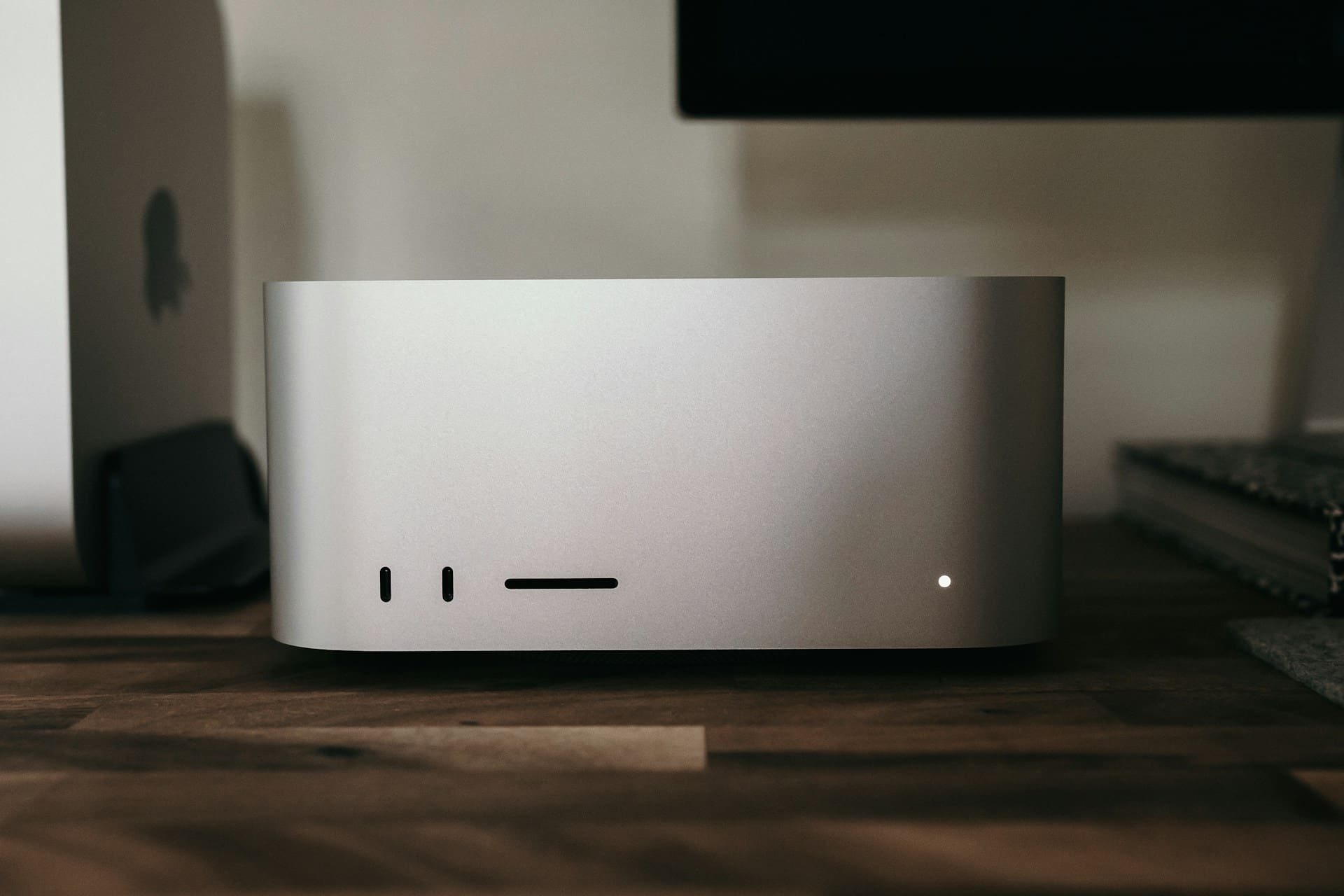
Apple could return to the server market nearly two decades after discontinuing the Xserve. A report from The Information, picked up by Reuters, points to an AI-focused server project that would use future M8 Ultra chips and could arrive in 2029, though Apple has not confirmed the effort and the project could still change or be canceled. The story becomes more interesting when you look at what’s already happening today: Mac mini and Mac Studio units are being installed by the hundreds or thousands in data center racks, and Apple has just officially embraced clustering multiple Mac Studio units together for AI inference.
Apple’s possible return to servers in 30 seconds
- Apple has reportedly revived an internal AI server project that could arrive in 2029, according to The Information.
- The precedent is Xserve, a 1U server line Apple sold between 2002 and January 2011.
- MacStadium already racks Mac mini, Mac Studio, and Mac Pro units, with designs that can hold up to 460 Mac mini per rack.
- The new Mac Studio with M5 Ultra supports up to 512 GB of unified memory and four-unit clusters for distributed inference.
- The difference would be Apple moving from adapting desktop computers for data centers to directly designing a machine built for that environment.
The connection between the two stories isn’t necessarily that Apple is copying what its customers are doing. There’s something more concrete going on: for years, specialized companies have had to build the infrastructure Apple doesn’t offer. MacStadium, for example, has spent more than a decade putting Mac hardware in data centers and currently works with Mac mini, Mac Studio, and Mac Pro units mounted in racks designed specifically for them.
That helps explain what Apple might be after with a server of its own. The market has already shown there’s demand for Apple hardware that runs permanently, remotely, without a screen or keyboard, inside data center infrastructure. What’s missing is for Apple to turn that need into a product designed from the ground up for that scenario.
Xserve Was a Real Server, Not a Desktop Mac Squeezed Into a Rack
Apple’s earlier foray into servers looked quite different from putting a Mac mini on a shelf today.
Apple introduced the Xserve in May 2002 as a 1U server for standard 19-inch racks. The first model used two PowerPC G4 processors at 1 GHz, supported up to 2 GB of memory, and could hold four hot-swappable ATA/100 drives with up to 480 GB of storage. It also included two Gigabit Ethernet connections. Apple positioned it explicitly for file and print services, databases, streaming, web and mail servers, and cluster computing.
The lineup evolved quickly. The 2004 Xserve G5 used two PowerPC G5 chips and could hold up to 8 GB of ECC memory, three Serial ATA drives, and two PCI-X slots. Apple also offered configurations aimed at distributed computing.
A 2008 generation arrived with up to two quad-core Intel Xeon processors, up to 32 GB of DDR2 ECC memory, and up to 3 TB of internal storage. In 2009, Apple updated the line with Intel Xeon Nehalem processors and an architecture optimized for 1U racks.
The design included features that are now standard in an enterprise server: hot-swappable storage, ECC memory, remote management, PCI expansion, dual Gigabit networking, and RAID options. The Xserve G5, for example, included dedicated tools for monitoring hardware and managing server services.
But Apple abandoned that strategy. In November 2010, it announced it would not develop a new generation and would stop accepting Xserve orders after January 31, 2011. As alternatives, it offered the Mac Pro and the Mac mini running Snow Leopard Server.
The decision left an important gap: the Mac mini could function as a server, but it hadn’t been designed as a 1U enterprise machine.
And that gap still matters today.
The Mac Mini Has Spent Years Proving It Can End Up in a Rack
The current phenomenon didn’t start with the rumored 2029 server. Specialized providers have spent years solving the problem of putting Macs in a data center on their own.
MacStadium is probably the clearest example. The company says it has racked everything from Xserve to current generations of Apple Silicon in its facilities. Its data centers use proprietary racks for Mac mini, Mac Studio, and Mac Pro because Apple’s form factors aren’t built around the standard 19-inch rack.
The scale isn’t trivial either. MacStadium says one of its highest-density racks can hold 460 Mac mini units. The company ended up designing its own trays because some customers were deploying hundreds of units at once.
Back with the 2018 Mac mini, the company had to redesign power, cooling, cabling, and mounting to use the machines intensively in a data center setting. Its testing showed the units could suffer thermal throttling under sustained loads, which forced specific work on airflow and rack density.
With Apple Silicon, the concept became even more compelling. When the first M1 Mac mini appeared in 2020, MacStadium ordered hundreds of units for its data centers and prepared them to offer as dedicated infrastructure for developers.
The company has also built software to turn those physical machines into manageable infrastructure. Orka lets users create macOS virtual machines on Apple Silicon nodes and organize clusters of machines for continuous integration and deployment (CI/CD) pipelines.
In other words, the Mac already functions as a server in practice. What’s happening is that part of the engineering needed to make that work sits outside Apple.
AI Is Changing What a Mac Studio Can Do
Here’s the piece that makes the rumored 2029 server especially consistent with the direction Apple is taking in 2026.
On August 25, 2026, Apple introduced the new Mac Studio with M5 Max and M5 Ultra. The top configuration can include up to 512 GB of unified memory, up to 80 GPU cores, and 1.2 TB/s of memory bandwidth. Apple explicitly markets it as a machine capable of running large language models (LLMs) locally.
But there’s an even more telling detail: Apple has added support for clustering multiple Mac Studio units via Thunderbolt 5 and RDMA, creating a distributed system for AI workloads. According to Apple’s figures, a set of four Mac Studio units can deliver up to three times the inference performance of a single machine.
This doesn’t turn four Mac Studio units into a traditional GPU server for massive training runs. The architecture, software, and memory type are different. But it shows that Apple is explicitly designing the Mac Studio with shared-computing and inference scenarios in mind.
The Mac mini has followed the same path. The new model with M6 and M5 Pro announced in August can run AI models locally and supports clustering via Thunderbolt 5 to work with large models distributed across multiple machines.
Apple, in other words, is already building some of the features into its desktop computers that would be useful for a future AI server.
From Racks of Mac Mini to a Machine Built for the Data Center
The difference between the two approaches may sound small, but technically it matters.
A rack full of Mac mini or Mac Studio units forces the operator to solve for power, cooling, remote management, cabling, storage, component replacement, and density. MacStadium has even patented mounting systems and remote-management devices to handle these tasks. One of its shelf designs can hold 144 Mac mini units in a standard rack.
A server designed by Apple could bake those needs in from the start.
And the rumored project now reported by The Information points precisely in that direction. Reuters says Apple is reportedly exploring an AI-inference server based on future M8 Ultra chips that could incorporate NVIDIA’s NVLink Fusion technology to interconnect the chips. The launch would tentatively land around 2029 and is not confirmed by Apple.
A possible partnership with NVIDIA would be especially notable because it would represent a very different architecture from the traditional separation between the Mac and data center accelerators. Rather than simply using a Mac Studio as a standalone unit, Apple could design a platform where multiple in-house processors work together through an interconnect built for AI workloads.
That would also explain why the comeback wouldn’t need to resemble the Xserve.
The Xserve was born in an era when Apple wanted to sell complete servers for enterprise services, storage, web, mail, and distributed computing. The hypothetical 2029 server would have a much narrower goal: turning Apple Silicon’s efficiency and unified memory into infrastructure for AI inference.
The evolution of the Mac mini and Mac Studio offers, meanwhile, a kind of market experiment. Specialized companies are already buying them, racking them, managing them remotely, and clustering them for specific workloads. MacStadium even currently offers dedicated Mac infrastructure and AI solutions built on Apple Silicon hardware, including the wave of Mac purchases reportedly driven by local AI demand.
That doesn’t prove Apple will launch the rumored server. It does show that the idea isn’t starting from zero: the market has already built servers around the Mac even though Apple doesn’t sell a server as such.
The remaining question would be what a machine designed specifically by Apple adds over hundreds of rack-adapted Mac mini or Mac Studio units. That’s where density, cooling, networking, remote management, memory, chip-to-chip interconnects, and, above all, the ability to design the whole system around AI workloads from day one would come in.
For now, everything related to the rumored M8 Ultra and the 2029 server should be treated as unconfirmed information. But the infrastructure already built around the Mac mini and Mac Studio helps explain why Apple might be looking at racks again after closing the Xserve chapter.
Frequently Asked Questions
When did Apple stop making Xserve servers?
Apple stopped accepting Xserve orders after January 31, 2011. The company had previously announced it would not develop a new generation and offered the Mac mini and Mac Pro as alternatives.
Are Mac mini units currently used as servers?
Yes. Specialized companies like MacStadium use Mac mini units in data centers, with custom racks, remote management, and dedicated infrastructure services. Its highest-density system holds up to 460 Mac mini units.
Can multiple Mac Studio units be connected to run AI?
Yes. The Mac Studio introduced in August 2026 supports clustering via Thunderbolt 5 and RDMA. Apple says a four-unit cluster can deliver up to three times the inference performance of a single Mac Studio.
Has Apple confirmed the new M8 Ultra server?
No. The information about a possible Apple server for 2029 comes from sources cited by The Information and has been picked up by Reuters. Apple has not officially confirmed the project, and the plan could still be changed or canceled.
