
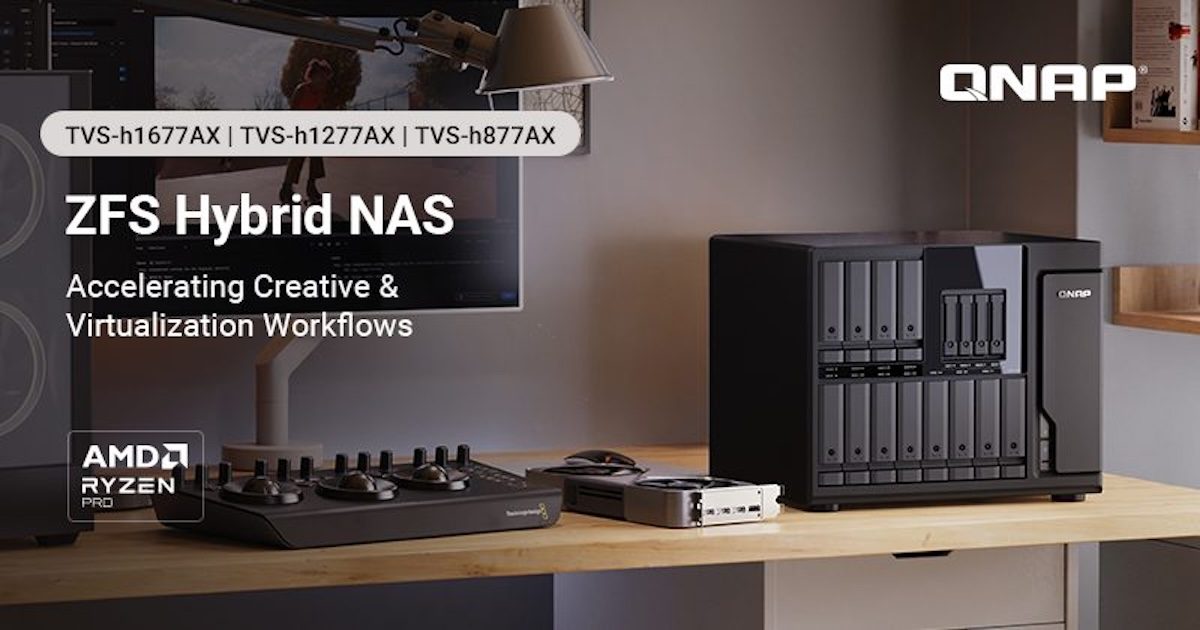
QNAP has unveiled the TVS-hx77AX series, a new family of enterprise ZFS-based NAS systems designed to ease one of the bottlenecks of AI workloads: moving large volumes of data between storage and servers. The systems combine AMD Ryzen 7000 processors, up to 192 GB of DDR5 memory, U.2 NVMe storage, and support for NFS over RDMA through 25 GbE network cards.
The new QNAP TVS-hx77AX NAS systems in 20 seconds
- The lineup includes 8-, 12-, and 16-bay models with AMD Ryzen 7000 processors.
- Supports up to 192 GB of DDR5 memory, with optional ECC.
- NFS over RDMA is available through compatible 25 GbE SmartNIC cards.
- Combines hard drives with PCIe 4.0 U.2 NVMe drives.
- QuTS hero runs on ZFS and adds immutable snapshots and data-integrity features.
The new lineup consists of the TVS-h877AX, TVS-h1277AX, and TVS-h1677AX, with eight, twelve, and sixteen bays respectively. QNAP is targeting the systems at businesses that need storage for virtualization, AI model training, containerized applications, and 4K video production.
One of its standout features is NFS over RDMA. The technology reduces CPU involvement during transfers and lowers latency compared with conventional NFS setups. That said, it’s worth noting the new NAS units don’t ship with 25 GbE connectivity built in: taking advantage of this feature requires installing a compatible SmartNIC in one of their PCIe slots.
NFS over RDMA tries to bring storage closer to GPU speed
The growth of artificial intelligence is also changing the requirements placed on storage systems.
Training a model isn’t just about having fast GPUs. Accelerators need a constant stream of large amounts of data, and if storage or the network can’t deliver it fast enough, part of that compute capacity can go to waste.
QNAP is trying to address this with NFS over RDMA (Remote Direct Memory Access).
RDMA transfers data directly between memory spaces with reduced involvement from the processor and operating system. Applied to NFS, it can cut latency and the CPU overhead associated with storage traffic.
QNAP claims this architecture can deliver latency close to that of local NVMe storage. That’s a vendor claim, and real-world performance will depend on factors like the drives installed, the network, the NAS configuration, concurrent load, and the clients used.
The TVS-hx77AX ships with two 10GBASE-T ports and two more at 2.5 GbE out of the box.
They also come with three PCIe Gen 4 slots. These allow installing additional cards, including 25 GbE SmartNICs such as the QNAP QXG-25G2SF-BCM, needed to set up the NFS over RDMA scenario QNAP is proposing.
The same connectivity can prove useful outside of AI, too. Video editing, virtualization, and applications handling large datasets can also benefit from lower latency and higher transfer speeds.
Ryzen 7000, U.2 NVMe, and ZFS in a desktop NAS
QNAP has built the new lineup around AMD Ryzen 7000 processors with Zen 4 architecture.
The systems support up to 192 GB of DDR5 memory, with the option to use ECC (Error-Correcting Code) memory for environments where protection against certain memory errors matters especially.
That capacity puts these NAS units closer to small enterprise servers than to traditional home storage.
QNAP explicitly designs for running virtual machines and containerized applications simultaneously, alongside tasks involving decompression and intensive data processing.
Storage uses a hybrid architecture.
Alongside bays meant for higher-capacity drives, there are dedicated slots for U.2 NVMe SSDs connected via PCIe Gen 4 x4. These drives can handle the workloads that need the highest number of input/output operations per second, while hard drives provide capacity at a lower cost.
The company also includes Qtier for QuTS hero, which distributes data across different storage tiers based on usage.
Frequently accessed data can stay on SSDs, while less-used information moves to higher-capacity hard drives.
The operating system is QuTS hero, QNAP’s ZFS-based platform.
ZFS brings integrity-checking and self-healing mechanisms when adequate redundancy is in place, along with other features designed to protect data against corruption.
QNAP specifically highlights immutable snapshots as an added layer of protection against ransomware.
Immutability can prevent certain snapshots from being modified or deleted during a configured period. Even so, a snapshot alone doesn’t replace an independent backup strategy, especially when the goal is protection against full system failures, administrative errors, or incidents affecting the entire infrastructure.
RAG, high availability, and GPUs extend the NAS beyond storage
The AI focus also shows up in the software.
QNAP integrates its Qsirch search engine with Retrieval-Augmented Generation (RAG). This architecture retrieves information stored on the NAS and feeds that context to a language model before it generates a response.
According to QNAP, the system can connect to large language models (LLMs) either in the cloud or hosted on the organization’s own infrastructure.
The idea is to enable natural-language search over documents an organization stores and to use the NAS as a repository for internal RAG-based applications.
Another enterprise feature is High Availability Manager.
The platform lets you build high-availability configurations using two NAS units. If one system suffers certain failures, the other can take over its services to reduce the disruption.
QNAP talks about near-zero downtime, though the actual result depends on the architecture and configuration used. High availability also shouldn’t be confused with a backup: the two mechanisms solve different problems.
The PCIe Gen 4 slots also allow installing discrete graphics cards of up to 200 W, including certain NVIDIA RTX models.
QNAP supports this through GPU passthrough, assigning the graphics card directly to a virtual machine to run certain graphics-processing or AI workloads.
That option is especially interesting because it turns the system into more than just a file server. In specific configurations, it can combine storage, virtualization, and acceleration capacity within the same box.
That flexibility comes with the need to plan resources carefully. A 25 GbE SmartNIC and a GPU both use PCIe slots, while virtualization, storage, and application workloads compete for CPU, memory, and bandwidth.
That’s why the right configuration will depend heavily on the intended use.
The TVS-hx77AX units also ship with a five-year standard warranty, a move that underscores QNAP’s push toward enterprise deployments.
The new lineup also reflects how AI is starting to influence products that were traditionally sold mainly on their terabyte capacity. It follows a similar direction to QNAP’s own QAI-h1290FX edge server for private AI, and builds on ZFS groundwork the company already laid with the all-flash, ZFS-based TS-h1077AFU it launched earlier this year.
For GPU-accelerated workloads, storing lots of data is no longer enough. What matters is how fast the system can find it, move it, and deliver it.
NFS over RDMA, NVMe, and 25 GbE networking target exactly that part of the problem. The challenge for QNAP will be proving in real deployments how close these desktop NAS units can get to the performance the company attributes to its new architecture.
Frequently asked questions
Which models make up the QNAP TVS-hx77AX series?
The new lineup includes the 8-bay TVS-h877AX, the 12-bay TVS-h1277AX, and the 16-bay TVS-h1677AX. All three use AMD Ryzen 7000 processors and ZFS-based QuTS hero.
Do the new QNAP units include 25 GbE out of the box?
No. They ship with two 10GBASE-T ports and two 2.5 GbE ports. Using 25 GbE and the NFS over RDMA setup QNAP proposes requires adding a compatible SmartNIC.
What does NFS over RDMA bring to AI workloads?
It reduces CPU involvement in data transfers and lowers latency. This can help deliver data faster to servers and accelerators working with large datasets.
Do immutable snapshots replace a backup?
No. They add protection against modification or deletion during the immutability period, but an enterprise strategy should also include independent copies and recovery mechanisms suited to the level of risk.