
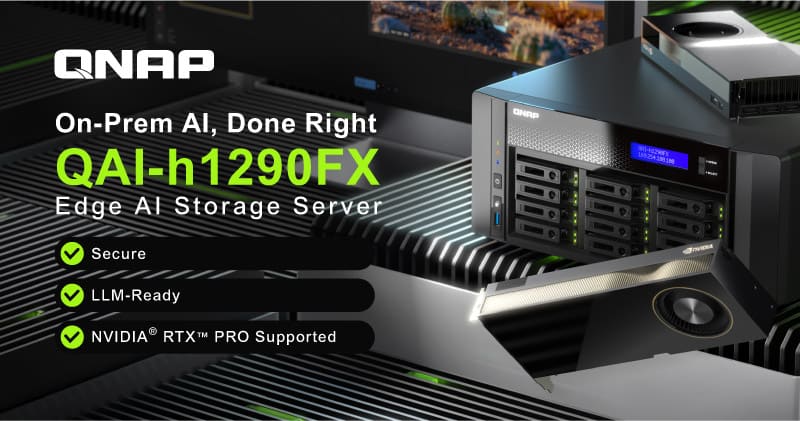
QNAP has unveiled the QAI-h1290FX, an edge storage server designed to run generative AI workloads on-premises, without relying on external cloud services. The system combines all-flash NVMe storage, AMD EPYC processors, options for NVIDIA RTX GPU acceleration, and the QuTS hero operating system based on ZFS.
This offering arrives at a time when many organizations want to experiment with or deploy internal assistants, document searchers with RAG, private language models, and content generation workflows—all without sending sensitive data to external platforms. QNAP aims to fill that space with a machine engineered to integrate storage, compute, virtualization, containers, and AI applications into a single local system.
A server for running LLMs and RAG inside the company
The QAI-h1290FX is aimed at businesses, technical teams, developers, and research groups that need to run language models or generative applications close to their data. It’s not just about storing files; it’s about providing a platform capable of moving, processing, and serving data with low latency within AI workflows.
A clear application is RAG, or Retrieval-Augmented Generation. This technique allows connecting a language model with a private document database to respond using internal company information. For example: contracts, manuals, corporate policies, technical documentation, reports, files, or knowledge bases. Instead of uploading these documents to an external service, an organization can keep them on-premises and allow a local assistant to access that information under its own security rules.
QNAP also targets internal conversational assistants, enterprise search, image generation with tools like Stable Diffusion or ComfyUI, and process automation with n8n. In all these scenarios, a common element is that data can remain within the organization’s infrastructure—an important factor for sectors dealing with sensitive information or regulatory compliance.
The system comes with a selection of pre-installed or ready-to-deploy tools such as AnythingLLM, OpenWebUI, and Ollama. Additionally, QNAP states that it is working on integrating other applications like Stable Diffusion, ComfyUI, n8n, and vLLM. This is significant, as one of the main hurdles in adopting local AI isn’t just hardware—it’s the complexity of installing, configuring, and maintaining advanced environments.
NVMe, AMD EPYC, and NVIDIA RTX GPU
The QAI-h1290FX features twelve U.2 bays compatible with NVMe or SATA SSDs. This all-flash architecture is designed to deliver high input/output performance, particularly useful when working with large datasets, vector indexes, documents, models, and intensive read workflows. In RAG workloads, fast storage helps reduce bottlenecks when retrieving relevant fragments before generating a response.
The processor selected is an AMD EPYC 7302P, a 16-core, 32-thread CPU. While not a new model, it’s a robust server platform capable of supporting virtualization, containers, storage services, parallel tasks, and enterprise workloads. For AI acceleration, the unit supports NVIDIA RTX GPUs, including options like the NVIDIA RTX PRO 6000 Blackwell Max-Q Workstation, which can have up to 96 GB of GPU memory depending on configuration, as noted by QNAP.
GPU support is a core feature. Many inference, image generation, or language model tasks benefit from NVIDIA technologies like CUDA and TensorRT. QNAP presents this system as an alternative to building a GPU workstation from scratch, with manual dependency installation and environment setup. Their goal is to simplify deployment so users can more directly run models and applications.
The system also offers native GPU access within containers via Container Station and GPU passthrough for virtual machines through Virtualization Station. This setup allows assigning resources to different workloads and isolating environments—for example, running a document assistant in a container, testing models in a VM, and managing storage on QuTS hero.
ZFS, high-speed networking, and expandability
The QuTS hero OS, based on ZFS, provides features for data integrity, snapshots, and inline deduplication. For private AI environments, these can help safeguard datasets, document versions, models, configurations, and experimental results. Snapshots enable rollback to prior states, while deduplication is useful where there are repeated data copies or similar file versions.
Connectivity options include two 25GbE ports and two 2.5GbE ports. Its PCIe slots support optional upgrades up to 100GbE. This networking capacity is significant because AI workloads often require moving data between workstations, servers, repositories, backup platforms, or documentation systems. Slow networks can negate the benefits of fast storage and GPU acceleration.
QNAP emphasizes compatibility with JBOD expansion units to increase capacity. This positions the device between advanced NAS, application servers, and edge platforms for AI. It can appeal to organizations that don’t want a full cluster but need more power than a typical NAS.
The concept of “edge” here isn’t limited to small remote offices. It can also mean infrastructure located near data and users—inside the company perimeter. For a law firm, HR department, creative team, engineering unit, or healthcare organization, processing documents and queries locally can improve privacy and control.
A response to the growing interest in private AI
This launch aligns with a clear trend: many businesses want to leverage generative AI but prefer not to send sensitive data to third-party services. Reasons include confidentiality, regulatory constraints, variable usage costs, provider dependency, latency concerns, or the need for model and workflow customization.
The QAI-h1290FX isn’t meant to compete directly with the large cloud clusters used for large-scale training. Its niche is local inference, private assistants, document search, automation, visual content generation, and controlled enterprise experimentation. For many companies, it offers a realistic first step toward on-premises AI infrastructure.
That said, it’s important to note that running AI locally still requires technical management. Users will need to handle model updates, security, permissions, energy consumption, backups, access controls, and monitoring. Not all large models will perform equally well depending on GPU memory, quantization, model size, and user concurrency.
The product’s value will depend on how well QNAP simplifies this experience. If pre-installed tools, AI application centers, and GPU management reduce configuration efforts, the system could be attractive for organizations seeking private AI deployment without building a custom platform from scratch.
QNAP positions the QAI-h1290FX as a practical way to bring LLMs, RAG, and content generation into the company’s local environment. The key will be in its real-world performance, final pricing, available configurations, and medium-term software support. The demand for private AI is already there. Now, storage and server manufacturers aim to turn that demand into accessible, installable, self-managed products without complete cloud dependence.
Frequently Asked Questions
What is the QNAP QAI-h1290FX?
It’s a private AI-oriented edge storage server combining NVMe SSDs, AMD EPYC CPU, NVIDIA RTX GPU options, containers, virtualization, and tools to run LLMs, RAG, and generative applications locally.
What is it used for in a business?
It can support internal assistants, document search with RAG, private knowledge bases, image generation, process automation, and model testing—keeping sensitive data on-premises.
How does it compare to just using the cloud?
It allows organizations to keep data within their infrastructure, reduce dependency on external providers, and have better control over performance, security, and resources. However, it requires local management, maintenance, and capacity planning.
Does it come with ready-to-use AI tools?
QNAP indicates it includes tools like AnythingLLM, OpenWebUI, and Ollama, and is integrating others like Stable Diffusion, ComfyUI, n8n, and vLLM.
via: qnap
