
Broadcom is preparing a renewed VMware vSphere Standard as a simpler alternative to VMware Cloud Foundation (VCF), after more than two years of commercial changes that have pushed numerous companies to reconsider their reliance on VMware. The move aims to serve organizations that only need virtualization and not the full VCF private-cloud package, though key public details on price, availability, and commercial terms are still missing.
The return of vSphere Standard in 20 seconds
- Broadcom admits it put too much of its strategy behind VMware Cloud Foundation.
- The company is preparing a vSphere Standard offering for customers who want virtualization without buying into all of VCF.
- The model will still be subscription-based, licensed per core.
- Pricing and full terms haven’t been publicly disclosed yet.
- For companies that have already migrated to Proxmox VE or other platforms, the announcement may be arriving too late.
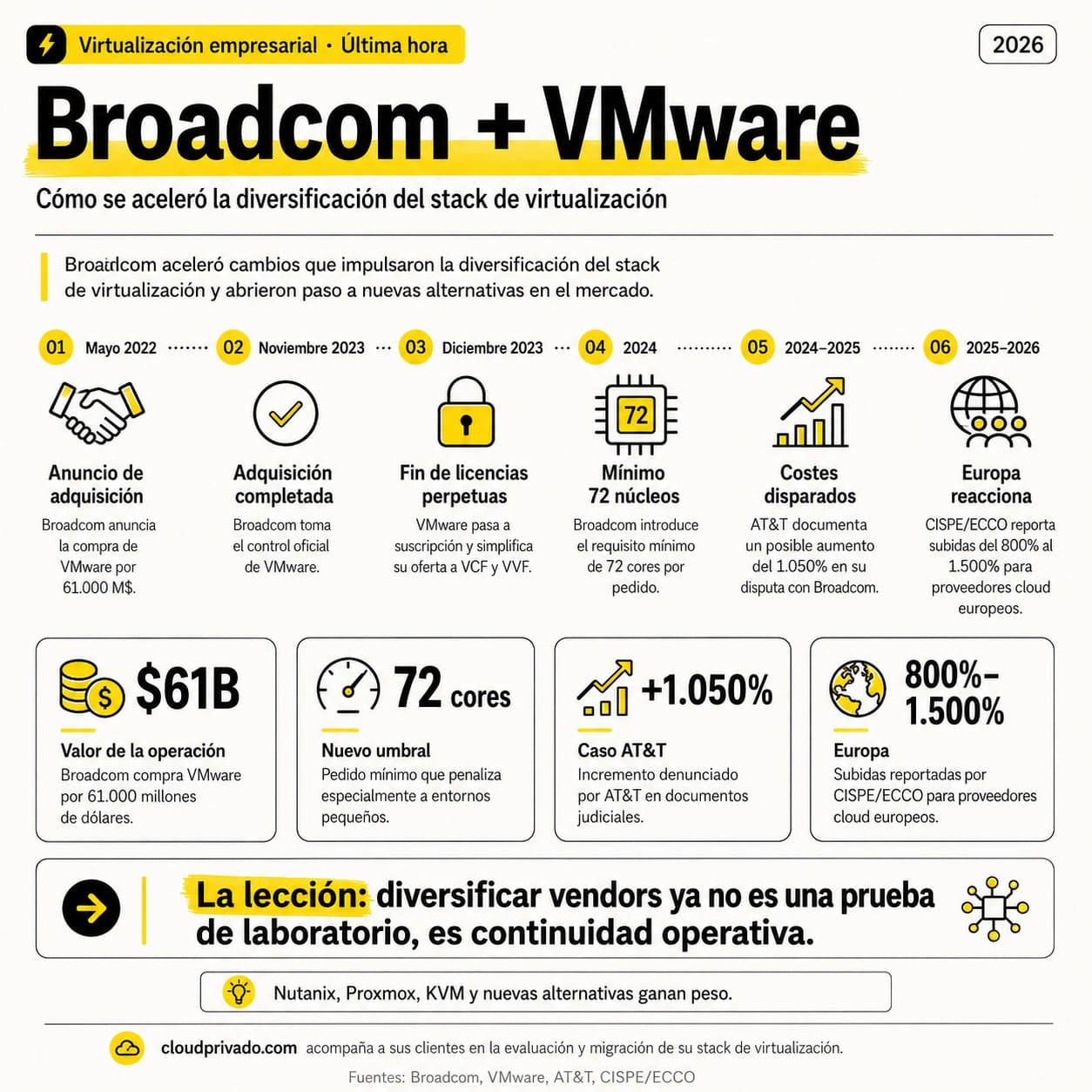
The shift matters especially for small and mid-sized businesses. After completing its roughly $69 billion purchase of VMware in November 2023, Broadcom reorganized products, licensing, channel, and go-to-market strategy around a much narrower catalog, with VMware Cloud Foundation as its flagship product.
That simplification had consequences. Companies that had previously used VMware mainly as a hypervisor started running into commercial packages far broader than what they needed, while perpetual licenses gave way to a subscription model.
The problem for Broadcom is that some of those customers didn’t just complain about the new pricing — they started migrating.
Broadcom admits it put too much focus on VMware Cloud Foundation
The shift in messaging became visible during VMware Explore 2026.
Broadcom acknowledged that it had put excessive weight on VCF in its strategy, especially for small and mid-sized customers whose needs could be met with a less extensive virtualization platform.
VMware Cloud Foundation packages together far more than a hypervisor. It’s built as a full private-cloud platform, with compute, networking, and storage virtualization, automation, and various management tools.
For large organizations that need that full set of capabilities, the strategy can make sense. The situation is different for a company that simply wants to run virtual machines across several servers and manage them through vCenter.
That’s where vSphere Standard comes back into the picture.
Broadcom is keeping vSphere Standard’s documentation updated through 2026. Its program documentation lays out a subscription model licensed per physical core, with a minimum of 16 licensed cores per processor.
The offering includes vSphere and one vCenter Server instance for centralized management, though the specific terms of this new commercial positioning still need to be clarified in more detail.
The distinction matters because talking about the “return” of vSphere Standard could suggest a return to pre-Broadcom VMware.
That’s not the case.
The perpetual licenses that for years let customers buy one version and keep it indefinitely aren’t the model the company is bringing back. Current documentation describes subscription-based software and keeps specific restrictions in place for the old vSphere Standard perpetual licenses.
In particular, customers with certain older perpetual licenses and active support can upgrade to vSphere 8.x under the established terms, but Broadcom specifies that those licenses don’t carry the right to upgrade beyond the 8.x branch.
Proxmox has spent two years capitalizing on VMware’s uncertainty
The problem for Broadcom is that the virtualization market hasn’t been waiting around.
Since 2024, numerous companies have started evaluating alternatives such as Proxmox Virtual Environment, Nutanix AHV, Microsoft Hyper-V, OpenShift Virtualization, or HPE’s newer offerings, among other options.
Proxmox VE has been one of the names benefiting most from that search for alternatives, especially among service providers, mid-sized companies, and organizations already comfortable managing Linux.
Its pitch is different from VMware’s. Proxmox VE combines KVM for virtual machines and LXC for containers, supports clustering and high availability, and integrates storage technologies like Ceph and ZFS. Its code is also open source, and its commercial subscriptions are mainly tied to access to enterprise repositories and support.
Migrating between the two environments, though, isn’t just a matter of converting virtual machines.
An organization leaving VMware has to review storage, networking, backups, high-availability procedures, monitoring, automation, and staff training. In large installations, the project can stretch out over months.
That effort explains why bringing back a simpler commercial option doesn’t automatically win back the customers who’ve already left.
A company that has bought new servers, deployed Proxmox, migrated its virtual machines, trained its administrators, and adapted its procedures would need a compelling economic and technical case to repeat that whole process in reverse.
The recent UpperBee case illustrates that dynamic. The Canadian software company replaced its VMware environment and a SAN architecture with Proxmox VE, Ceph, and ZFS, using the migration as an opportunity to redesign its storage and reduce vendor lock-in as well.
Other customers are taking different paths. Tottenham Hotspur, for example, moved its virtualization to HPE technology and credits the move with cutting its virtualization licensing costs by more than 85%.
Not every project will be driven purely by price, but these cases show that the market for VMware alternatives is more active today than it was before the acquisition.
Price will decide whether the change actually matters
The main unknown around the renewed vSphere Standard isn’t technical.
VMware has been used for enterprise virtualization for decades, and vSphere remains a platform widely known by administrators, integrators, and vendors. For plenty of organizations, sticking with technology they already know can be simpler than starting a migration.
The question is how much doing that will cost.
Until Broadcom publishes final pricing, availability, and terms, it’s hard to know which customers will actually benefit from the change.
The offering will also need to be compared with VMware vSphere Foundation and VMware Cloud Foundation, since too small a price gap could undercut the appeal of dropping down to a smaller edition.
Broadcom also faces another challenge that a new SKU alone won’t solve: rebuilding predictability.
Over the past few years, VMware customers have had to absorb changes to licensing, products, distribution channels, support, and cloud services. Microsoft, for example, is adjusting Azure VMware Solution to require portable VMware Cloud Foundation licenses. License-included SKUs are being phased out, and affected customers will need to move to the VCF BYOL model or choose another path.
That’s why a company’s decision no longer comes down to simply comparing the features of two hypervisors.
It also matters how well they can estimate the platform’s cost over the next few years and what options will exist if the commercial model changes again.
The return of vSphere Standard addresses one of the most repeated criticisms since the VMware acquisition: not every company needs VMware Cloud Foundation to run its virtualized infrastructure.
For those still on VMware and weighing a migration, the new offering might justify waiting to see the final terms before making a decision.
For those who’ve already made the jump to Proxmox VE, Nutanix, HPE, or another platform, Broadcom faces a much bigger challenge. It no longer has to convince them that vSphere works. It has to prove it’s worth coming back.
Frequently Asked Questions
Is Broadcom selling VMware vSphere Standard again?
Broadcom is reinforcing vSphere Standard as an offering for organizations that don’t need all of VMware Cloud Foundation. The vSphere Standard documentation keeps being updated through 2026, though public details on the new positioning, pricing, and commercial availability are still missing.
Will VMware’s perpetual licenses come back?
The available information doesn’t point to a return of the old perpetual-license model. Current vSphere Standard documentation lays out per-core subscription licensing, with a minimum of 16 cores per processor.
What’s the difference between vSphere Standard and VMware Cloud Foundation?
vSphere Standard is mainly geared toward server virtualization and its centralized management. VMware Cloud Foundation offers a much broader private-cloud platform, with additional storage, networking, operations, and automation components.
Does it make sense to halt a VMware-to-Proxmox migration?
The announcement alone doesn’t provide enough to make that call. Companies evaluating a migration should wait to see vSphere Standard’s final pricing, licensing, and terms and weigh them against the full cost, support, and architecture of the alternative they’re considering.