
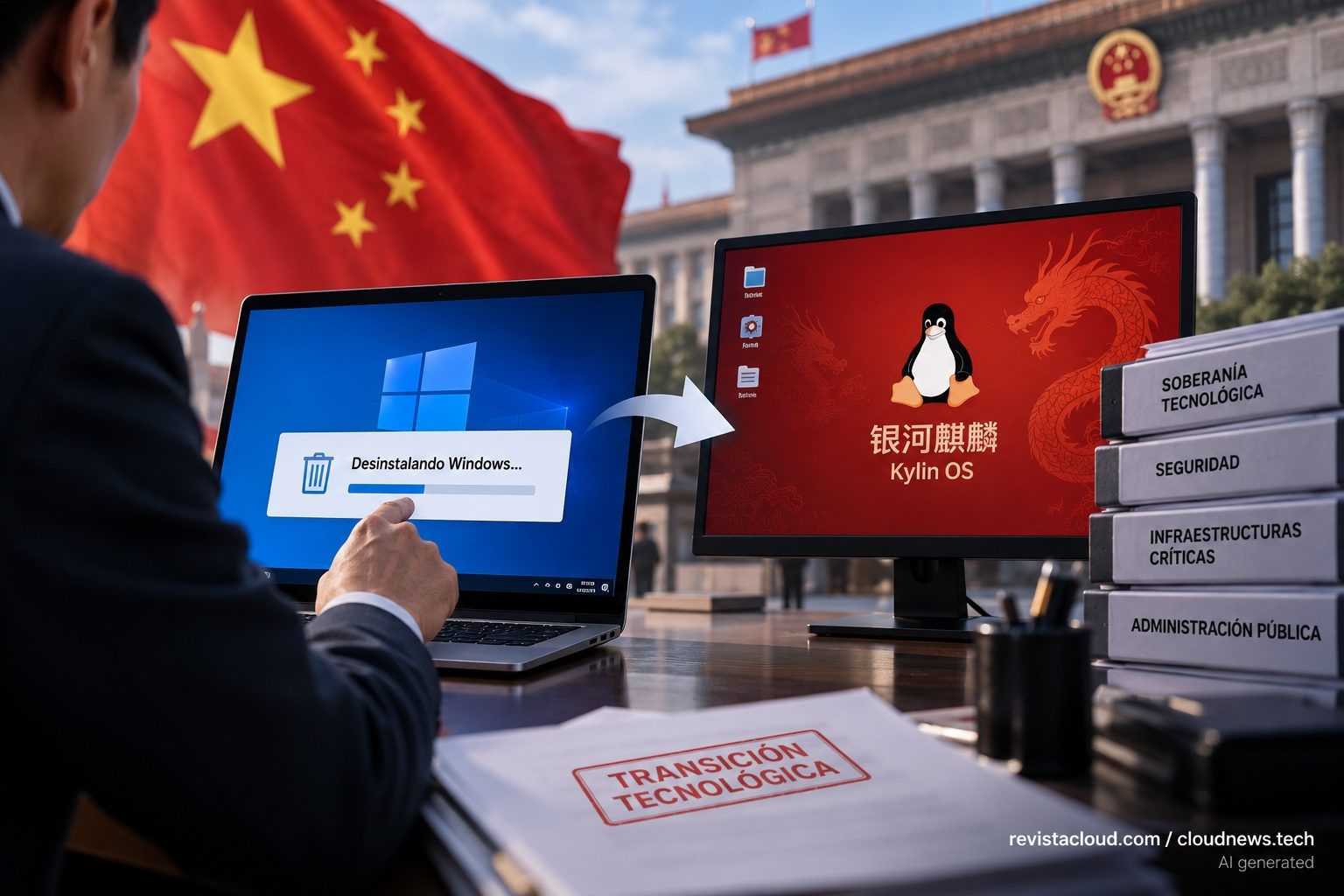
China has accelerated the removal of Windows 10 China Government Edition from part of its state-linked bodies. The instruction, attributed to the Ministry of State Security and reported in mid-August 2026, moves up the retirement of an edition built specifically for the Chinese administration that had originally been scheduled for February 2027. The move fits into Beijing’s broader policy of cutting its reliance on foreign technology, though some of the interpretations that have accompanied the story go further than what has actually been confirmed publicly.
China’s Windows exit in 20 seconds
- The Ministry of State Security has reportedly asked certain state-linked bodies to uninstall Windows 10 China Government Edition.
- Its retirement had originally been set for February 2027.
- The stated concern is related to data security.
- No specific vulnerability explaining the decision has been disclosed.
- China has spent years favoring operating systems and computers from domestic vendors.
The first clarification matters: there’s no public evidence of an order to remove Windows from every computer in the Chinese administration before December 31, 2026. The information originally published by Bloomberg, based on sources familiar with the decision, refers to certain state-linked organizations and to an early retirement of the government version of Windows 10.
Nor has it been shown that China discovered a backdoor in Windows, or that Microsoft could remotely shut down the country’s computers in the event of a conflict. Those are geopolitical risk scenarios that may explain China’s interest in controlling its own technology infrastructure, but they shouldn’t be confused with the known official justification for this decision.
China once had its own version of Windows, developed with Microsoft
The decision is especially notable because Beijing wasn’t simply running the same version of Windows installed on millions of personal computers.
Microsoft and the state-owned China Electronics Technology Group Corporation (CETC) set up C&M Information Technologies (CMIT) to develop a specific version aimed at the government and public bodies.
Microsoft officially unveiled Windows 10 China Government Edition in May 2017.
The system was based on Windows 10 Enterprise, but included significant changes to meet Chinese requirements.
Among other things, it allowed removing features the administration considered unnecessary, such as OneDrive, controlling telemetry and updates, and using homegrown cryptographic algorithms inside government systems.
China Customs, the city of Shanghai, and state-owned Westone Information Technology were among the first bodies to trial that edition.
The setup represented an unusual compromise: China could keep compatibility with the massive Windows ecosystem while gaining more control over aspects it considered sensitive.
Nearly a decade later, that balance seems to have stopped being enough for some state bodies.
The government edition was due to be retired in February 2027, but the instruction reported in August moves that timeline up.
| Detail | Status |
|---|---|
| System affected | Windows 10 China Government Edition |
| Developer | CMIT |
| CMIT partners | CETC and Microsoft |
| Launch | 2017 |
| Planned retirement | February 2027 |
| New instruction | Move up its removal at certain bodies |
| Stated reason | Data security concerns |
| Specific vulnerability disclosed | None |
Microsoft, according to reporting on the decision, wasn’t aware of any specific security issues that would justify the retirement.
From Windows to Kylin, UOS, and other domestic alternatives
The decision doesn’t come out of nowhere, either.
China has spent more than a decade trying to gradually reduce the presence of foreign technology inside public bodies and sectors considered strategic.
Back in 2014, it already excluded Windows 8 from certain government purchases. It later stepped up programs aimed at replacing foreign computers, processors, operating systems, databases, and applications.
Public procurement in 2026 shows that same direction.
A centralized purchase of laptops published in August for state bodies listed domestic systems such as Kylin, UnionTech UOS, and NeoKylin/Fangde as options, alongside other systems meeting official security and reliability requirements. Windows wasn’t explicitly listed among the alternatives.
Kylin is one of the best-known projects in this effort. China has spent years developing different generations of homegrown technology like this and deploying it across public bodies and other environments.
UnionTech OS (UOS) is another of the main commercial alternatives.
The challenge, though, isn’t simply installing Linux instead of Windows. Huawei’s own move away from Windows on its PCs shows how deep that shift can run.
A public body can have thousands of applications built over the years to run specifically on Microsoft technologies. Some may rely on legacy components, Active Directory integrations, Win32 applications, macros, internal tools, or drivers with no direct Linux equivalent.
Peripherals are another problem.
Specialized printers, card readers, biometric devices, scanners, and other equipment can depend on drivers built exclusively for Windows.
That’s why large-scale operating system migrations usually require far more work than simply swapping the software installed on a computer.
Applications need to be inventoried, compatibility checked, programs replaced, documents and data migrated, drivers developed, users trained, and parallel environments maintained for some time.
The geopolitical risk is real, but no “remote shutdown” has been confirmed
One of the most striking interpretations of China’s decision holds that Beijing fears the United States could weaponize Windows during a conflict.
It’s a plausible hypothesis within the broader debate over tech sovereignty, but it isn’t backed by any known public statement from the Chinese government about this specific retirement.
No evidence has been published that Microsoft has a mechanism to remotely disable Chinese government systems, or that such a scenario triggered the August decision.
The broader concern about depending technologically on another country is real, though.
A modern operating system receives continuous updates, relies on certificates, depends on international software supply chains, and needs maintenance for years. Whoever controls a large part of that technology retains considerable influence over how it evolves.
The same issue shows up in semiconductors, cloud services, electronic design tools, databases, and telecom equipment.
China is trying to reduce those points of dependence while the United States restricts Chinese access to certain GPUs, chipmaking equipment, and other advanced technologies.
A computer’s operating system is another piece of that policy.
The strategy also differs from what’s happening in the private market.
The information available doesn’t describe a general ban on Windows for Chinese citizens and businesses. Microsoft continues operating commercially in China, and Windows retains a dominant presence among the country’s personal computers.
The main target of these substitution policies is public bodies, state-owned enterprises, and activities considered sensitive.
That distinction matters, because replacing Windows across hundreds of millions of personal computers would be an operation of a completely different scale.
Digital sovereignty comes with a technological cost
China also has an advantage few countries could replicate: the size of its market can economically sustain homegrown alternatives.
An operating system on its own has little value without applications, developers, support, drivers, and compatible hardware.
The more public bodies that adopt Kylin, UOS, and other platforms, the greater the incentive for manufacturers to adapt their products.
It’s a process that can feed on itself.
But it also creates costs.
Maintaining domestic alternatives to globally used technologies requires ongoing investment in development, security, and compatibility. And replacing systems that have run for decades can introduce new problems while old dependencies are being eliminated.
China appears willing to absorb part of that cost in exchange for greater control over its computing infrastructure.
The early retirement of Windows 10 China Government Edition is especially symbolic for that reason. The system was born precisely as a middle-ground solution: Microsoft technology jointly modified with a Chinese state company to meet Beijing’s requirements.
If even that model isn’t enough for certain bodies, the direction of China’s tech policy is fairly clear.
But it’s worth separating that well-documented trend from claims that haven’t yet been proven. China is accelerating the replacement of Windows at certain state entities; a total removal of Windows from the entire administration before the end of 2026, and the existence of a supposed U.S. mechanism capable of triggering a remote shutdown, have not been confirmed.
The story is significant on its own, without needing those added certainties.
Frequently asked questions
Has China banned Windows across the whole country?
No. The known instruction affects certain state-linked organizations, specifically Windows 10 China Government Edition. There’s no known general ban for private citizens and businesses.
What is Windows 10 China Government Edition?
It’s a version of Windows 10 Enterprise developed by CMIT, a joint venture between CETC and Microsoft, specifically for Chinese public bodies. Among other changes, it allowed removing OneDrive, controlling updates and telemetry, and using Chinese cryptographic algorithms.
What operating systems could replace Windows in China?
Domestic alternatives include Kylin and UnionTech UOS, along with other systems that meet Chinese government requirements.
Does China fear the U.S. could remotely shut down Windows?
That scenario appears in analyses of tech sovereignty, but it hasn’t been publicly presented as a proven fact or as a specific official explanation for the August decision. The available reporting points to concerns tied to data security.