
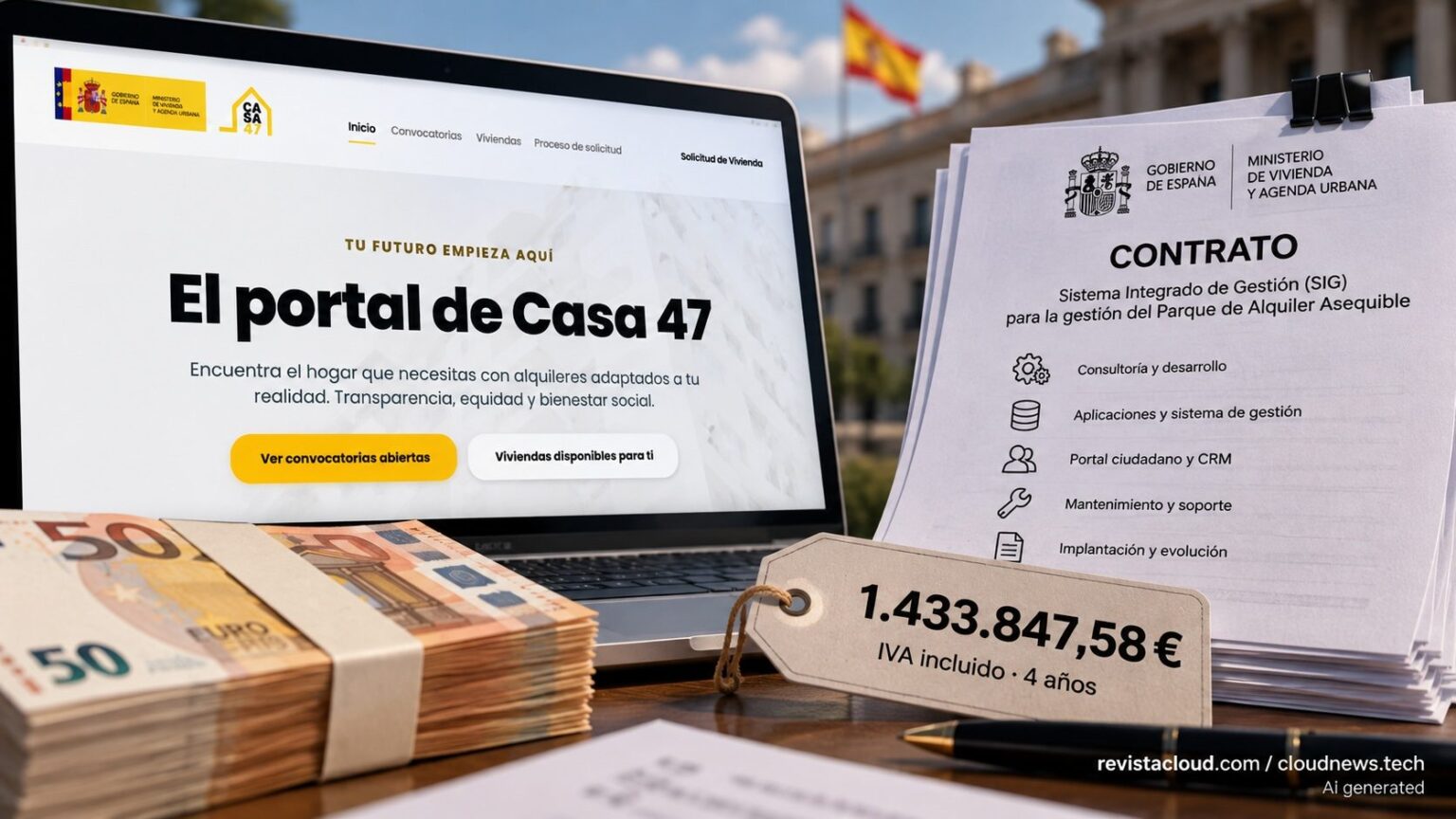
Spain’s new state housing portal Casa 47 has drawn criticism on social media over both its look and the cost of its development. The figure circulating online is real: SEPES awarded EY Transforma Servicios de Consultoría a contract worth €1,433,847.58, VAT included. However, attributing that entire amount solely to the website citizens see would be inaccurate: the official documentation shows the contract covers, over four years, a much broader Integrated Management System (IMS), including consulting, development, applications, maintenance, deployment support, and a public portal.
The Casa 47 technology contract in 20 seconds
- SEPES awarded the project to EY for €1,184,998 excluding VAT, €1,433,847.58 with taxes.
- The contract runs for four years.
- It doesn’t just cover portal.casa47.es, but an Integrated Management System for the rental housing stock.
- It includes development, rollout, maintenance, a CRM, and the citizen-facing portal.
- The tender received eight bids.
That distinction matters because it lets you criticize public spending using the actual documents, without turning a real figure into a misleading comparison. The visible website is part of the project, but that shouldn’t be used to dodge a reasonable question either: what system was actually procured for €1.43 million, and how will anyone be able to judge whether the result justifies that cost.
The case file answers most of the first question. The second will take more time.
From a €2.27 million ceiling to a €1.43 million award
The case file is numbered 132019 and is published both by Casa 47 itself, formerly SEPES, and on Spain’s public procurement platform.
Its official title already makes clear the scope goes well beyond a simple website: “Consulting services for process design, configuration, development, and maintenance of an Integrated Management System (IMS) for managing the Affordable Rental Housing Stock.”
The tender started with a maximum budget of €1,880,949 excluding VAT, plus €394,999.29 in taxes. The maximum available therefore came to €2,275,948.29.
Eight bids were submitted, two of them from small and medium-sized companies.
The contract was awarded on November 26, 2025 to EY Transforma Servicios de Consultoría for €1,184,998 excluding VAT, roughly 37% below the tender budget.
With €248,849.58 in VAT, the final contract price comes to exactly:
€1,433,847.58, taxes included.
The contract was formalized on December 26, 2025.
| Item | Amount |
|---|---|
| Maximum budget excluding VAT | €1,880,949.00 |
| VAT on maximum budget | €394,999.29 |
| Maximum budget with VAT | €2,275,948.29 |
| Award excluding VAT | €1,184,998.00 |
| VAT on the award | €248,849.58 |
| Contract awarded with VAT | €1,433,847.58 |
| Duration | 4 years |
| Bids received | 8 |
SEPES itself published a press release on November 27, 2025 summarizing the award as a €1.4 million contract, taxes included.
So that figure isn’t an estimate from social media or the sum of separate contracts. It’s information published by the contracting body itself.
The €1.4 million doesn’t just cover the Casa 47 portal
This is where the nuance that substantially changes the analysis comes in.
Anyone visiting the new portal can judge its design, performance, user experience, or the number of available homes listed. But the €1.43 million contract cannot be equated directly with the cost of building that web interface.
The contract documentation describes a four-year project.
It includes process consulting, configuration, development, and rollout of the Integrated Management System, application maintenance, deployment support, and evolutionary maintenance.
SEPES also explained that the system would include a CRM (Customer Relationship Management) tool designed to coordinate processes and automate interactions with the various parties involved in managing the homes.
The Citizen Portal is part of that broader package.
It’s the layer that lets citizens browse listings and calls for applications, check eligibility requirements, and submit housing applications. There’s also a restricted section related to managing successful applicants afterward.
Underneath that must sit the system responsible for handling processes and data tied to the state’s housing stock.
That means a comparison along the lines of “this website cost €1.4 million and could be built in a weekend” oversimplifies what was actually procured.
A developer could likely reproduce much of the visible interface fairly quickly using modern frameworks and coding assistants like Codex or Claude Code. That wouldn’t mean they had reproduced the awarded system.
A public platform of this kind needs to manage case files, users, permissions, documentation, integrations, administrative processes, security, data protection, traceability, availability, maintenance, and evolution over several years.
The cost of an enterprise application isn’t measured solely by the number of pages a user sees, either.
AI does change one important question about these contracts
Having clarified that, there is a genuinely relevant technology debate here.
Today’s AI tools are considerably cutting down the time needed to develop certain parts of software. Generating interfaces, writing tests, documenting code, building APIs, or developing conventional features now requires less manual work than it did just a few years ago, when coding assistants are used well — tools like Claude Fable 5.1 have already shown coding costs dropping by as much as 45% in some workflows.
That doesn’t automatically make a €1.43 million contract expensive.
But it does call for a review of how government agencies calculate software development costs and, above all, how they measure the results delivered.
The Casa 47 tender used several award criteria. Price accounted for 40% of the score and the methodological proposal 37%. Certifications and additional staffing resources were also assessed.
This model still leans heavily on teams, profiles, experience, and methodology. The question AI is starting to raise is whether tenders should give even more weight to measurable outcomes: features delivered, availability, response times, accessibility, incidents, security, user satisfaction, or how fast changes can be rolled out.
Because building public-sector software isn’t just about contracting programmer hours.
Nor should it be judged solely on how polished or simple its front page looks.
The Casa 47 portal officially launched in September 2026 as a centralized search tool for public and affordable housing. It lets users browse listings from different regions and submit applications. The system is starting up as Casa 47 gradually expands the housing stock it will manage, including tens of thousands of homes coming from Sareb and other state assets.
That could considerably increase the system’s complexity over the coming years.
Which is exactly why the contract deserves to be evaluated using objective metrics.
If, four years from now, the IMS is managing tens of thousands of homes, automating awards, properly integrating documentation and case files, delivering a reliable service to citizens and administrators, and evolving without requiring large additional contracts, then judging the €1.43 million purely on the website’s appearance will have been the wrong comparison.
If the opposite happens, the government will have the contract, its scope, its awardee, and its price all publicly documented to demand answers.
There’s one more relevant detail: the €1.43 million is the price for four years, not an annual cost. A simple division works out to roughly €358,462 a year with VAT, though actual spending doesn’t necessarily spread evenly, since initial rollout and later maintenance represent different kinds of work.
The most useful criticism, then, isn’t claiming that “a website cost €1.4 million.” The official documents don’t support that description.
The more precise question is this: will Casa 47’s Integrated Management System deliver enough service, security, maintenance, and capacity to justify €1,433,847.58 in public money over its four-year contract?
The answer can’t be found by looking only at the homepage on launch day. But since this is public money and a system meant to manage a significant share of the state’s affordable housing stock, checking that should be part of holding it accountable.
Frequently asked questions
Did the Casa 47 website cost €1.4 million?
Not exactly. There is a contract awarded for €1,433,847.58 with VAT, but it covers a four-year Integrated Management System. The citizen-facing portal is only one part of the project.
Which company built the Casa 47 system?
The contract was awarded to EY Transforma Servicios de Consultoría, S.L. on November 26, 2025 and formalized a month later.
What does the €1.43 million contract include?
It includes process consulting, configuration, development and rollout, application maintenance, deployment support, and evolutionary maintenance of the IMS. The documentation also covers a CRM and the Citizen Portal.
What was the initial budget?
The maximum tender budget was €1,880,949 excluding VAT, or €2,275,948.29 including taxes. The winning bid came in at €1,184,998 excluding VAT.
Sources:
- Casa 47 / SEPES, procurement file 132019.
- Casa 47 / SEPES, formalized contract for the Integrated Management System for the Affordable Rental Housing Stock.
- SEPES, press release on the award to EY Transforma, November 27, 2025.
- Spain’s Official State Gazette (BOE), formalization of file 132019.
- Casa 47, Affordable Rental Housing Portal.