
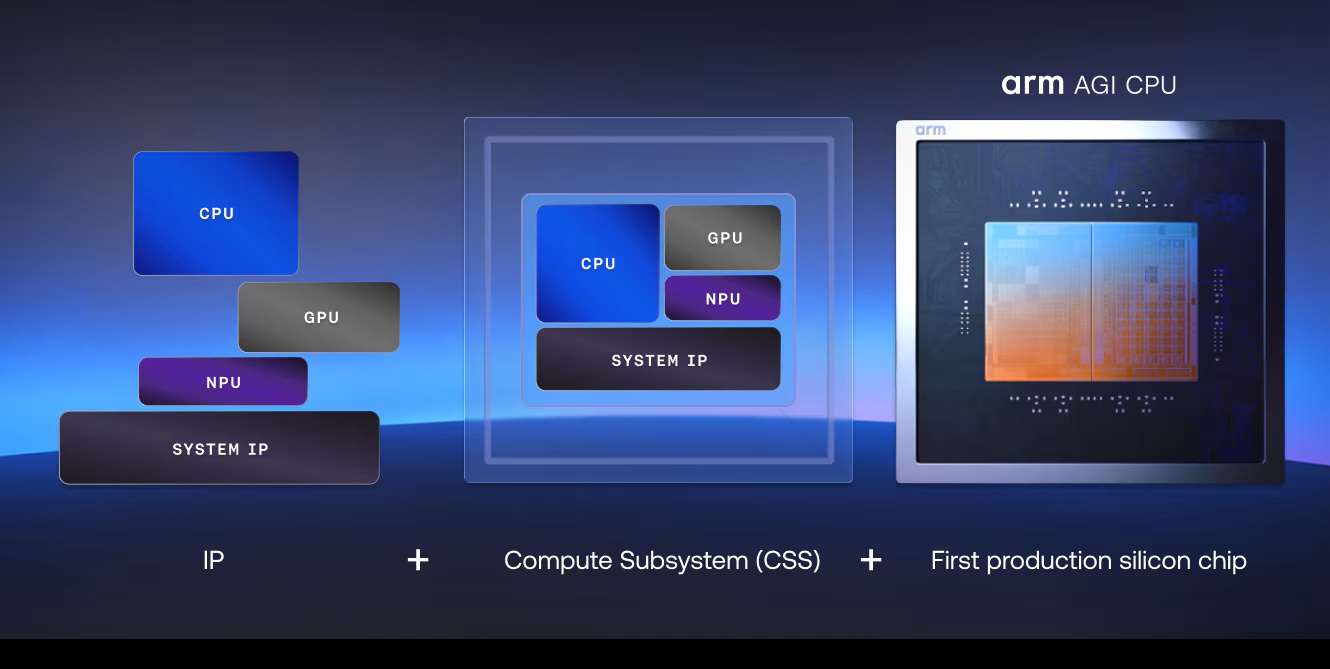
Arm has made one of the biggest pivots in its history with Arm AGI CPU, its first production processor designed directly by the company. Developed together with Meta and aimed at AI data centers, the chip pushes Arm beyond its traditional licensing business and puts it in a market where it will have to compete for the same servers that run Intel and AMD’s x86 architectures.
Arm AGI CPU in 20 seconds
- It’s the first in-house production processor in Arm’s more than 35-year history.
- It packs up to 136 Neoverse V3 cores and is built on a 3nm process.
- Meta took part as the lead partner and will be one of its first major users.
- Arm is targeting it specifically at inference and AI agents.
- It can reach more than 45,000 cores per rack in liquid-cooled configurations.
The business shift is almost as significant as the technical specs. Arm built much of its industry position by selling intellectual property and designs that other manufacturers could adapt into their own processors. Qualcomm, Apple, AWS, NVIDIA, and numerous other chipmakers use Arm technologies in very different ways.
Now Arm also wants to sell silicon.
The company will keep licensing its architectures and offering its Compute Subsystems (CSS), but it’s adding a third option: buying a processor designed by Arm itself and ready to install in servers.
That move aims to extend the architecture’s reach to companies that can’t afford to develop their own processor. Designing an advanced data center chip requires specialized teams, several years of work, and investment that can run into hundreds of millions of dollars.
Arm wants to offer some of the advantages hyperscalers have gained from their custom processors without forcing every operator to also become a chip designer.
Up to 136 Cores, and More Than 45,000 per Rack
Arm AGI CPU is based on Neoverse V3 and Armv9.2 and is built on TSMC’s 3-nanometer N3P process. The top configuration has 136 cores, while Arm also offers 128-core and 64-core variants.
Maximum clock speed depends on the configuration. The 136-core and 128-core models reach up to 3.5 GHz, while the 64-core variant can hit 3.7 GHz. The processor has a base TDP of 300 watts.
This distinction matters, since some early descriptions of the product summarized its specs as “136 cores at 3.7 GHz,” when Arm’s current documentation assigns that 3.7 GHz figure to the 64-core model.
Each processor includes 12 DDR5 memory channels running at up to 8,800 MT/s, 128 MB of system cache, and 96 PCIe 6.0 lanes. It also supports CXL 3.0 to expand memory and device connectivity options.
Arm is putting particular emphasis on rack-scale density.
Its reference server uses a 1OU design with two nodes and two processors per blade, adding up to 272 cores. A conventional air-cooled 36 kW rack can hold 30 blades and reach 8,160 cores.
With liquid cooling, density increases considerably.
A configuration developed with Supermicro can pack 336 Arm AGI CPU processors into a 200 kW rack, equivalent to 45,696 cores.
Arm claims certain configurations can deliver more than double the performance per rack compared to recent x86 systems. That figure comes from the company’s own evaluations and depends on the configurations and workloads used, so it shouldn’t be read as a universal advantage over any given Intel or AMD processor.
The choice of the rack as the unit of comparison isn’t accidental either.
Large AI data centers are increasingly constrained by the power and cooling available to them. In these facilities, a CPU’s performance matters, but so does how much work can be packed into a given power budget and footprint.
Meta Is Driving a Processor Arm Will Sell to the Rest of the Market
Meta played a direct role in AGI CPU’s creation.
The two companies announced in March that they would work together on multiple generations of data center processors — a project for which Arm had already reported strong early demand months earlier. Meta will use AGI CPU within its infrastructure and combine it with other components in its portfolio, including its MTIA accelerators.
But the processor won’t be exclusive to Meta.
From the announcement onward, the company explained that the board and rack designs would be contributed to the Open Compute Project (OCP) and that Arm would sell the processor to the rest of the industry. OCP already lists an AGI CPU reference server aimed at high-density installations.
This strategy could fill a space that, until now, was mostly reserved for the largest cloud providers.
AWS develops Graviton, Google has its own Arm CPUs, and other hyperscalers have invested in custom designs. The problem is that developing a processor in this class requires an economic scale beyond the reach of most operators.
Arm is trying to package that know-how into a commercially available product.
That could be especially appealing to providers specializing in AI infrastructure who need to increase CPU density without developing their own silicon.
There’s also a connection to NVIDIA.
AI data centers don’t run on GPUs alone. CPUs handle numerous tasks related to data preparation, storage, communications, running services, and coordinating accelerators.
Arm says AGI CPU can coexist with different accelerators within standardized infrastructure. The company has spent years working through its SystemReady program to reduce differences between various Arm platforms and make it easier for operating systems and software to run on hardware from multiple vendors.
That compatibility will matter if AGI CPU wants to find a place in facilities using NVIDIA, AMD, or other accelerator architectures.
AI Agents Put the CPU Back in the Spotlight
The AGI name may grab attention, but Arm’s technical thesis centers mainly on agentic AI, not on any claim that the processor enables artificial general intelligence.
Agents introduce workloads that are different from massive model training.
A GPU can handle the computations needed to run the LLM, while around it there are processes that query databases, run searches, use tools, call APIs, coordinate services, and prepare information for new inference passes.
A good part of that work still depends on the CPU.
Arm argues that the expansion of agents could multiply current CPU capacity needs per gigawatt of infrastructure by more than four times. That’s the company’s own estimate, and it will depend on how agentic applications evolve and on how much of their operations end up running on CPUs, GPUs, or other accelerators.
Meta is already showing signs of that trend.
Besides working with Arm, the company announced a deal this year with AWS to add tens of millions of Graviton cores to its infrastructure — not the only outside CPU Meta is lining up for its data centers, since it has also signed on Qualcomm’s Dragonfly data center chip — precisely in response to growing CPU needs tied to agentic AI.
The market, then, might not simply turn into a CPU-versus-GPU battle.
The architecture of large AI systems is evolving toward combinations of CPUs, GPUs, specialized accelerators, high-speed memory, and networking capable of moving enormous amounts of data between all of them.
For Arm, that’s an opportunity, but also a business risk.
The company is going from providing technology to firms that manufacture processors to manufacturing a processor that can compete with products developed by some of its own customers.
Arm says it will keep offering all three options: intellectual property, CSS, and complete processors. From that angle, AGI CPU expands Arm’s market rather than replacing its traditional business.
It remains to be seen how its licensees will respond as the product picks up customers.
There’s also a much more physical limitation: manufacturing.
AGI CPU uses TSMC’s N3P process, which happens to be one of the most in-demand production capacities in the semiconductor industry. Arm will have to compete for wafers with other major chip designers using the Taiwanese foundry’s advanced technologies.
That’s a new situation for a company used to selling designs without having to directly manage large production volumes.
Arm will no longer just need to make sure its architectures are good. It will have to manufacture enough processors, coordinate servers and firmware, maintain a supply chain, and convince data center operators that it’s worth installing its CPU.
That’s probably the most important change behind AGI CPU.
After more than three decades supplying the architecture other companies built chips on, Arm has decided to build one itself and take it straight to the data center.
Frequently Asked Questions
What is Arm AGI CPU?
It’s the first production processor designed directly by Arm. It’s aimed at data centers, cloud infrastructure, inference, and workloads related to AI agents.
How many cores does Arm AGI CPU have?
Arm offers configurations with 136, 128, and 64 Neoverse V3 cores. The highest-density variant packs 136 cores and runs at a base TDP of 300 watts.
Is Arm AGI CPU exclusive to Meta?
No. Meta took part as the lead partner in its development and will use it in its data centers, but Arm sells AGI CPU to other customers as well, and part of the infrastructure designs are being contributed to the Open Compute Project.
Will Arm stop licensing its designs to other manufacturers?
Arm hasn’t announced that change. Its strategy involves keeping its IP licenses and Compute Subsystems in place while adding complete processors as another way to consume its technology.