
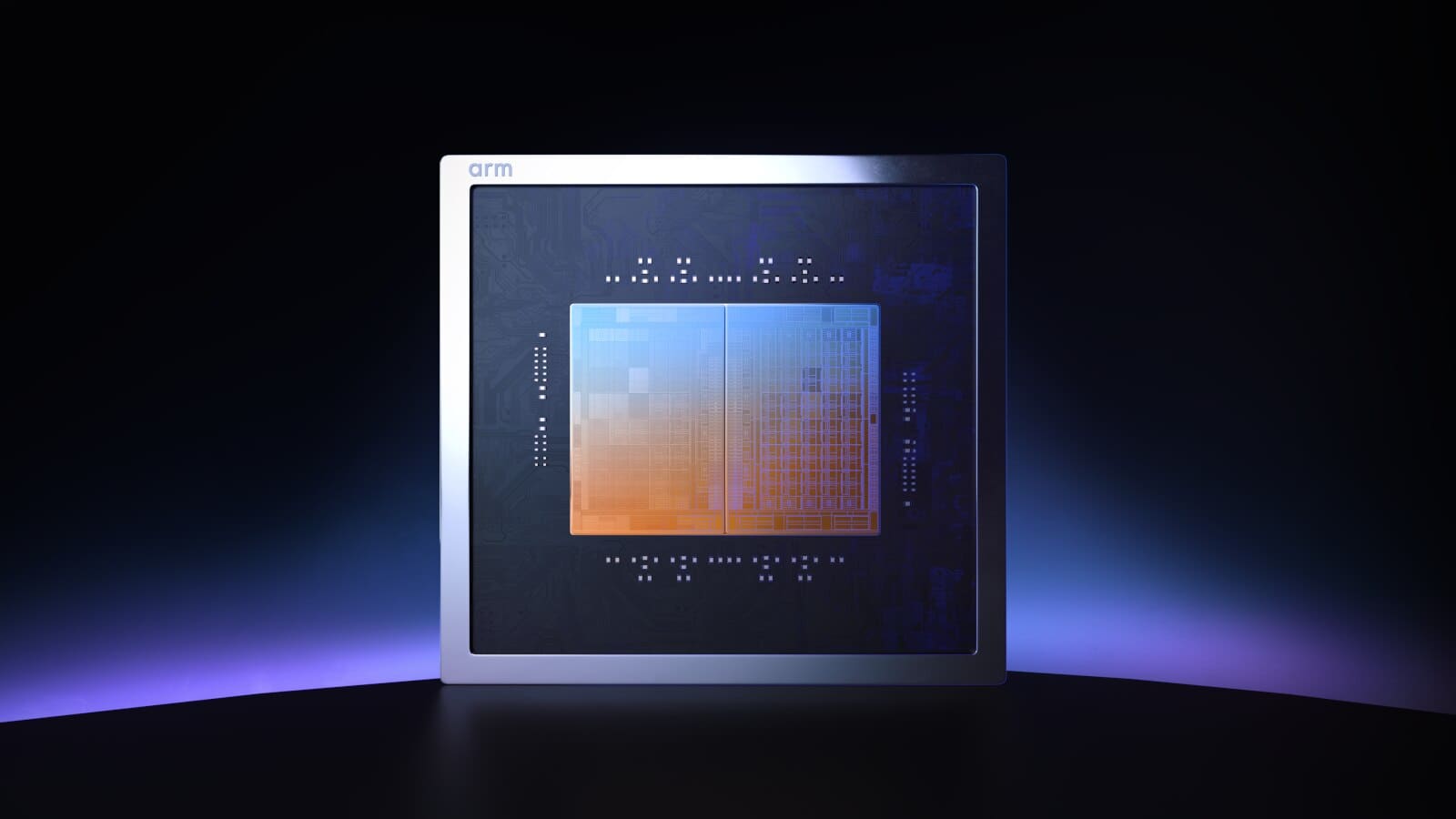
Arm has significantly raised expectations for its first proprietary data center processor. The company claims to have visibility into over $2 billion in demand for its ARM AGI CPU for the fiscal years 2027 and 2028, more than doubling the figure announced in its March presentation. This news comes just weeks after Arm announced a historic shift in its business model: in addition to licensing technology and selling computing subsystems, it now also offers fabricated silicon designed by the company itself.
This figure should not be confused with revenue already recognized. Arm talks about customer demand and commercial visibility, not actual sales. This distinction is important because CEO Rene Haas has acknowledged that the company has secured the capacity to meet the initial $1 billion tranche, but has not yet closed enough supply to cover the second demand block. The stock market reaction reflected this tension: strong results and revenue forecasts were partially overshadowed by concerns over the production capacity of the new chip.
A Historic Shift: Arm Moves from Licensing IP to Selling Silicon
For decades, Arm has been one of the most influential companies in the industry without manufacturing or selling complete processors under its own brand. Its business has been based on licensing architecture and IP to manufacturers like Apple, Qualcomm, NVIDIA, Amazon, Microsoft, or MediaTek, which then design their own chips and pay royalties. With the AGI CPU, Arm enters a different territory: offering a finished data center processor, while not abandoning its traditional licensing model.
The company presents this as a natural extension of its platform. Customers can continue to utilize Arm technology via IP, Compute Subsystems, or now through ready-to-integrate silicon for servers. It’s a way to accelerate adoption in a market where deployment times have become critical. AI data centers need capacity upfront, not three design cycles later.
The AGI CPU is designed for agentic AI workloads, not to replace GPUs or specialized accelerators. Its role is to coordinate, feed, and manage distributed systems where thousands of tasks run continuously. In practice, these CPUs will function as orchestration engines alongside AI accelerators, managing control planes, APIs, services, agent execution, parallel tasks, and inter-component communication.
The architecture is based on Arm Neoverse V3. According to Arm documentation, the chip can include up to 136 cores, 2 MB of L2 cache per core, support for DDR5-8800, up to 6 GB/s memory bandwidth per core, memory latency below 100 ns, 96 PCIe Gen6 lanes, and CXL 3.0 for expansion and memory pooling. The company mentions a TDP of 300 W and designs optimized for high-density rack deployment, with reference configurations of 1U and air or liquid cooling options.
OpenAI, Cerebras, and Others Drive Demand
Arm states that Cerebras, OpenAI, Positron, and Rebellions are integrating the AGI CPU alongside accelerator-based systems. It also mentions Verda, a European AI cloud provider, as a customer planning to deploy this processor for agentic AI orchestration. Additionally, the company says that commercial systems are already available for order through manufacturers like ASRock, Lenovo, Quanta, and Supermicro.
The involvement of these firms explains part of the excitement. OpenAI and Cerebras represent two prominent segments of the AI market: one as a developer of models and reference services, the other as a provider of specialized compute systems. Positron and Rebellions point to a new generation of alternative accelerators, while Verda offers a European perspective linked to AI cloud services and digital sovereignty.
Arm also highlights that more than 50 companies support the expansion of its platform into silicon, including AWS, Broadcom, Google Cloud, Marvell, Microsoft, Micron, NVIDIA, Oracle, Samsung, SK Hynix, and TSMC. The message is clear: Arm aims to position itself as a cross-industry standard for AI infrastructure, not as a competitor isolated from Intel or AMD.
The context favors this strategy. Amazon has been developing Arm-based Graviton CPUs for AWS for years. Google has advanced with Axion. Microsoft introduced Cobalt. NVIDIA uses Arm CPUs in some of its Grace and Grace Hopper systems. This adoption has helped Arm claim that its CPU market share among top hyperscalers is now around 50%. This is a significant statement, though it depends on how compute is measured and which workloads are included in that category.
Agentic AI Transforms the Role of the CPU
Arm’s narrative relies on an emerging idea: agentic AI doesn’t just require GPUs. An agent system not only responds to queries but can plan tasks, call tools, query databases, coordinate processes, execute code, communicate with other services, and maintain workflows over long periods. Such operations require accelerators, but also many efficient, predictable, and well-connected CPUs.
In large AI clusters, the CPU doesn’t disappear. It becomes a coordination component. If the CPU is slow, consumes too much power, or doesn’t scale well, it can reduce accelerator utilization—platforms that cost tens of thousands of dollars per unit. That’s why Arm emphasizes performance per rack and energy efficiency. The company claims that its AGI CPU can deliver more than double the performance per rack compared to x86 platforms and reduce CAPEX by up to $10 billion per gigawatt of data center capacity—a projection from the manufacturer that should be interpreted with caution and as an estimate, not an universal outcome.
This also has a competitive aspect. Intel and AMD continue to dominate much of the server CPU market, but hyperscalers have shown they can introduce alternative architectures if they offer better total cost, efficiency, and control over their stacks. Arm seeks to leverage this window before data centers of AI revert to a single dominant architecture.
Not all challenges are solved. Moving into silicon requires managing supply chain, manufacturing, inventory, technical support, certifications, OEM platforms, and customer relationships differently from licensing IP. Arm has long avoided the industrial risks of selling complete chips directly. Now, it’s assuming some of those risks—particularly at a time when demand might outstrip available capacity.
It will also be crucial to see how its traditional clients react. Arm must sell AGI CPUs without eroding the trust of those licensing its IP for custom processors. The company is addressing this tension by offering multiple adoption models: IP for design, subsystems for faster development, and complete chips for deployment convenience.
The financial results support the company’s strategy. Arm closed Q4 2026 with $1.49 billion in revenue, up 20% year-over-year, highlighting growth in the data center segment. Yet, the success of this new phase depends on manufacturing capacity, OEM backing, hyperscaler confidence, and real performance tests in AI deployments.
The AGI CPU by itself doesn’t make Arm an immediate rival to NVIDIA; its domain is different. However, it positions the company more strategically within AI infrastructure: as the CPU that orchestrates, connects, and sustains the systems where accelerators perform the intensive work. If agentic AI becomes a dominant cloud workload, this orchestration layer could be worth considerably more than it seemed just a few years ago.
Frequently Asked Questions
What is the Arm AGI CPU?
It is Arm’s first in-house manufactured processor, designed for AI data centers and agentic AI workloads. It’s based on Arm Neoverse V3 and can incorporate up to 136 cores.
Has Arm doubled its estimated demand or revenue?
Arm has announced over $2 billion in customer demand for FY2027 and FY2028. These figures represent commercial visibility and commitments, not yet recognized revenue.
Which companies are using or integrating the AGI CPU?
Arm cites Cerebras, OpenAI, Positron, Rebellions, and Verda among clients or partners planning to deploy the AGI CPU with accelerators and AI platforms. Several commercial systems are also available from ASRock, Lenovo, Quanta, and Supermicro.
Does the AGI CPU compete directly with NVIDIA’s GPUs?
Not directly. It is meant to coordinate workloads, manage agents, feed accelerators, and operate AI services at scale. GPUs and accelerators remain essential for heavy-duty computation.
