
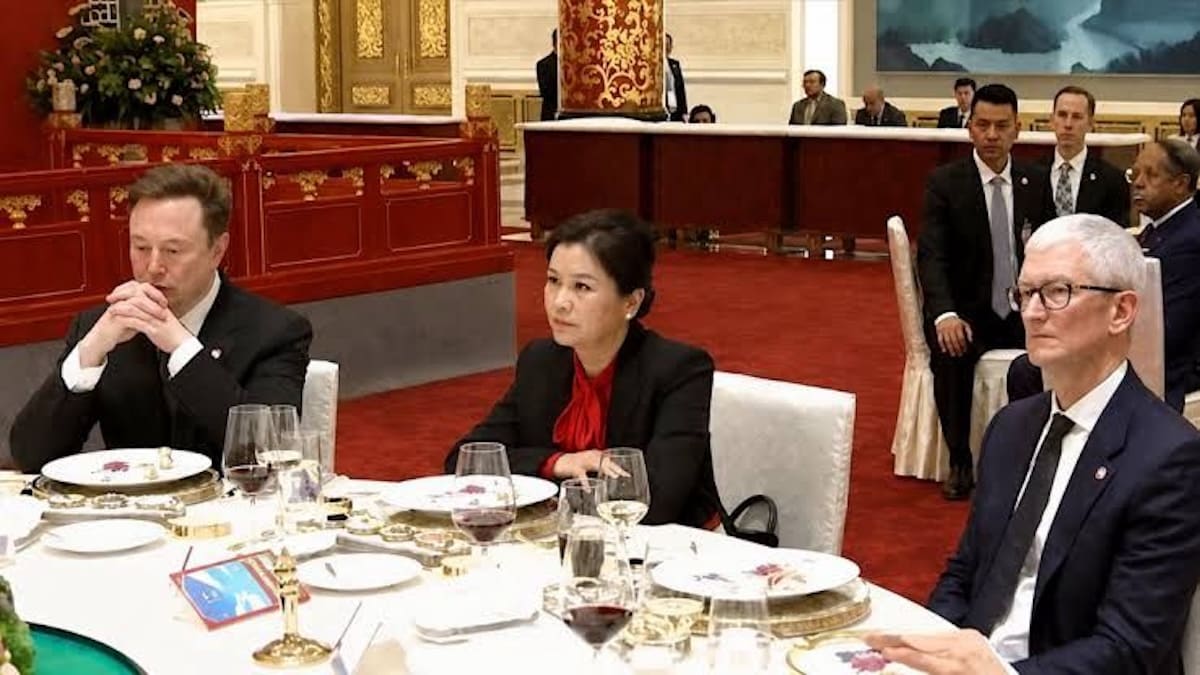
The scene lasted only a few seconds, but it revealed a lot about how global technological power is being reshuffled. During the state banquet hosted by Xi Jinping for Donald Trump at the Great Hall of the People in Beijing, cameras captured a table laden with symbolism: Tim Cook, Elon Musk, Jensen Huang, and, between the first two, a Chinese businesswoman that many Western viewers did not immediately recognize.
Her name is Zhou Qunfei. She doesn’t run a social media platform, doesn’t present smartphones in large auditoriums, and doesn’t appear weekly in headlines about artificial intelligence. But her company, Lens Technology, manufactures a crucial part of the devices millions use every day: the glass, covers, and precision components that enable the tactile experience of smartphones, smartwatches, connected cars, and other electronic devices. Outlets like South China Morning Post and The Standard identified Zhou as the businesswoman sitting between Musk and Cook during that dinner—a position that’s hard to interpret as a coincidence.
The image worked because it condensed a larger story. For years, technology has often been told from the perspective of the visible founders: Steve Jobs, Elon Musk, Jensen Huang, Sam Altman, or Tim Cook. Zhou represents another layer—less media-covered but equally decisive: advanced manufacturing, supply chains, materials, and industrial precision that turn an idea into millions of units produced with minimal tolerances.
From a Hunan village to the iPhone supply chain
Zhou Qunfei was born in 1970 in Xiangxiang, in China’s Hunan province. Her public biography is marked by a tough childhood: she lost her mother as a young girl, grew up in a low-resource family, and had to leave school during her teens to work. According to profiles published by Chinese and international media, she moved to Shenzhen at a time when the city was beginning to transform into China’s major industrial laboratory.
Her first job was related to glasswork. She worked in a factory polishing crystals for watches—repetitive, physically demanding work far removed from the clean image associated today with premium devices. That experience gave her practical knowledge that would later prove decisive: understanding how to polish, treat, and control a glass piece until it became a reliable industrial component.
In 1993, with modest savings, she started a small family workshop in Shenzhen. The company initially made watch crystals, but the turning point came when the mobile industry began replacing plastic screens with glass. Motorola, TCL, Nokia, Samsung, and later Apple were all part of the journey that led Lens Technology to become one of the most significant suppliers in the sector.
The most critical moment arrived with the iPhone. Apple not only created a new product category; it also reorganized part of Asian manufacturing around high-precision components. The touch glass, seemingly simple to the end user, had to be thin, durable, uniform, sensor-compatible, and feasible for mass production. Lens Technology found its place here.
Zhou’s story is often told as a tale of perseverance, and it is. But it’s also an industrial story. Her success isn’t solely explained by personal tenacity but also by positioning her company at one of modern electronics’ most critical points: the physical interface between user and device.
Lens Technology in numbers
Lens Technology is not a minor player within China’s tech ecosystem. Its results demonstrate the scale it has reached. In 2025, the group recorded revenues of 74.4 billion yuan, a 6.46% increase from the previous year, and an attributable net profit of 4.02 billion yuan, up 10.87%. The company is also listed in Shenzhen and completed its Hong Kong market debut in 2025.
| Key Data | Highlights |
|---|---|
| Founder | Zhou Qunfei |
| Company | Lens Technology |
| Origin | Family glass workshop in Shenzhen, founded in 1993 |
| Sector | Glass components, touch surfaces, modules, and solutions for consumer electronics, automotive, and smart devices |
| Major public-profile clients | Apple, Samsung, Huawei, and other tech manufacturers |
| 2025 Revenue | 74.4 billion yuan |
| 2025 Net Profit | 4.02 billion yuan |
| Revenue Growth 2025 | 6.46% year-over-year |
| Net Profit Growth 2025 | 10.87% year-over-year |
| Shenzhen IPO | ChiNext, March 2015 |
| Hong Kong Listing | 2025, under stock code 6613 |
| Main Segment | Smartphones and PCs still account for most of the business |
Dependence on the consumer business remains high. Based on analysis of the 2025 financial report, Apple probably represented around 45% of Lens’s revenue, with 33.5 billion yuan, while areas linked to smartphones and computers likely accounted for over 80% of its sales.
This explains why Zhou was seated with Cook and Musk. With Apple, the relationship is clear: Lens has been part of the iPhone’s supply chain and other Apple devices. With Tesla, the connection involves Lens’s expansion into automotive, screens, smart cockpits, and components for connected vehicles. Modern technology isn’t built with software alone; it requires glass, sensors, casings, chemical processes, precision machinery, and global logistics.
The factory is also a source of technological power
Zhou Qunfei’s presence at a state dinner alongside influential U.S. entrepreneurs has geopolitical significance. China wants to remind the world that its role in global technology isn’t limited to cheap assembly. Companies like Lens Technology exemplify an evolution toward advanced manufacturing, vertical integration, high-precision materials, and the capacity to serve global giants at volumes that are hard to replicate.
This point is especially relevant amid ongoing debates around AI, chips, electric vehicles, and industrial sovereignty. Western economies increasingly talk about reshoring, secure supply chains, and reducing dependence. But the reality remains that many consumer technologies still depend heavily on highly specialized Asian suppliers. Reshaping this structure isn’t quick or cheap.
Zhou embodies that silent layer of technology. She doesn’t design the iPhone’s operating system or Tesla’s software, but her company helps enable the manufacturing of these products with the quality, finish, and scale demanded by the market. In tech industry visibility isn’t always proportional to true importance.
There’s also a lesson about the kind of leadership she represents. While many founders evoke vision from the stage, Zhou has built her reputation working on the production floor. Profiles of her career emphasize her obsession with detail, her hands-on knowledge of manufacturing processes, and her tendency to personally involve herself in technical issues. That culture suits an industry where a micron, a speck of dust, or a miscalculated tolerance can ruin millions of units.
The viral image from Beijing’s banquet wasn’t just enigmatic—though it seemed so. If Tim Cook embodies the company that turned the smartphone into the most profitable product in recent history, and Elon Musk symbolizes the new era of electric vehicles and automation, Zhou Qunfei signifies an under-told but essential infrastructure: the physical backbone supporting both worlds.
The technology we use daily has a surface. We touch it, look at it, clean it, and rarely consider who makes it. Zhou Qunfei has built her fortune around that surface. Her story reminds us that technological power isn’t always found where the product’s brand appears but often in the millions of perfect parts manufactured seamlessly behind the scenes.
Frequently Asked Questions
Who is Zhou Qunfei?
Zhou Qunfei is the founder and chairwoman of Lens Technology, a Chinese company specializing in glass components and touch surfaces for electronic devices, automotive, and other smart products.
Why did she attract attention at the Beijing banquet?
Because she was identified sitting between Tim Cook and Elon Musk during the state dinner held during Donald Trump’s visit to China—a position carrying strong symbolic weight given her role in the tech supply chain.
What does Lens Technology manufacture?
The company produces glass covers, touch surfaces, and other precision components for smartphones, smartwatches, computers, connected vehicles, and electronic devices.
Why is her story important for understanding current technology?
Because it shows that innovation isn’t just about software or media-focused founders. It also depends on factories, materials, suppliers, industrial processes, and supply chains capable of large-scale production.
