
While the global debate about semiconductors continues to focus on lithography, manufacturing capacity, and supply chains, the Chinese manufacturer Zhaoxin (兆芯) has released its own “year-end” message with a very clear statement: the battle is no longer just about raw performance, but about the combination of product, security, and ecosystem.
In its review of 2025, the company summarizes a roadmap focused on three pillars: expanding its catalog for servers and desktops, strengthening its own technological base centered on ZX86, and accelerating adoption through agreements with software and industry partners.
A year marked by the leap into servers: KH-50000 as a flagship
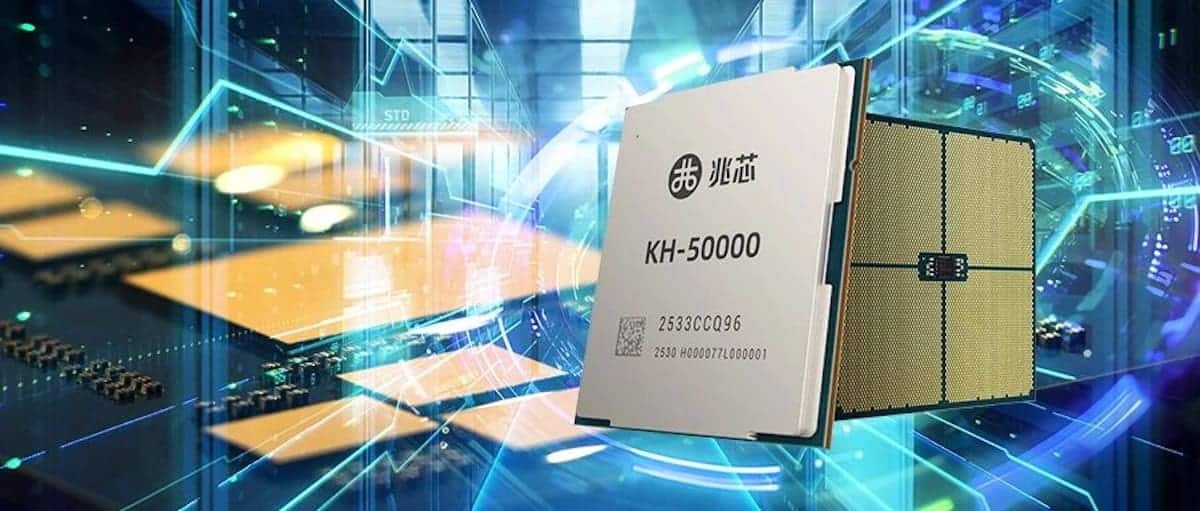
One of the milestones Zhaoxin emphasizes is the launch of its new server processor “Kaisheng KH-50000”, aimed at scenarios such as data centers, cloud computing, large-scale storage, and AI-related workloads. The company plans to introduce it in the third quarter of 2025, framing it as a step toward consolidating its “cloud–edge–end” strategy (cloud–edge–device).
Beyond the announcement, the underlying message is important: Zhaoxin is shifting focus from “institutional” PCs (administration and verticals) to the infrastructure that determines a country’s actual capacity to scale digital services.
ZX86 and the idea of “sustained compatibility” as an industrial policy
Alongside hardware, Zhaoxin continues to emphasize its core narrative: control and technological continuity. It reports building a property intellectual system (IP) for ZX86, supported by years of development, with an inventory of key CPU technologies and several product generations already in production. The company also highlights having over 1,600 patent applications, as part of its strategy for “technological autonomy”.
In terms of positioning, this responds to two recurring concerns in the corporate world (especially in public procurement):
- dependence on external suppliers, and
- compatibility cycles that require re-writes or forced migrations.
Security “from the instruction set”: integrated cryptographic acceleration
Another part of the review highlights security. Zhaoxin explains that it has incorporated in ZX86 instructions for acceleration of Chinese cryptographic algorithms (SM2/SM3/SM4/SM9 and others), aiming to bring cryptography closer to hardware and reduce software load for encryption operations.
The company frames this approach within a broader set of capabilities (such as secure boot, key management, hardware-level protection and defense mechanisms), conveying the idea: if the environment is sensitive, security cannot rely solely on “patches”.
VARA and the message to critical sectors: “This is about infrastructure, not marketing”
In its review, Zhaoxin also mentions its presence at the VARA (Vulnerability Analysis & Risk Assessment) conference, where it claims to have showcased comprehensive solutions (chips and systems) focused on protecting critical infrastructure and regulated environments.
Such forums are often good indicators: it’s less about “selling a model” and more about demonstrating support, certification, and deployment capacity in real-world scenarios.
The real bottleneck: the ecosystem (and here’s where Zhaoxin boasts)
If there’s one area where Zhaoxin’s balance tries to sound definitive, it’s in the ecosystem. The company asserts that, by the end of 2025, it has collaborated with three “xinchuang” operating system vendors to complete over 230,000 projects involving compatibility and performance optimization. This includes everything from GPU, DPU, AI acceleration cards, databases, middleware, security, cloud platforms, storage, backups, to industry-specific software.
In other words: Zhaoxin knows that without a solid software layer, its hardware remains in the laboratory. It also recognizes that one of the biggest penalties for any alternative is the hidden “compatibility cost.”
A year-end outlook for 2026: KX-8000, 4 GHz, PCIe 5.0, and DDR5
Looking ahead to 2026, Zhaoxin anticipates the arrival of a new chip for PCs/embedded systems: Kaixian KX-8000. Described as a “high value-for-money” processor with performance improvements, a targeted 4 GHz clock speed, integrated high-performance graphics, and support for PCIe 5.0 and DDR5.
This announcement alone doesn’t guarantee competitiveness against global giants. However, it signals ambition: if 2025 was about “solidification,” 2026 aims for “scaling”.
*(The corporate overview consulted is dated December 31, 2025, on Zhaoxin’s official portal.)
Frequently Asked Questions
What is ZX86, and why is it important for Zhaoxin?
ZX86 is the compatibility and intellectual property core that Zhaoxin uses to build its processor platform and support an ecosystem of hardware and software, focusing on technological continuity and deployment in regulated sectors.
Why is it important to block or accelerate cryptography from hardware (SM2/SM3/SM4/SM9)?
Because it reduces CPU and software load, improves efficiency, and can strengthen security controls by bringing critical operations closer to silicon — especially useful in environments with strict data protection requirements.
What does “more than 230,000 projects of compatibility and optimization” practically mean?
It entails certifications, adjustments, and improvements to ensure operating systems, drivers, cloud platforms, security, databases, and applications run stably and efficiently on the ZX86 platform.
What does Zhaoxin reveal for 2026, and what should the market watch?
The KX-8000 (PC/embedded) is presented with specific goals (4 GHz, PCIe 5.0, DDR5, and iGPU). Its actual adoption in final products, availability, and the maturity of software support will be key indicators to follow.
Source: zhaoxin