
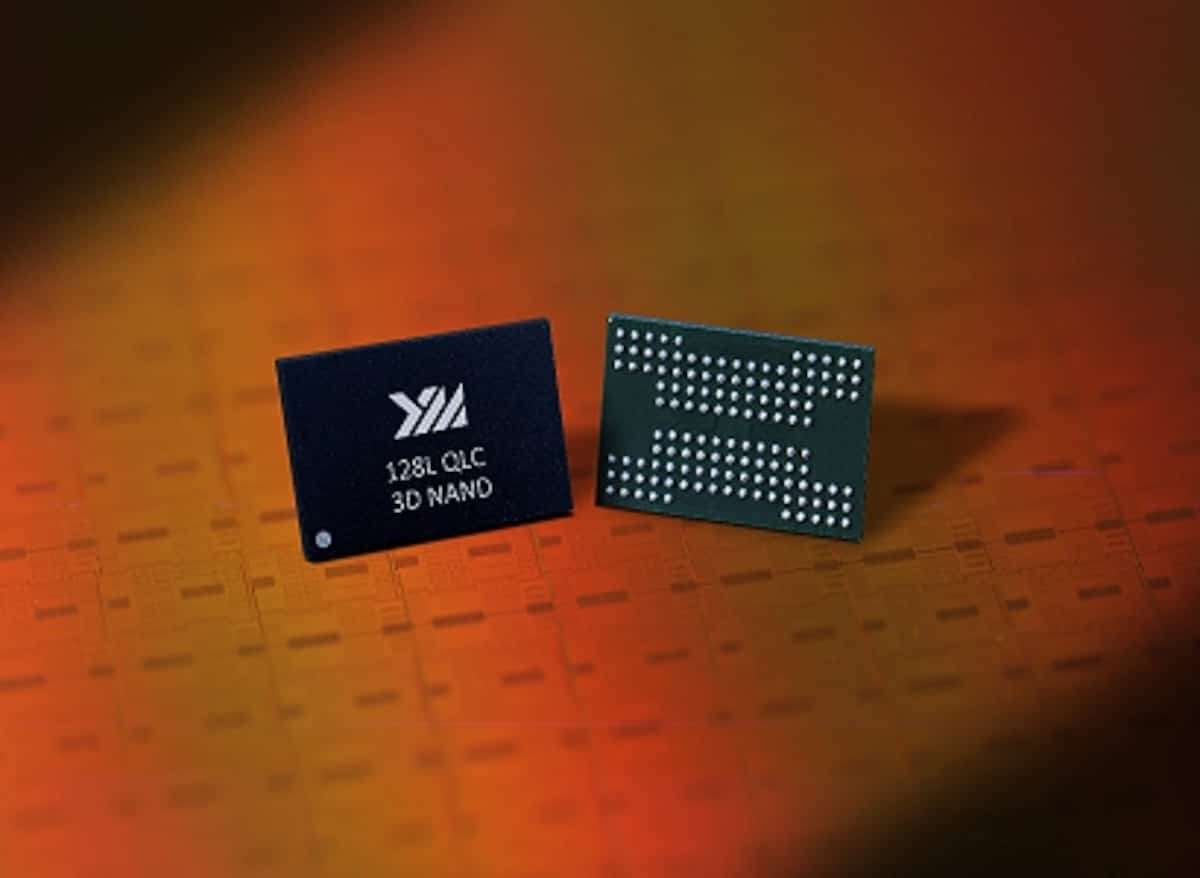
Chinese manufacturer Yangtze Memory Technologies Co. (YMTC) already has its first commercial SSD with PCIe 5.0 interface in the catalog. It’s called PC550, available in M.2 2242 and M.2 2280 formats, offered in 512 GB, 1 TB, and 2 TB capacities, and primarily aimed at business systems and the new wave of AI PCs. On paper, the 2 TB version reaches speeds of up to 10,500 MB/s sequential read and 10,000 MB/s write, with support for PCIe 5.0 x4 and NVMe 2.0.
This announcement is noteworthy for two reasons. First, technologically: it confirms that YMTC is now commercially launching high-performance client SSDs with its own Xtacking 4.0 memory. Second, industrial: it comes at a time when the global NAND Flash market is experiencing significant supply tension, driven by demand for enterprise SSDs for AI servers and capacity migration from consumer products to more profitable segments.
A Gen5 Focused on Efficiency and AI PC Systems
The official specs of the PC550 make it clear that YMTC isn’t presenting this product as an “extreme” enthusiast SSD but rather as a commercial unit aimed at laptops, professional systems, and computers designed for local AI workloads. The company mentions a four-channel architecture instead of eight, which, according to their own description, aims to reduce power consumption and temperature compared to more aggressive designs. They also highlight features like multiple namespace management, thermal control, HMB, SMART, SMBus, and security options like TCG-Pyrite/Opal, albeit some features are partly configurable.
The official figures align with this positioning. The 512 GB model offers up to 10,000 MB/s read and 7,600 MB/s write, with up to 880,000 IOPS random read and 1,100,000 IOPS random write. The 1 TB and 2 TB versions reach up to 10,500 MB/s in read, and 9,500 MB/s and 10,000 MB/s in write, respectively, and achieve up to 1,300,000 IOPS in both read and write operations. YMTC states endurance ratings of 300 TBW for the 512 GB, 600 TBW for 1 TB, and 1,200 TBW for 2 TB, with a MTBF of 2 million hours, less than 3 mW idle power, and under 6 W under load.
However, it’s important to contextualize the product. The PC550 supports PCIe 5.0 but does not occupy the top tier of Gen5 SSDs. Currently, commercial SSDs such as the Samsung 9100 Pro or TeamGroup T-Force Z54E reach nearly 14,800 or 14,900 MB/s. Even Tom’s Hardware noted recently that a previous YMTC NAND-based SSD, the Zhitai TiPro9000 with Silicon Motion SM2508 controller, tested over 14,500 MB/s read. So, YMTC’s move to PCIe 5.0 is significant, but their first commercial model isn’t aiming to set performance records—it’s more about establishing presence and technology validation.
Launch Comes at a Challenging Time for the NAND Market
Another key angle is timing. The memory industry is experiencing a period of tight supply. TrendForce reported on March 3 that the five largest NAND Flash suppliers increased their quarterly revenues by 23.8% in Q4 2025, reaching $21.17 billion, mainly driven by demand for enterprise AI server SSDs and a shift of capacity from consumer products towards more profitable segments.
This tension doesn’t seem to be easing soon. The same analyst upwardly revised their price forecast, estimating NAND Flash could increase in price by 55-60% quarter-over-quarter in early 2026. At the same time, they predict at least a 40% rise in client SSD prices, and between 53-58% for enterprise SSDs, as manufacturers focus on higher-margin applications. Back in January, they warned that enterprise SSDs will become the largest NAND Flash application in 2026, driven by ongoing AI infrastructure spending and high-performance storage demands.
In December, TrendForce also openly discussed the risk of a “dry year” for NAND, with tight inventories and some major PC manufacturers considering cuts in standard SSD capacities for entry-level and mid-range models to contain costs. In other words, while enterprise and data center markets absorb more memory, the consumer side is already feeling pressure in prices, availability, and configurations.
More Than an SSD: A Sign of Maturity for YMTC
In this context, the arrival of the PC550 doesn’t solve the global shortage but signals important progress for YMTC. The company has finally launched a PCIe 5.0 SSD under its own brand, utilizing Xtacking 4.0 NAND in an X4 configuration—one of its most advanced 3D NAND developments. Strategically, this makes sense for China: the product aligns with increasing industrial focus on strengthening local storage ecosystems for commercial PCs, lightweight workstations, and edge AI devices.
Another practical aspect to note is that YMTC’s official website currently doesn’t list pricing or direct purchasing channels, only a contact form. This suggests that, at least for now, the PC550 is intended more for OEMs, system integrators, and corporate customers rather than as a retail-ready product for general consumers. That’s an important distinction in a market where media hype often precedes real availability.
Nevertheless, the move carries deeper significance. PCIe 5.0 is no longer limited to niche Western brands or specialty players. With the PC550, YMTC is formally entering this generation with a balanced, efficiency-focused product aimed at professional use—just as the global memory market faces its most tense period in recent years. While it may not be the fastest Gen5 SSD on display, it represents a key piece in understanding how the global storage landscape is shifting around AI and advanced compute.
Frequently Asked Questions
What are the specifications of the YMTC PC550?
The YMTC PC550 is a PCIe 5.0 x4 NVMe 2.0 SSD available in 512 GB, 1 TB, and 2 TB formats, in M.2 2242 and 2280 sizes. The 2 TB version delivers up to 10,500 MB/s sequential read and 10,000 MB/s write.
Is the YMTC PC550 the fastest PCIe 5.0 SSD on the market?
No. While its figures are impressive, other PCIe 5.0 SSDs already reach approximately 14,800 or 14,900 MB/s, such as the Samsung 9100 Pro or the TeamGroup T-Force Z54E.
Why is there now talk of a worldwide shortage of SSDs and NAND?
Because enterprise SSDs for AI servers are absorbing much of the supply, with manufacturers prioritizing higher-margin segments. TrendForce forecasts significant price increases—55-60% for NAND and SSDs—in early 2026.
Is the YMTC PC550 already available at official retail prices?
For now, YMTC’s official website displays the product details and a contact form but does not list prices or direct purchasing channels for general consumers.