
Xiaomi no longer wants to be seen solely as a brand of budget smartphones, TVs, vacuum cleaners, or e-scooters. The Chinese company is aiming to build something much more ambitious: an ecosystem where phones, electric vehicles, appliances, wearables, proprietary chips, and AI models work as a unified platform. The approach is costly, risky, and very Chinese in its mindset: integrating many layers at once before the market decides which will be the winner.
The latest indicator comes with MiMo-V2.5-Pro, the AI model recently introduced by Xiaomi. According to information published by South China Morning Post, the Artificial Analysis evaluation platform ranked it as the top open-source model in agentic capabilities, meaning its ability to perform complex, multi-step tasks with a certain level of autonomy. In general tests of intelligence and programming, the model ranks behind DeepSeek and Moonshot AI among Chinese open systems, two of the most prominent names in the country’s AI race.
This matters because Xiaomi has only been publishing open models for about a year. It’s not competing from the same starting point as OpenAI, Anthropic, or Google, nor exactly from the same place as DeepSeek. Its potential advantage isn’t just in the model labs, but in the vast number of physical devices where it can integrate AI: smartphones, cars, watches, glasses, TVs, appliances, and smart home products.
AI as the glue between mobile, car, and home
Lei Jun, Xiaomi’s co-founder and CEO, unveiled in April the “Human × Car × Home” vision as one of the company’s strategic pillars. This concept isn’t new in the industry: many tech companies have aimed to create integrated ecosystems. What’s notable is that Xiaomi is starting to have tangible pieces in all these areas.
In smartphones, it remains one of the top global manufacturers. In connected home devices, it has been selling products under its own brand and through a network of partners for years. In automotive, it has entered at a pace that’s uncommon even for the Chinese market. And in AI, it seeks to ensure it’s not entirely dependent on third parties for the features that will differentiate the next generation of devices.
The logic is straightforward. A modern electric car is no longer just a vehicle; it’s a software platform with sensors, navigation, entertainment, voice assistants, assisted driving, and connectivity with other devices. A smartphone is no longer just a display; it’s the hub for identity, communication, payments, photography, health, and home control. If AI becomes the main interface across these products, Xiaomi cannot afford to be late.
| Xiaomi Area | Role of AI |
|---|---|
| Smartphones | Assistants, computational photography, productivity, and local functions |
| Electric Vehicles | Cabin experience, navigation, multimodal interaction, connected services |
| Smart Home | Automation, voice control, energy management, personalized routines |
| Wearables | Health, personal context, alerts, continuous assistance |
| Proprietary Chips | Performance optimization, efficiency, and differentiated features |
| Open Models | Less reliance on external sources and greater control over integration |
Hayden Hou, senior analyst at Canalys cited by SCMP, summarizes it simply: AI is the most important factor for consumer technology companies. However, he also highlights a key point: Xiaomi doesn’t necessarily need to beat pure AI labs. It suffices to have its own technology ready to launch products when new opportunities to combine AI and hardware arise.
Electric cars have shifted Xiaomi’s perception
For years, Xiaomi was compared to Apple. Lei Jun was often seen as a Chinese version of Steve Jobs, not just because of his presentation style but due to an aspiration to create consumer tech products with thoughtful design and competitive prices. But the current moment places Xiaomi in a different position.
Apple abandoned its car project after years of rumors and billions invested. Xiaomi, on the other hand, launched the SU7 in 2024, its first electric sedan, which received strong positive feedback in China. According to data collected by SCMP, the company delivered over 410,000 vehicles in 2025, including the SU7 and the YU7 SUV, up from 136,000 in 2024. The SU7 starts at 219,900 yuan, and the YU7 at 233,500 yuan.
Comparisons with other Chinese manufacturers are also revealing. Xpeng delivered over 429,000 vehicles in 2025, Nio over 326,000, and Li Auto more than 406,000. Xiaomi, just entering the market, is already operating on a scale comparable to some of China’s most well-known EV players.
| Company | Deliveries in 2025 |
|---|---|
| Xiaomi | Over 410,000 vehicles |
| Xpeng | Over 429,000 vehicles |
| Nio | Over 326,000 vehicles |
| Li Auto | Over 406,000 vehicles |
The initial success isn’t just about design or price. Xiaomi has leveraged its mobile software expertise, benefited from China’s mature EV supply chain, and used its brand to generate attention that many startups take years to achieve. Phate Zhang, founder of CnEVPost, attributes part of this market entry to the maturity of China’s supply chain and Xiaomi’s ability to manage suppliers—skills it developed over decades with smartphones.
Proprietary chips and open models: more control over the stack
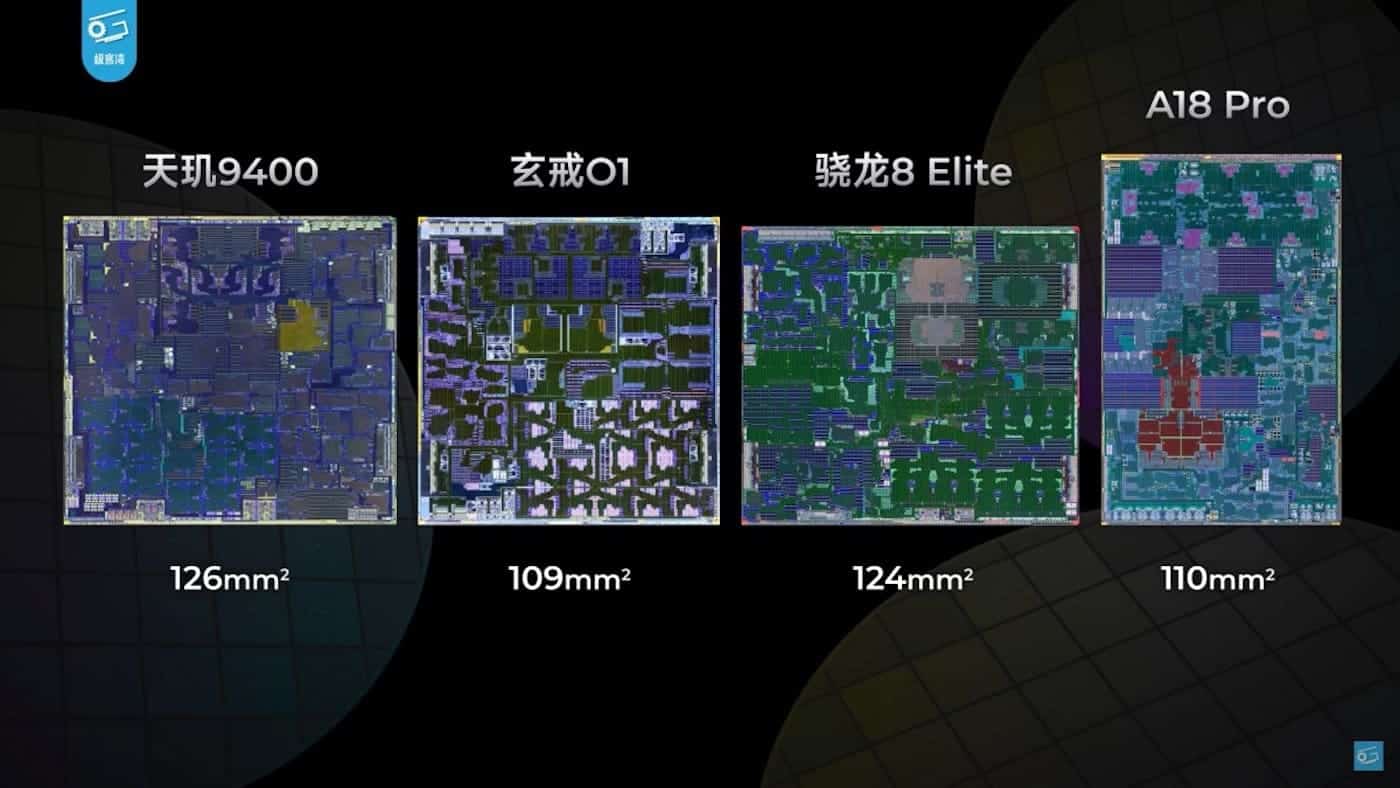
The third pillar of the strategy is silicon. Xiaomi has already developed its own chip, the XRing O1, used in premium devices such as the Xiaomi 15S Pro and Xiaomi Pad 7 Ultra. The company announced that the XRing O1 is manufactured using a 3-nanometer process, contains 19 billion transistors, and has a density comparable to Apple’s A18 series, surpassing the A18 Pro in certain benchmarks. As always with these comparisons, independent testing for power consumption and sustained performance is necessary before drawing definitive conclusions.
What matters is not just whether Xiaomi outperforms Apple in a specific benchmark, but that it is building greater control over its technological stack. AI models, chips, mobile software, electric vehicles, and connected devices can be reinforced if integrated coherently.
This integration can also lower R&D costs. Some knowledge developed for phones can be applied to cars; automotive software can connect with the home; AI models can be reused across assistants, vision, navigation, automation, and productivity. While not a guarantee of success, this creates a different economy of scale compared to a company that produces only one product type.
The trade-off is financial risk. Xiaomi has committed over 60 billion yuan (~$8.8 billion) in AI investments over the next three years. Additionally, its R&D expenditure is set to nearly double to 200 billion yuan (~$29.4 billion) in the next five years, up from 105.5 billion yuan (~$15.5 billion) in the previous period. These are significant figures for a company operating in markets with tight margins and rapid product cycles.
A long-term strategy for survival
Xiaomi’s approach makes sense when seen as a long-term defense. The Chinese smartphone market is mature, hardware advancements are increasingly less differentiating, and price competition remains fierce. In this environment, expanding into electric vehicles, chips, and AI is not just growth—it’s a way to prevent the core business from becoming stagnant.
It’s also a response to China’s national direction. The country aims to reduce technological dependence, accelerate open models, strengthen its chip industry, and lead in electric vehicles. Xiaomi aligns its strategy with these national priorities, but from a consumer-focused perspective. While Huawei advances in telecommunications, cloud, semiconductors, and enterprise, Xiaomi focuses on everyday devices.
The challenge will be translating this ambition into practical, valuable products. AI in mobile devices has so far promised more than delivered for many users. In cars, integration must be reliable and safe. In the connected home, value depends on devices working together seamlessly. In chips, performance and efficiency must be demonstrated across generations.
Xiaomi’s advantage is its proven ability to manufacture, sell, and distribute hardware at scale. However, the next phase demands something more challenging: coordinating devices, models, software, data, and services into an experience that users perceive as superior—not just more connected.
It appears Xiaomi understands that AI will not be just an app but a layer woven throughout the entire product. If successful, Xiaomi could transition from a competitively priced hardware brand to one of China’s most comprehensive tech ecosystems. Failure could mean investing heavily in AI, cars, and chips without a sufficient short-term return.
For now, this move sends a clear signal to the industry: the next race among device makers will be decided not only by cameras, screens, or batteries but by who controls the intelligence connecting all those objects.
Frequently Asked Questions
What is MiMo-V2.5-Pro?
MiMo-V2.5-Pro is Xiaomi’s new AI model, focused on agentic capabilities, programming, and complex tasks. According to Artificial Analysis, cited by SCMP, it stands out among open-source models for its performance in agent functions.
Why is Xiaomi investing so heavily in AI?
Because it aims to embed AI across smartphones, electric vehicles, connected homes, and other devices—reducing reliance on third parties and preparing to launch new products.
How many electric cars did Xiaomi deliver in 2025?
Based on data cited by SCMP, Xiaomi delivered over 410,000 vehicles in 2025, including the SU7 and YU7 models.
What role does the XRing O1 chip play?
The XRing O1 demonstrates Xiaomi’s intention to control more layers of its technology stack. It is used in premium devices and forms part of its strategy to integrate hardware, software, and AI.
