
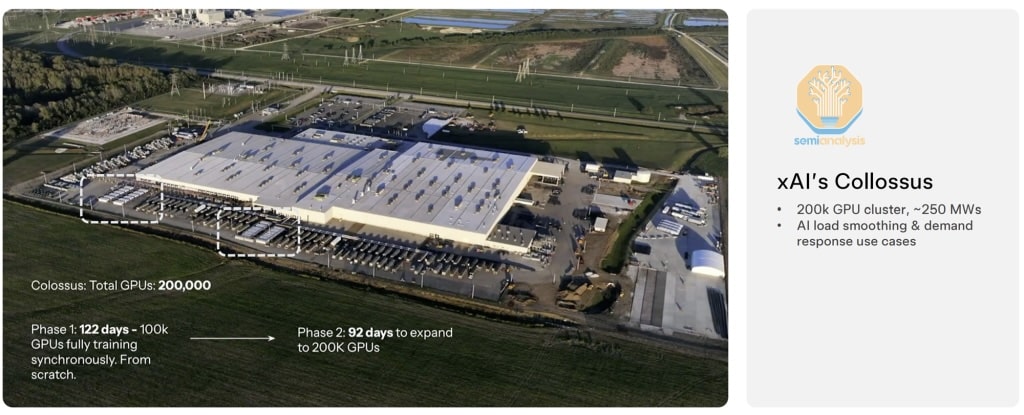
The speed at which xAI has built its artificial intelligence infrastructure in the Memphis area has a less visible counterpart beyond its thousands of GPUs. An investigation based on communications with regulators indicates that the company installed 59 natural gas turbines to power Colossus 2 without obtaining the federal air quality permits required by civil and environmental organizations.
At least 57 of these units are located in Southaven, Mississippi, just across the state border from the data center in Tennessee. The other two are believed to be installed in an unconfirmed location. This number doubles comfortably the 27 temporary turbines xAI publicly acknowledged in early 2026. The company, now owned by SpaceX, did not respond to questions sent during the investigation.
Key facts about the Colossus 2 case in 20 seconds
- xAI reportedly installed 59 natural gas turbines without federal emissions permits.
- At least 57 are in Southaven, Mississippi, near the Tennessee border.
- Colossus 2 is located on the other side of that border, in the Memphis area.
- xAI had publicly acknowledged operating 27 temporary turbines.
- Mississippi authorized the construction of 41 permanent turbines in March.
- This permit does not cover the mobile units that are already operating.
- xAI and the state regulator claim the temporary turbines are exempt.
- The EPA maintains that temporary installations also require permits if they exceed emission limits.
- An estimate for just 30 turbines suggests thousands of tons of pollutants annually.
- These figures represent potential emissions, not direct measurements of what has been released so far.
- The NAACP and several environmental groups have taken the case to court.
- The Department of Justice has requested that the lawsuit be dismissed on legal and national security grounds.
The controversy extends beyond counting turbines. The debate will determine whether a company can build a large power plant next to a data center, classify its generators as temporary, and start using them before undergoing the environmental review process required for large industrial facilities.
A permit for 41 turbines that does not cover 59 mobile units
Mississippi granted a permit in March 2026 to build 41 permanent turbines for Colossus 2. The authorization followed three weeks after the only public hearing held on the project. However, the units now recognized are part of another set: mobile or temporary turbines that are already supplying electricity to the data center and are not included in that permit.
xAI and Mississippi’s Department of Environmental Quality (MDEQ) argue that these machines do not need permits because they can be transported and will remain at the same site for less than a year. The company has used a similar interpretation since constructing its first Colossus complex in Memphis.
The U.S. Environmental Protection Agency (EPA) stated in January 2026 that the temporary nature of a turbine does not eliminate the need for a permit when its potential pollution exceeds federal thresholds. The agency also indicated that it is considering regulatory flexibility for portable units without reducing public health protections.
This legal distinction underpins much of the conflict. Mississippi views mobile turbines as not forming a permanent installation subject to the same permitting process as a conventional power plant. For the NAACP, Earthjustice, and the Southern Environmental Law Center, these units operate together, serve a single project, and produce aggregated emissions that turn the site into a large industrial source.
Practically, this results in a large power plant built behind the meter, off the public grid, serving a single client. Ben King, a Rhodium Group analyst, described it as an unprecedented deployment of gas generation for a single installation.
xAI began with 27 turbines publicly recognized in January. Later documents indicated 46 units in May after installing 19 in just a few weeks. The newer data increases the count to 59. The rapid growth makes the discussion on their temporary status especially relevant: individual machines may change, but the energy supply based on mobile turbines continues to expand.
Thousands of tons potential, but no direct emissions measurements
The analyzed data includes emission profiles provided by manufacturers for 32 turbines. Based on this, Reuters estimated the potential impact of 30 units located in Southaven, approximately half of the identified set.
If operating continuously at 80% capacity, these 30 turbines could emit nearly 2,500 short tons of nitrogen oxides, 4,000 tons of carbon monoxide, and 22 tons of formaldehyde annually. The calculation assumes an 80% load because the EPA considers gas turbines generally operate in this range or higher to achieve efficiency.
These figures are not measurements of actual emissions or released amounts but estimates of potential emissions based on technical specifications, assumed hours of operation, and load level used in the calculation.
The distinction matters. To know actual emissions, detailed data on operational hours, load, fuel used, pollution controls, and measured emissions during operation are needed.
The calculated potential is sufficient to trigger regulatory action. The U.S. Clean Air Act imposes additional requirements on facilities capable of emitting over 100 tons of certain pollutants annually. The estimated NOx emissions from 30 turbines would greatly surpass this threshold.
Nitrogen oxides contribute to ground-level ozone formation and can worsen respiratory inflammation. Carbon monoxide interferes with oxygen transport in the body, while formaldehyde is recognized as a carcinogen. Individual risk depends on concentration, exposure duration, proximity, and weather conditions, not only annual volume emitted.
The April complaint by the NAACP, Earthjustice, and the Southern Environmental Law Center was still based on the 27 turbines then known. They estimated the plant could emit over 1,700 tons of NOx, 180 tons of fine particles, 500 of CO, and 19 of formaldehyde annually. The emergence of additional units requires revisiting the initial scope of the case, with the court ultimately deciding on violations and which units should be included.
Neighborhoods with higher asthma rates and predominantly Black populations
The investigation includes demographic and health data from within a five-mile (about 8 km) radius around the turbines. This distance is commonly used in environmental studies to analyze populations potentially exposed to pollution from stationary sources.
In 27 of the 28 census tracts studied, estimates of asthma exceeded the general figures for their respective counties. In 24 tracts, the estimated prevalence of chronic obstructive pulmonary disease (COPD) was also higher. These data come from local health statistics by the CDC.
The analysis does not prove that Colossus 2 caused these health issues. Respiratory problems were present before turbines were installed, and the region already has other industrial sources, traffic, and pollution episodes. What is concerning is that a new emission source has been added next to communities whose respiratory health was already vulnerable.
Racial distribution is also uneven. In the DeSoto County area where turbines are located, about 46% of residents are Black, compared to 33% county-wide. To the Tennessee side, the percentage jumps to 94%, while the entire Shelby County is at 52%.
Tennessee residents are additionally in a unique administrative position. They may be exposed to emissions from Mississippi but do not participate in Mississippi’s regulatory decisions. The border thus physically separates the data center from much of its power generation but does not isolate the shared air space.
There is no evidence that xAI intentionally chose the area to harm Black communities. The dispute is part of broader environmental justice issues: polluting facilities often concentrate near less-resourced populations with worse health indicators due to historical land use, housing, and segregation policies.
A 2022 study found that neighborhoods affected by redlining—discriminatory banking practices that limited mortgage access for Black citizens—continue to face higher exposure to pollutants from fossil fuel facilities. The Memphis and Southaven case does not alone prove this historical pattern but aligns with documented trends across other U.S. cities.
NAACP lawsuit and U.S. government intervention
The NAACP filed a federal lawsuit on April 14, 2026, against xAI and its subsidiary MZX Tech. It accuses both of operating more than two dozen turbines without the required Clean Air Act permits and seeks a court order to halt operations until environmental compliance is met. At the time of filing, xAI had not publicly responded to the allegations.
The case has gained political significance after the Department of Justice requested its dismissal, citing legal and national security considerations. The government argues that federal law grants broad authority to control enforcement of environmental standards and limits on citizen suits.
It also claims that shutting down Colossus 2 could harm economic interests and national security because xAI systems are used in government and military operations. The NAACP maintains that citizen suits are a crucial mechanism to address regulatory deficiencies and protect public health.
The judge has yet to decide on these issues. Until then, it cannot be definitively stated that xAI violated the law or that classifying turbines as temporary is lawful. Both sides remain opposed: the EPA and plaintiffs stress cumulative emissions; Mississippi regulators argue mobile units do not need permits.
The outcome could set a precedent for other data centers. If the court accepts that dozens of mobile turbines can operate sequentially without review as a large plant, tech companies would have a fast route to generate power while awaiting grid connection.
Conversely, if the other interpretation prevails, developers will have to conduct environmental studies, public consultations, and emissions controls beforehand. This could delay projects but would prevent operations before environmental effects are properly assessed.
The AI race is building its own power plants
Colossus 2 exemplifies a growing challenge across the U.S.: large data centers need hundreds of megawatts, but grids cannot always supply them promptly. Building new lines, substations, and plants can take years. Modular turbines offer a solution—power can be generated within months, capacity added in phases, and delays partly avoided. For xAI, this has been key to rapidly expanding Colossus.
However, calling these turbines “temporary” does not reduce emissions. A turbine used intensively for eleven months can operate at high capacity, and multiple units can be swapped in and out without eliminating the overall energy complex they form.
The debate isn’t only about AI or the environment. Projects can rely on the grid, power purchasing agreements, energy storage, efficiency improvements, or their own permitted sources. The real question is: how much time and public oversight is a company willing to trade for faster capacity expansion?
Recently, SpaceX offered residents in Memphis area a 50% discount on Starlink fees and free equipment rentals as a thank you for local support. Environmental groups criticize that this does not address concerns over noise, air quality, or turbine operation.
While these perks may help households, they do not substitute environmental assessments or reduce emissions directly. Business relationships with neighbors shouldn’t rely solely on commercial compensation when federal permits and public health are at stake.
Colossus 2 was designed for rapid capacity expansion to meet the needs of Grok and other AI services linked to Elon Musk’s companies. As energy infrastructure grew as swiftly as servers, courts now face whether that pace stayed within legal bounds or if turbines began operating before undergoing the necessary regulatory reviews typically applied to large off-grid gas plants serving data centers.
Frequently Asked Questions
Does xAI have 59 turbines operating without any permits?
The investigation identifies 59 turbines lacking federal air quality permits. Mississippi has approved 41 permanent units, but this authorization does not cover the mobile turbines already in operation.
Have the turbines already emitted thousands of tons as reported?
That cannot be confirmed. The figures are potential annual estimates for 30 turbines operating at 80% capacity, not actual measured emissions.
Why does xAI believe permits are unnecessary?
The company and Mississippi regulators argue that the turbines are mobile, temporary, and will be on site less than a year. The EPA and plaintiffs disagree when emissions exceed federal thresholds.
Is it proven that Colossus 2 caused respiratory illnesses?
No. Data shows nearby neighborhoods already had higher estimated rates of asthma and COPD before turbines were installed. The concern is that new emissions could worsen existing conditions.
via: tomshardware
