
Claude is one of the most recognizable names of the new generation of AI assistants. Anthropic has made it a brand associated with language models featuring a carefully crafted identity: Haiku, Sonnet, Opus, and more recently families like Fable or Mythos. But behind the main name, there’s a recurring question among users and developers: why is it called Claude?
The most widespread explanation points to Claude Shannon, a mathematician, engineer, and founder of information theory. Anthropic hasn’t launched an extensive public campaign or an official corporate explanation about the origin of the name. Still, the attribution to Shannon best fits the technical history of language models. It’s also the one echoed by communities, communicators, and even academic profiles linked to MIT. It’s wise to be cautious in stating it definitively, but the connection is hard to ignore.
Shannon didn’t invent modern LLMs. He didn’t design transformers, train deep neural networks, or work in today’s data centers. But many of the ideas that help us understand Generative AI stem from his work: information, entropy, bits, channels, noise, prediction, and language as a statistical phenomenon.
From relays to bits: digital computing before AI
The story begins before language models and even before modern electronic computers. In 1937, Claude Shannon presented a master’s thesis at MIT that is now considered a foundational piece of digital computing. In A Symbolic Analysis of Relay and Switching Circuits, he demonstrated that Boolean algebra could be applied to the design of relay-based electrical circuits.
The idea was remarkably clear: a circuit could represent logical operations with switches being open or closed. True or false. One or zero. What now seems natural in any processor was then a new way of thinking about electrical system design. Shannon didn’t build digital electronics single-handedly, but he provided a mathematical foundation that helped turn circuit design into a formal discipline.
This historical thread matters because LLMs don’t start at the software layer. They originate in a chain of abstractions that goes from switch to logical circuit, from circuit to computer, from computer to network, and from network to large-scale model training. Claude, as an AI product, operates on the highest layer of that stack, but its likely name alludes to a moment when that stack started to take shape.
After his early work at MIT, Shannon worked at Bell Labs, one of the most influential laboratories of the 20th century. There, key technologies such as the transistor, laser, Unix, C language, and advances in telecommunications were developed. Shannon fit perfectly into that environment of intellectual freedom and experimentation. He could publish fundamental mathematics and simultaneously build machines that looked like toys: mechanical mice, chess devices, juggling mechanisms, or computing educational systems.
Information theory and language as probability
In 1948, Shannon published A Mathematical Theory of Communication, the paper that established information theory. His goal was not to explain message meaning but to measure how much information messages carry and how it can be efficiently transmitted over noisy channels.
This approach forever changed technology. Data compression, error correction, telecommunications, digital networks, and much of modern computing owe a debt to that mathematical framework. Shannon emphasized concepts such as entropy, uncertainty, and information quantity. He also worked with binary units when the logarithmic base was 2, making the bit the natural measure of digital information.
For today’s language models, the connection becomes particularly strong in 1951, when Shannon published Prediction and Entropy of Printed English. In that work, he studied the entropy of written English through experiments predicting letters. The idea was simple: show a text fragment and ask someone to guess what the next character would be.
The comparison with LLMs must be made carefully. A model like Claude isn’t just guessing letters. It predicts tokens using neural networks trained on vast amounts of text, code, documents, and multimodal signals. But Shannon’s intuition remains recognizable: language has regularities, dependencies, and statistical structures. Given a context, some continuations are much more probable than others.
That bridge between Shannon and LLMs isn’t just anecdotal. Generative AI relies on an idea familiar to the father of information theory: reducing uncertainty based on context. In 1951, it was about predicting letters with humans. Today, it involves attention architectures, distributed training, and systems capable of generating text, code, analysis, and reasoning enhancements.
MiniVac 601: when Shannon made digital logic visible
Shannon wasn’t just a theorist. In 1961, he designed the MiniVac 601, an educational electromechanical digital computer sold by Scientific Development Corporation. It was a kit with relays, switches, lights, buttons, cables, and a motorized dial. Its purpose was to teach digital logic in a tangible way when most people had no access to real computers.
The MiniVac 601 didn’t have a CPU in the modern sense. It used electric relays as switching and temporary storage elements. It featured a 6-bit input/output matrix, six indicator lights, six switches, six push-buttons, and a 16-position rotary selector that could serve as numeric input, output, or clock signal. Programming was done by manually connecting cables on a panel.
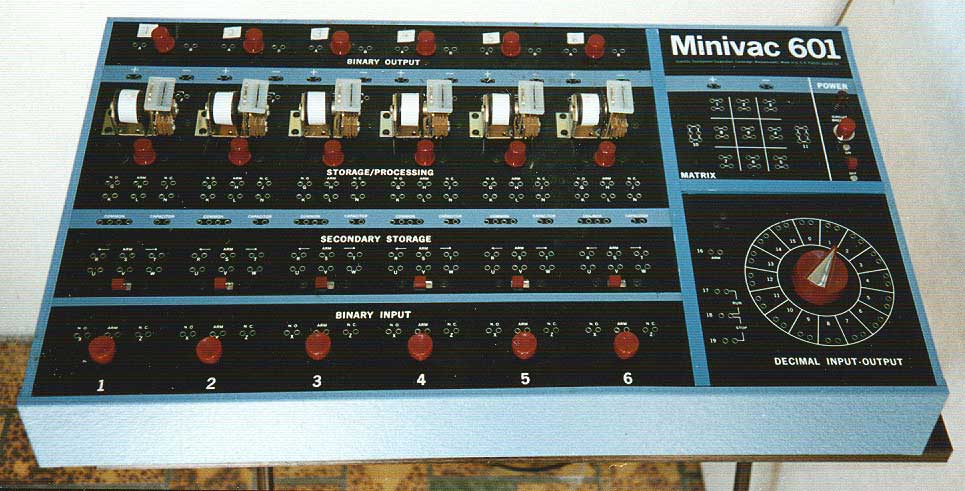
To modern eyes, it might seem primitive, but it was a powerful educational tool. It allowed visualizing how information moved within a machine: a relay changed state, a light turned on, a cable modified the circuit’s logic. Some setups let you play tic-tac-toe or simulate a simple elevator control system.
The MiniVac is especially interesting in the AI era because it represents the opposite of today’s models. LLMs are opaque, distributed, massive systems that are hard to inspect visually. The MiniVac was slow, mechanical, and visible. It demonstrated computation at a human scale. Yet, both share a fundamental obsession: transforming symbols, decisions, and rules into processes a machine can execute.
There’s something almost poetic about this continuity. Claude, the AI assistant, probably takes its name from a researcher who not only formulated information theory but also wanted students and hobbyists to touch digital logic with their own hands. From relays to tokens, the technological distance is enormous. The core question remains: how to represent information so that a machine can operate on it.
Haiku, Sonnet, Opus: literary names for a technical architecture
The choice of “Claude” aligns with another very visible decision by Anthropic: its naming system. Unlike other labs that use letter, number, and version combinations that are hard to remember, Anthropic has developed a family with an almost editorial logic. Haiku, Sonnet, and Opus are not just technical labels but literary forms.
Haiku suggests brevity, precision, and lightness. Within the Claude family, it’s associated with faster, more efficient models. Sonnet refers to the poetic structure, often representing a balance between capacity, cost, and speed. Opus conjures a major work, a more ambitious composition, reserved for the most powerful models.
This coherence has led some to think Claude might reference Claude Debussy, the French composer. That’s a reasonable confusion: Sonnet and Opus have artistic resonances, and Debussy’s musical legacy fits a poetic branding. But for a language model developed by an AI company, Claude Shannon offers a clearer explanation. The literary choices complement, rather than replace, the technical genealogy of the main name.
From a product perspective, Anthropic has achieved something rare: names that work for non-technical users but also carry layers of meaning for those familiar with computing history. Claude feels approachable. Shannon adds depth. Haiku, Sonnet, and Opus organize the family without cold nomenclature. The brand seems designed to remind us that these systems operate with language but originate from mathematics.
Why the name matters in the age of generative models
Asking about the name of Claude isn’t just social media curiosity. It also helps explain where language models come from. Generative AI didn’t suddenly appear with conversational interfaces. It’s the result of decades of research across computing, statistics, linguistics, neural networks, hardware, and information theory.
Shannon helps tell this story because he connects several layers. His circuit thesis links to digital electronics. His information theory connects to networks, compression, and transmission. His English prediction experiments connect to language as a probabilistic system. His MiniVac relates to the desire to make computation tangible and understandable.
That’s why a tribute like Anthropic’s works so well. Claude isn’t just a friendly chatbot name. It’s a reference to a scientist who showed that information could be measured and that language has a statistical structure amenable to analysis. He didn’t invent generative AI but contributed a key part of the conceptual map that helps us understand it.
Next time a user asks Claude for an explanation, code snippet, or summary, it’s worth remembering that behind that name lies a story older than Silicon Valley. A story of relays, bits, entropy, printed texts, and educational machines with lights. Today’s AI seems new because of its scale, but its roots have been growing for nearly a century.
Frequently Asked Questions
Is Claude named after Claude Shannon?
There is no official extended explanation from Anthropic that confirms it definitively in a promotional way. The most common hypothesis is that Claude references Claude Shannon, the founder of information theory, due to the direct relationship between his work and language models.
What did Claude Shannon contribute to computing?
Shannon demonstrated that Boolean algebra could be applied in relay-based electrical circuits and later founded information theory. His work was pivotal for digital electronics, telecommunications, and the mathematical analysis of communication.
What’s Shannon’s connection to LLMs?
Shannon studied entropy and the prediction of written English. In 1951, he proposed experiments to estimate language uncertainty by predicting the next letter. Modern LLMs operate on a different scale but are also primarily about predicting probable continuations based on context.
What was the MiniVac 601?
The MiniVac 601 was an educational electromechanical digital computer designed by Claude Shannon and sold starting in 1961. It used relays, lights, switches, buttons, and cables to teach digital logic and basic computing principles.
