
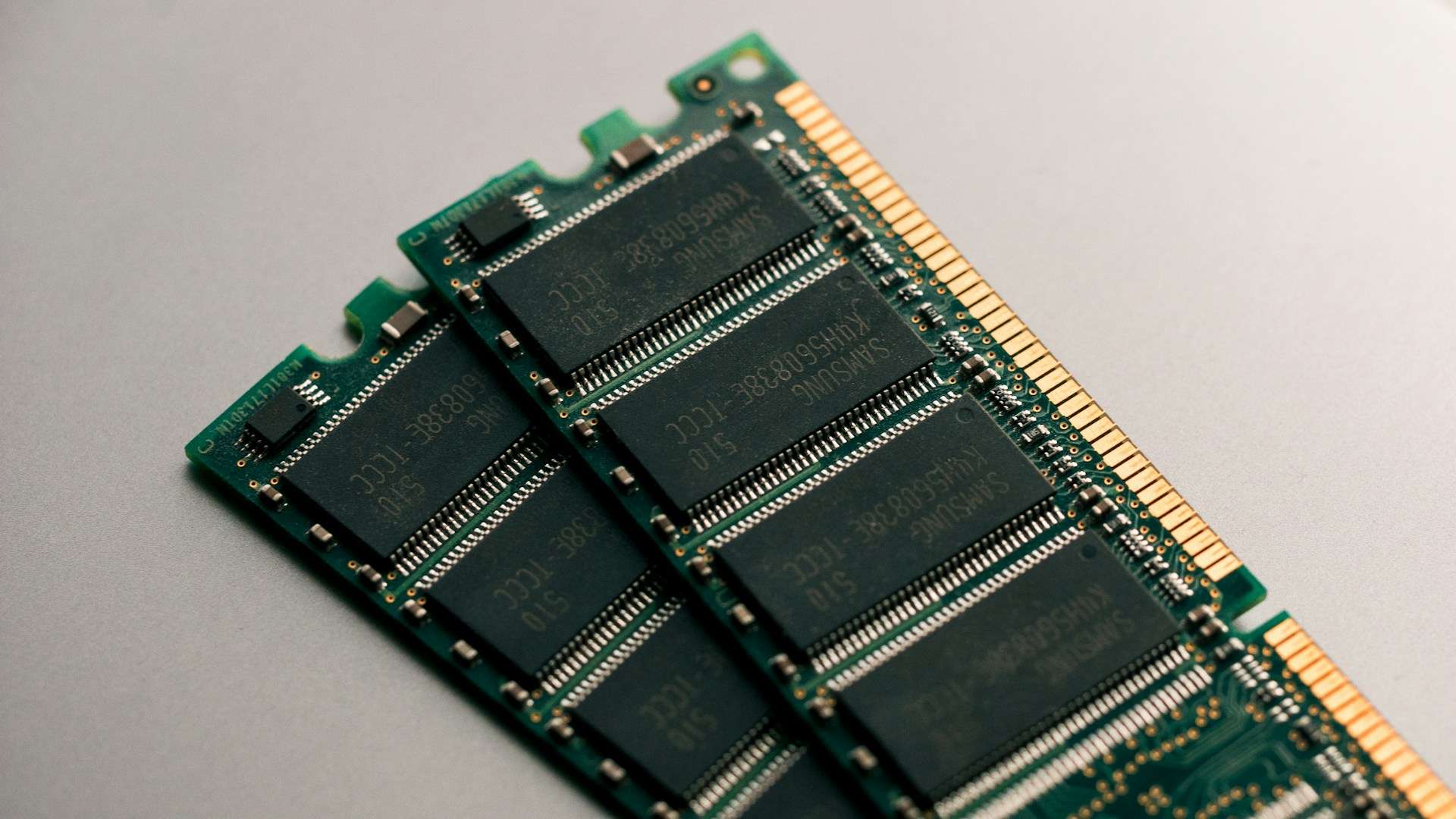
For years, the debate around “memory” in the hardware industry was almost understood as a volume conflict: how many gigabytes fit, at what price, and in what format. But the rise of AI — and, especially, the infrastructure that fuels it — is reshaping priorities. In this new landscape, DRAM (and its more strategic derivative, HBM) increasingly appears as the “premium” asset, while NAND (the foundation of flash storage) acts more like a commodity product, competitive with narrower margins.
Income share data helps put some numbers to this intuition. In DRAM, the market remains dominated by a clear trio: SK hynix (36%), Samsung (34%), and Micron (25%) in 2025 (Q1–Q3), with the remaining 5% shared among smaller players. In NAND, the distribution is more fragmented: Samsung (34%), SK hynix (20%), Kioxia (15%), Micron (14%), Sandisk (13%), and YMTC (4%) in the same period. At first glance, a structural difference is evident: in DRAM, three players lead; in NAND, competition is broader and vendor switching more common.
NAND: More Competitive Market, Greater Interchangeability, and Narrower Margins
NAND is essential for SSDs, mobile devices, enterprise storage, and countless other gadgets. However, its market dynamics tend to be more “commodity-like” for three clear reasons:
1) More real competition.
NAND is divided among several relevant manufacturers, and there is increasing pressure from China (YMTC being the most prominent in the chart). In terms of pricing power, an ecosystem with more alternatives generally leads to more aggressive negotiations by buyers.
2) More “replaceable” product.
In many environments, switching NAND doesn’t require a complete platform overhaul. There are nuances (performance, controllers, firmware, endurance), but the market reality is that customers can rotate suppliers with less friction than with advanced memory linked to specific architectures. This “swap” capability tends to push prices downward when supply exceeds demand.
3) Historically tighter margins.
Without needing specific figures, the simple industrial logic is that when a component is more interchangeable and more players can produce it, average margins tend to shrink. Additionally, buyers often focus on cost per terabyte and availability—variables highly sensitive to cycles and oversupply.
Result: NAND remains a huge market, but its competitive profile resembles more a volume-driven market where scale and efficiency defend leadership… and price rules.
DRAM: Higher Demand, More Differentiation, and an Oligopoly
If NAND is “capacity at a good price,” DRAM — especially HBM — has become “performance that unlocks business.” This distinction shifts the playing field.
1) Better demand outlook (especially for AI).
AI infrastructure not only requires GPUs; it demands feeding those GPUs with enormous memory bandwidth. Here, HBM (an advanced form of DRAM) becomes the bottleneck and the component that captures the most value. Even when the public discussion centers on power consumption or the number of accelerators, actual performance ultimately depends on the memory supporting them.
2) Greater differentiation: HBM is moving towards increasingly “customized” designs.
Standard DRAM exists, yes, but transitioning to HBM introduces complexity that cannot be resolved by simply manufacturing more chips. The market’s direction points toward highly customized HBM (for example, using specific base dies tailored for certain needs), raising entry barriers and reducing immediate substitutability among suppliers. In other words: it’s not just “having DRAM,” but “having the right DRAM” for a specific platform.
3) A more disciplined market: three dominant players.
The income share breakdown for DRAM in 2025 (Q1–Q3) makes this clear: SK hynix, Samsung, and Micron virtually split the entire market, with only 5% for “others.” A market with three major players tends to be more rational in capacity and pricing, as the incentive to just slash prices wildly is less than in a scenario with many equally-sized participants.
In this context, DRAM is not just a component: it has become a strategic lever. And when something turns strategic, margins tend to improve, not worsen.

An Important Distinction: The Future is Not “DRAM or NAND,” but “Value and Negotiating Power”
It’s important not to fall into oversimplifications. NAND is indispensable: without flash storage, there are no modern data centers, smartphones, agile PCs, or scalable digital economies. But the prevailing discussion in the industry now is different: where is bargaining power, and where is more value captured per wafer?
- In DRAM/HBM, value is captured because it enables performance and, by extension, revenue.
- In NAND, value is defended through scale, efficiency, and the ability to move volume in a market that’s more price-sensitive.
This also helps explain why, as the technological cycle shifts toward AI, the stock market narrative and market interest tend to focus more on DRAM than on NAND. In a world obsessed with inference and training, memory that unlocks throughput becomes almost a toll.
What to Watch Going Forward
- Bottlenecks and capacity allocation. If demand for advanced DRAM continues to grow, manufacturers will be incentivized to prioritize higher-value products.
- Standardization (or lack of it) in advanced memory. The more “custom” the HBM, the more differentiation is reinforced and the harder it becomes for suppliers to substitute.
- Competitive pressure in NAND. More players and substitution potential keep the market more price-competitive.
- Collateral effects on other industries. When memory becomes scarce or expensive, other sectors adjust specifications, schedules, or configurations.
In summary: NAND will continue to sustain the digital world out of necessity, but DRAM — especially the kind fueling AI — is better positioned to capture the “extra” value of this decade. And in the semiconductor markets, this subtle difference often makes the difference between volume and real leadership.
via: X Twitter