
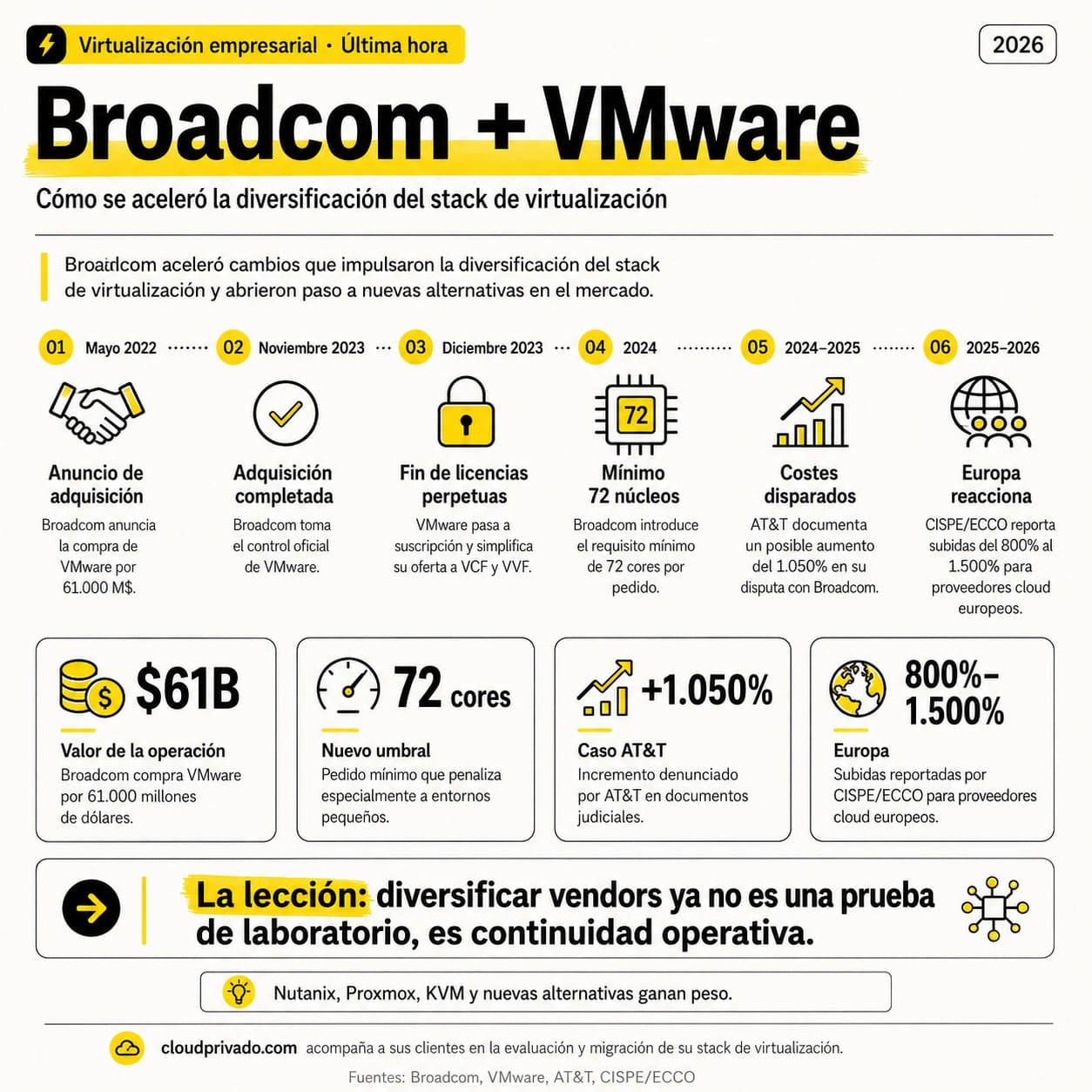
Broadcom’s overhaul of VMware’s licensing and subscription model has done something few product launches ever manage: it got IT teams who had never seriously questioned their hypervisor to start shopping around. Proxmox VE is the name that keeps coming up in those conversations — not as a fallback for teams on a tight budget, but as a platform that has quietly matured into a real contender for production workloads.
The short version
- Broadcom’s changes to VMware’s catalog and licensing are the trigger, not the whole story — Proxmox had already spent years building toward this moment.
- Proxmox VE bundles virtualization, clustering, HA, SDN, Ceph, and containers in one platform, with subscriptions tied to support rather than feature unlocks.
- That model lets administrators build a lab that mirrors production without a commercial agreement first.
- Proxmox VE 9.2 keeps extending cluster load distribution and SDN — this isn’t a platform standing still.
- None of this makes Proxmox the automatic right answer for every organization; VMware, Hyper-V, and XCP-ng all still have scenarios where they win.
What actually changed at VMware
Broadcom’s acquisition of VMware didn’t touch the technology — vSphere still does what it has always done. What changed is everything around it: catalog simplification, a hard shift toward subscriptions, and licensing terms that forced plenty of organizations to ask a question they had barely considered in years: is VMware still the right choice for the next platform, regardless of how well it keeps working technically?
That question is exactly where Proxmox found its opening. But crediting Broadcom alone for Proxmox’s rise would be too simple — the platform had been building toward enterprise readiness long before the VMware shakeup gave it a reason to be noticed.
The platform Proxmox actually is today
Proxmox VE runs on KVM (Kernel-based Virtual Machine) for virtual machines and LXC for Linux containers. Around that core it layers cluster management, high availability, live migration, software-defined networking (SDN), Ceph integration, multiple storage backends, snapshots, replication, and a single web-based management console.
Proxmox Backup Server sits alongside it, built specifically for this environment, with incremental backups, deduplication, and encryption baked in. None of these pieces is groundbreaking on its own — what makes the combination notable is having all of it under one platform that stays relatively simple to deploy and run day to day.
Subscriptions buy support, not features
This is the detail that tends to get lost in cost comparisons: upgrading a Proxmox subscription tier doesn’t unlock capabilities. Clustering and high availability work the same whether or not a company has paid for support. What the commercial tiers change is access to the Enterprise repository — packages that go through extra testing and are recommended for production — plus ticket volume and response times.
In practice, that means an administrator can download Proxmox VE, spin up several nodes, and build a lab that looks structurally like the production environment they’ll eventually run — breaking the cluster, rebuilding it, testing what happens when quorum is lost — without signing anything first. That kind of hands-on access to the real thing has real value, especially at a time when it’s easy to operate infrastructure without understanding what’s happening underneath it.
Why vendor dependency belongs in the spreadsheet too
Most hypervisor comparisons stop at cost per socket, cost per core, and what support runs. Those numbers matter, but they leave out a question that VMware customers have just been forced to confront: how much should a company’s infrastructure depend on one vendor’s future business decisions?
A platform can stay technically excellent while the economics around it shift completely — that’s the lesson of the last two years for a lot of VMware shops. Proxmox doesn’t remove every dependency (nothing does), but its stack leans on open, widely understood components — Linux, KVM, QEMU, LXC, Ceph, Corosync — each with its own community outside Proxmox’s control. Proxmox VE itself ships under the GNU AGPLv3, which means core functionality doesn’t stop working if a commercial edition isn’t renewed.
That won’t matter to every organization. For others, it will land as one of the defining criteria in the decision.
Freedom isn’t the same as fewer responsibilities
None of this turns Proxmox into a shortcut. Three servers don’t become a highly available enterprise platform just because HA is switched on. Storage, networking, quorum, backup strategy, and the capacity that stays available when a node fails all still need proper design — Ceph in particular needs enough disks, nodes, and bandwidth to behave well, not just a checkbox.
That’s precisely why treating “Proxmox is cheaper” as the whole argument does the platform, and whoever ends up running it, a disservice.
A platform that keeps moving
Proxmox VE 9, built on Debian 13, brought a new generation of the platform with continued work on SDN and cluster management. The 9.2 branch, released in 2026, pushed further with load-distribution improvements across clusters and additional SDN capabilities — the kind of feature set that used to be reserved for far more complex enterprise platforms.
That progress doesn’t make Proxmox the default answer for every company. VMware still carries decades of accumulated experience, enterprise integrations, and a footprint in critical infrastructure that makes migrating away from a working deployment a real cost and a real risk — not something a friendlier license automatically erases. Microsoft Hyper-V remains a logical fit for organizations built around the Windows ecosystem, and Proxmox’s own push toward round-the-clock enterprise support shows the project knows it’s now being evaluated against platforms with that expectation baked in. XCP-ng remains the other open option worth a look, especially for teams that prefer the Xen and Xen Orchestra model.
The right choice depends on what’s built around the hypervisor, not the hypervisor in isolation.
| Platform | Makes the most sense when… |
|---|---|
| Proxmox VE | You want control, open technologies, virtualization and containers in one place, and a simple commercial structure |
| VMware vSphere | You already run a consolidated VMware estate with integrations that justify staying |
| Microsoft Hyper-V | Your organization is built around Windows Server and the Microsoft stack |
| XCP-ng | You want an open, Xen-based platform managed through Xen Orchestra |
Reducing the comparison to a features checklist misses the point, too. A company running 200 virtual machines on external storage with critical applications faces a different problem than an SMB running three servers, and an infrastructure provider needs different things than a business virtualizing a dozen internal apps.
Even inside Proxmox, the architecture isn’t fixed: clusters can run on Ceph or centralized storage, with two nodes and an external QDevice or dozens of servers; management, storage, migration, and VM traffic can sit on physically separate networks; backups can run through Proxmox Backup Server or another strategy entirely. The tool doesn’t do the design work for you — which is arguably the point. It lets a team start small without being locked into staying small. A small business can begin with a handful of nodes and conventional storage; an organization with bigger demands can add redundant networks, distributed storage, high availability, and a separate backup tier — all inside a platform the same team already knows how to operate.
The real question isn’t whether Proxmox can compete
There’s still an old instinct in some IT departments to pair proprietary software with “professional” and open source with “lab tools.” That divide stopped matching reality a while ago: Linux runs a large share of the internet’s servers, KVM has powered large-scale virtualization for years, Ceph shows up across distributed storage deployments, and OpenStack still underpins plenty of private and public clouds. Proxmox’s contribution is bringing several of those pieces together under a management layer simple enough that a team doesn’t need to become QEMU, Corosync, and Ceph specialists to benefit — while still leaving the internals open to anyone who wants to look.
In plenty of scenarios, whether Proxmox can go head-to-head with VMware is no longer really in question. The more interesting one is what’s left to justify leaving it out of the shortlist when a new virtualization platform is on the table. Some organizations will still land on VMware, others on Hyper-V, XCP-ng, or something built entirely around public cloud and containers — but for SMBs, professional labs, dev environments, private clouds, and a lot of conventional production workloads, Proxmox VE has earned a seat at that table. Not because it’s the cheap VMware — because it’s stopped needing that comparison to make its case.
Frequently asked questions
Why are companies moving from VMware to Proxmox now?
Mainly because of Broadcom’s changes to VMware’s licensing, subscriptions, and product catalog since the acquisition, which have pushed organizations to re-evaluate whether VMware remains the right platform even when it keeps working well technically. Proxmox’s own maturity — clustering, HA, Ceph, and years of production use — gave that re-evaluation somewhere credible to land.
Does a Proxmox subscription unlock extra features?
No. Every Proxmox VE edition includes the same technical capabilities. Commercial subscriptions add access to the Enterprise repository (extra-tested packages recommended for production), plus support tickets and response times — they don’t gate clustering, HA, or any other feature behind a paywall.
Is Proxmox VE actually ready for production?
Yes, with the same caveat that applies to any hypervisor: readiness depends on how well storage, networking, redundancy, and backups are designed around it, not just on which platform is chosen. Proxmox provides the clustering, HA, live migration, and distributed storage integration; the architecture around them still has to be built correctly.
Proxmox, VMware, Hyper-V, or XCP-ng — which one fits?
It depends on what already surrounds the hypervisor. Proxmox stands out for combining open technologies, built-in enterprise features, and a support-based business model; VMware still carries the deepest enterprise track record; Hyper-V fits naturally into Microsoft-centric shops; and XCP-ng offers another open, Xen-based route for teams that prefer that ecosystem.
