
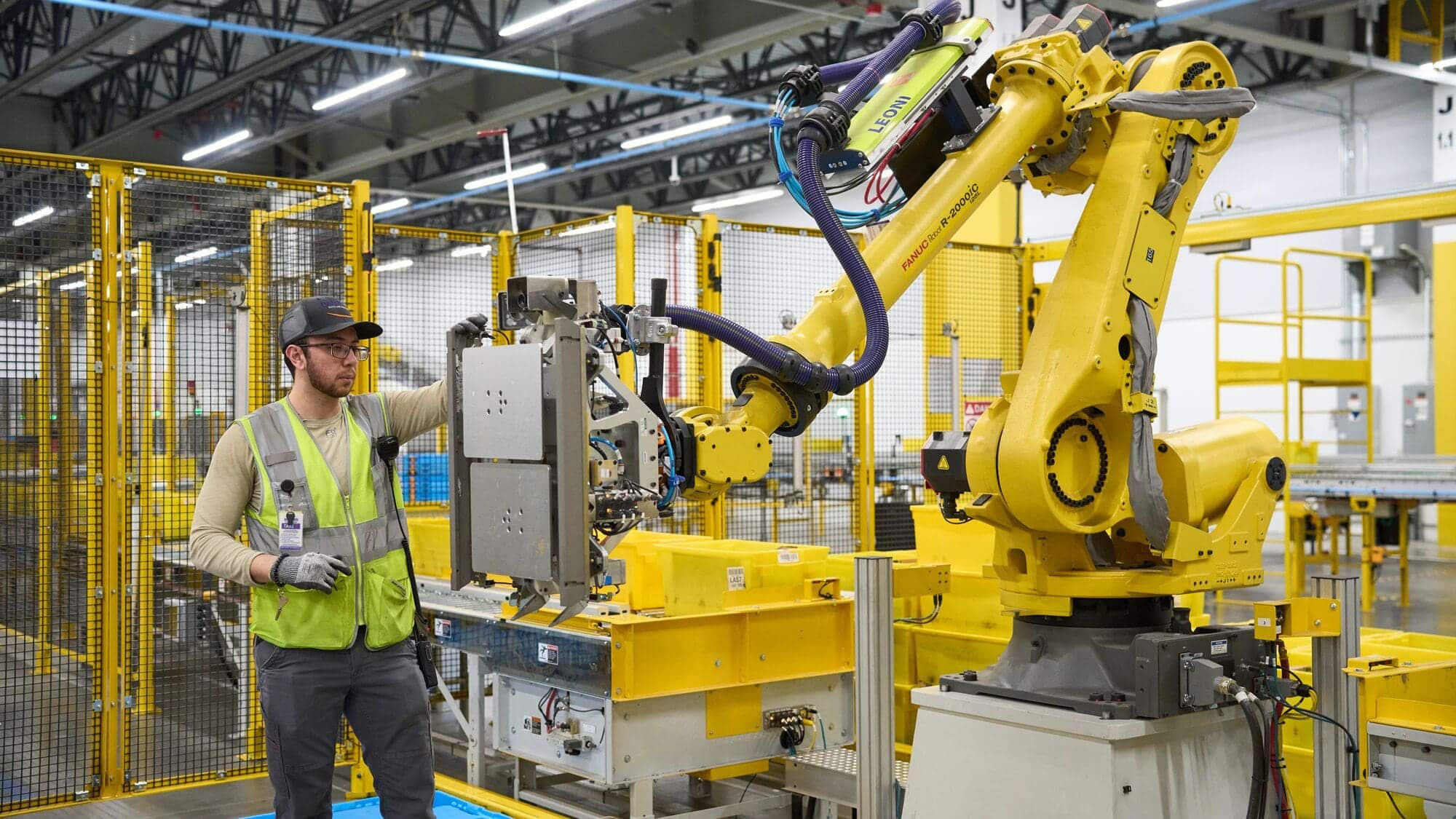
Amazon is approaching a symbolic milestone in the history of business automation: its fleet of robots could surpass its human workforce in the coming years if it maintains its current deployment pace. It won’t be a sudden job shutdown or a linear replacement of people by machines, but it is a very clear signal of where global logistics are headed as a company automates over more than a decade with discipline, capital, and scale.
In 2025, the company announced it had deployed one million robots across its global network of logistics centers. The one millionth robot was delivered to a fulfillment center in Japan and integrated into a network of over 300 facilities. Amazon also explained that its robots now assist in 75% of customer orders, showing that automation has shifted from being peripheral to becoming a core part of its operation.
The other half of the equation is the workforce. Amazon reported 1,556,000 employees at the end of 2024 and 1,576,000 at the end of 2025, according to its annual reports and public financial series. This figure includes full-time and part-time employees across the entire group, not just warehouse staff. Therefore, comparing robots to humans should be approached carefully: it doesn’t measure exact “jobs replaced,” but rather the relationship between the physical scale of automation and the company’s overall size.
The curve didn’t start with generative AI
Amazon didn’t arrive here due to a decision made in 2025. The path started much earlier, especially after acquiring Kiva Systems in 2012, which enabled the company to control a key technology in warehouse mobile robotics. Since then, automation has gradually expanded to classification, shelf movement, internal transportation, packaging, inventory management, and worker assistance.
The difference in 2025 is scale. One million robots is no longer a pilot; it’s an industrial layer. If Amazon adds 250,000 robots annually, as some market projections assume, they could reach about 1.5 million by 2027. If the human workforce remains near its current level, the crossing point may be close. And if hiring is slightly reduced or staff decreases, the crossing could happen sooner.
| Year | Robots Deployed | Human Employees | Approximate Ratio |
|---|---|---|---|
| 2013 | 1,000 | 88,000 | 1 robot per every 88 employees |
| 2020 | 265,000 | 798,000 | 1 robot per every 3 employees |
| 2025 | 1,000,000 | 1.556-1.576 million | 1 robot per every 1.5 employees |
| 2027, projection | 1,500,000 | Approximately 1.5 million if the workforce declines or stagnates | Potential crossing point: robots > humans |
This table should not be interpreted as an exact accounting of job replacements. A warehouse robot doesn’t equate to a person. Some robots move shelves, others classify, some assist with packing, or reduce internal movements. But the trend is clear: Amazon is increasing operational capacity without the workforce growing at the same pace.
Automation doesn’t always eliminate jobs, but it transforms their nature
Amazon emphasizes that robotics complements human labor, improves safety, and creates new technical roles. The company often highlights positions such as maintenance technicians, flow specialists, system operators, and robotics-related profiles. This is true: an automated network requires people to install, maintain, oversee, and improve systems.
However, it is also true that automation reduces the need to hire for certain repetitive tasks. Andy Jassy, Amazon’s CEO, clearly expressed this in an internal message about generative AI: the company will need fewer people performing certain current jobs and more in other roles. He added that in the coming years, Amazon expects to reduce its overall corporate staff as it gains efficiencies using AI across the company.
The broader lesson extends beyond Amazon. For years, many companies viewed automation as a way to boost productivity without significantly changing the workforce structure. Now, with AI, robotics, algorithmic planning, and real-time assignment systems, automation begins to influence work organization—not just package movement.
Business Insider has reported on internal systems like Full Facility Load Balancing, a tool that recalculates staffing needs every few minutes and reassigns workers based on workload forecasts. This data suggests potential savings of millions of work hours, though Amazon presents it as a support tool rather than a direct substitute for human management.
The mistake many companies will make is wanting to copy later
The most important aspect of this story isn’t that Amazon could have more robots than employees by 2027. It’s that it took more than a decade to reach that point. Amazon has purchased technology, integrated hardware and software, redesigned warehouses, built teams, learned from operational failures, and deployed robots in hundreds of facilities.
Many companies will try to compress that learning into two or three years. That’s where the risk lies. Automation isn’t just about buying robots; implementing AI isn’t just about contracting an API. It requires process redesign, data management, roles, maintenance, security, metrics, training, and workforce relations. Doing it quickly and recklessly can create rigidity rather than productivity.
Amazon has a scale advantage that’s hard to replicate: it can justify investments that others cannot, test technologies across multiple centers, develop or adapt proprietary systems, and absorb errors over years. A midsize company cannot simply copy this model. It must first identify which tasks are repetitive, which processes are sufficiently standardized, what data exists, and what real return is expected.
There’s also a lesson for employment. Automation doesn’t instantly eliminate the need for people but shifts value toward oversight, maintenance, process engineering, data analysis, security, quality control, and exception management. Those who measure workforce solely by headcount will be late. Those who start training their teams to work with automated systems will have more room to grow.
If the crossing point between robots and humans in Amazon happens in 2027, it will be a notable date. But the real shift occurred earlier: the company moved from using robots as occasional support to designing operations around them. This is a signal other sectors—from food and retail to logistics, manufacturing, healthcare, or data centers—should observe carefully.
Frequently Asked Questions
Does Amazon already have more robots than employees?
Not yet. Amazon announced the deployment of one million robots in 2025, while its total workforce was around 1.56 to 1.58 million employees. The crossing point could happen in 2027 if the robotics fleet continues growing and the workforce remains stagnant or decreases.
Does an Amazon robot directly replace a worker?
Not necessarily. Many robots perform specific tasks such as moving shelves, transporting packages, or assisting with sorting. The labor impact depends on how each facility is redesigned and how many future hires are avoided.
Why has Amazon been able to automate so extensively?
Because it has invested over a decade in robotics since acquiring Kiva Systems and because it has enormous operational scale to test, improve, and deploy systems in hundreds of facilities.
What should other companies learn?
That automation isn’t improvisation. It requires clear processes, data, training, maintenance, organizational redesign, and a gradual strategy. Attempting to reproduce in two years what Amazon built in twelve can be very costly.
