
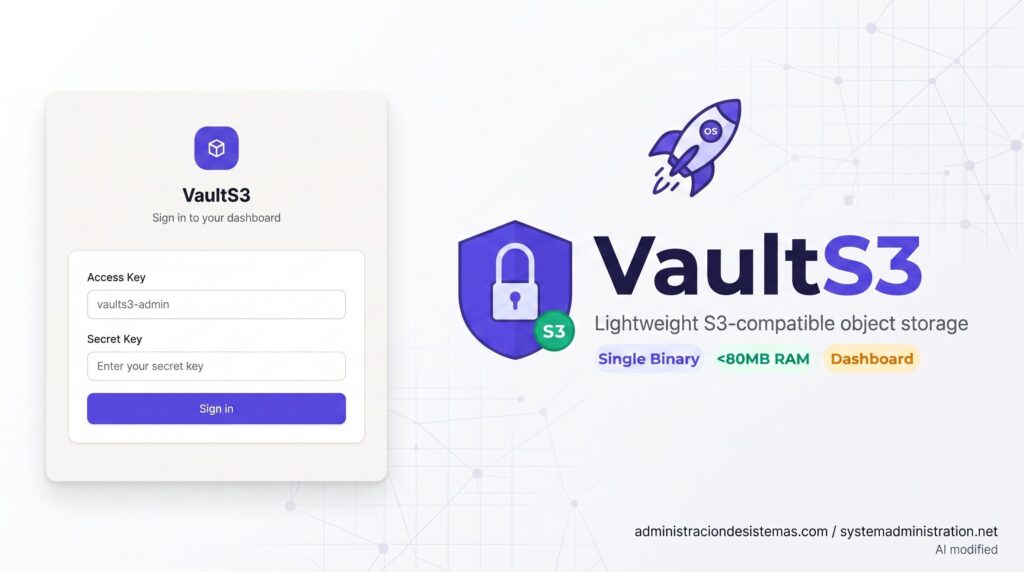
VaultS3 is a new way to run Amazon S3-compatible object storage on your own infrastructure, with an unusual pitch: a single binary, no required external services, and an idle memory footprint its developer puts at about 17 MiB. It lands in a market that runs from managed services like Amazon S3 to established open-source platforms such as Ceph, Garage, and SeaweedFS.
VaultS3 in 20 seconds
- VaultS3 implements more than 80 S3 API operations and runs as a single binary.
- Its developer measures about 17 MiB of RAM at rest, though that climbs under load.
- It includes encryption, IAM, OIDC, versioning, Object Lock, Prometheus metrics, and erasure coding.
- It competes with Ceph, Garage, SeaweedFS, and managed services like Amazon S3.
- VaultS3’s distributed mode still has components considered beta.
S3 compatibility has become a standard piece of many storage designs. Backup software, analytics platforms, data repositories, Kubernetes, and plenty of enterprise tools can all talk to that interface, whether the backend is Amazon Web Services (AWS) or something you installed yourself.
VaultS3 targets that second case while trying to skip some of the complexity of the bigger distributed options. It is written mostly in Go and released under the AGPL-3.0 license.
From 17 MiB at rest to about 185 MiB under load
The memory number is the eye-catcher. In tests the project itself published, VaultS3 uses around 17 MiB of RAM when idle.
That doesn’t mean it handles any storage load on that budget.
In a test writing 64 MiB objects with 16 concurrent operations, for instance, memory can climb toward 185 MiB. What you actually need depends on the number of connections, object sizes, and the workload.
The comparisons are also mostly the project’s own and aren’t an independent benchmark. Treat the 17 MiB as a marker of how light the base process is, not a fixed requirement for production.
VaultS3 folds a lot into one executable. It doesn’t need an external database and uses BoltDB for metadata. It ships Docker images, packages for several Linux distributions, and Kubernetes options.
It comes with a built-in web interface, AWS Signature Version 4 authentication, IAM, OIDC and LDAP integration, AES-256-GCM encryption, bucket policies, Prometheus metrics, and several data-protection mechanisms.
VaultS3 vs Ceph, Garage, and SeaweedFS
There are enough S3-compatible options that memory use alone won’t decide the best fit.
A rough comparison helps place each one:
| Solution | Model | S3 API | Complexity | Main focus |
|---|---|---|---|---|
| VaultS3 | Open source, AGPL-3.0 | Yes | Low in single-node setups | Labs, edge, home labs, and lightweight private storage |
| Ceph | Open source | Yes, via RGW | High | Enterprise clusters and distributed storage |
| Garage | Open source | Yes | Medium-low | Lightweight distributed storage |
| SeaweedFS | Open source | Yes | Medium | Distributed object/file storage |
| MinIO AIStor | Commercial, with evaluation/free tier depending on mode | Yes | Medium | Enterprise S3 storage |
| Amazon S3 | Managed cloud service | Natively | Low for the user | Large-scale cloud object storage |
The table isn’t trying to crown a winner; the architectures are too different.
Ceph, for one, plays in another league. It can serve object, block, and file storage from the same distributed cluster. Its RADOS Gateway (RGW) covers a big chunk of the Amazon S3 API and offers versioning, lifecycle policies, encryption, IAM, and multisite setups.
That power comes with operational cost. Deploying Ceph means multiple components and usually several OSD servers or devices to build a redundant platform. The official docs note you typically need at least three OSDs for redundancy and high availability.
VaultS3 goes the other way: start with a small server and a simple configuration.
Garage is another useful comparison, since it was built around lightweight distributed storage that can run on mixed hardware and connections. VaultS3 sets itself apart by packing extra management and data-protection features into the same project.
SeaweedFS reaches further than an S3 server. Its distributed architecture can use different components to handle volumes, metadata, and data access, which adds flexibility and complexity.
MinIO’s position has shifted over the years
MinIO has long been one of the best-known ways to run S3-compatible storage outside AWS.
Its licensing and commercial stance have changed, though.
Current MinIO docs say the distributed software is under its own license, and without an active Enterprise agreement, that license limits it to a single instance for internal evaluation, not production. The company now sells its platform under the AIStor brand.
So comparing today’s MinIO AIStor with an AGPL project like VaultS3 under a single “open-source S3” label can mislead.
VaultS3 wants to bring back some of what made early self-managed S3 platforms appealing: download a program, run it, and get an endpoint that S3 clients can use in minutes.
Amazon S3 serves a different purpose
At the far end of the comparison is Amazon Web Services S3.
AWS runs the physical infrastructure, redundancy, hardware replacement, and much of the platform’s availability. With a self-managed option like VaultS3, all of that lands on whoever runs the servers.
That changes the economics a lot.
Running a private S3 server can pay off when you hold a large volume of local data, when some workloads have to stay inside the organization, or when transfer costs to and from cloud services add up.
But software alone doesn’t turn a server into something that matches Amazon S3.
Real durability comes down to disk configurations, backups, replication, server setup, and data center architecture.
Erasure coding and replication widen the options
VaultS3 doesn’t just keep one copy of each object on disk. It implements Reed-Solomon erasure coding, versioning, Object Lock, scheduled backups, and processes to rebuild damaged fragments.
It also offers clustering through Raft consensus, consistent hashing, and active-active replication.
That leads to one of its main current limits.
The project separates stable features from ones still in development. Single-node deployments, including erasure coding across several disks, are the most mature scenario. Some clustering and distributed-replication features are still in beta.
For a home lab, that gap may not matter. For a business storing terabytes of backups or critical data, it is a different story.
You shouldn’t judge a storage system by its idle memory alone. Data durability, fault recovery, consistency, behavior during network partitions, version updates, monitoring, and the ability to rebuild large volumes after a disk or server fails all count just as much.
A good fit for labs and edge deployments
VaultS3 has a clear place right now. Its low resource use and easy setup make it attractive for home labs, development environments, small servers, edge devices, or any application that needs a local S3 endpoint.
You can also use it to test S3-compatible applications without leaning on an external service all the time.
For larger enterprise deployments, Ceph brings a mature distributed architecture and a wider feature set, including IAM policies, OpenID Connect, LDAP, encryption, and multisite configurations on its storage backend.
Managed services like Amazon S3 handle part of the problem by taking infrastructure operations off your plate, in exchange for their own usage and cost models.
VaultS3 aims for the middle. Its real test will come as deployments grow and people can watch how its distributed features hold up under sustained load, updates, and hardware failures.
For now, that 17 MiB of RAM at rest points to something more interesting: there’s still room to build S3-compatible storage without starting from a complex cluster.
Frequently Asked Questions
Is VaultS3 compatible with Amazon S3?
It implements more than 80 S3 API operations and works with compatible tools and SDKs, but that doesn’t mean it copies every Amazon S3 feature.
Can VaultS3 replace Ceph?
It depends on the scenario. VaultS3 aims for simplicity and low resource use, while Ceph is built to run large-scale distributed storage clusters for objects, blocks, and files.
Does VaultS3 really use only 17 MiB of RAM?
That is the developer’s measurement with the server idle. Under load it rises; one published test shows around 185 MiB when writing 64 MiB objects with 16 concurrency.
Is VaultS3 ready for production?
Its single-node setup is the most mature. Some distributed features, including clustering and active-active replication, are still in beta and should be tested thoroughly before you store critical data.
