
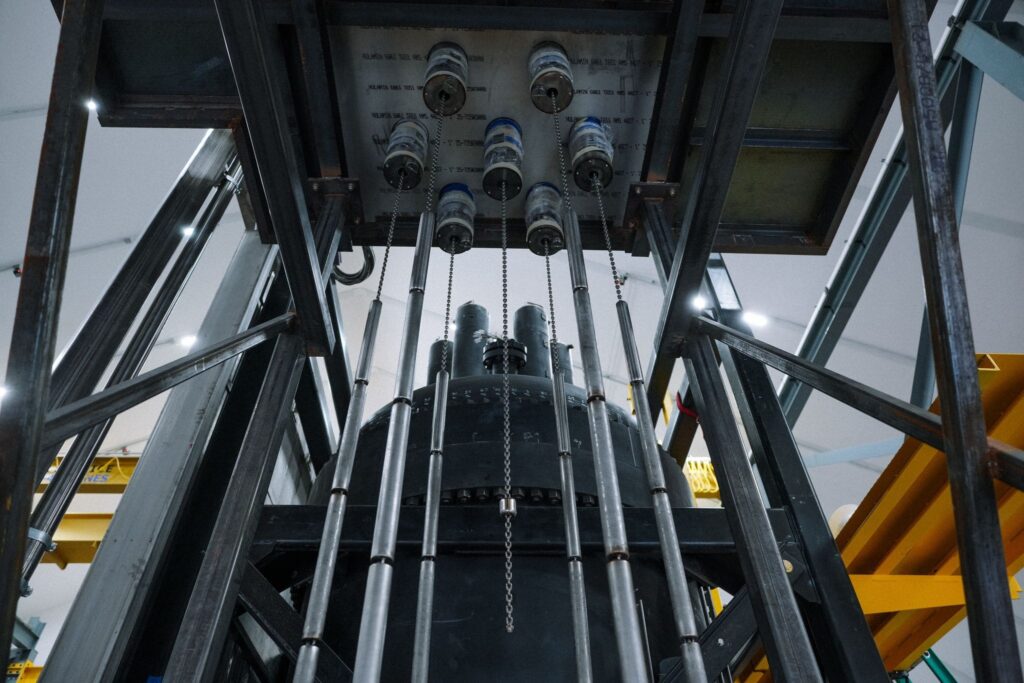
Valar Atomics has staged a demonstration designed to catch the industry’s attention: powering an Nvidia Spark system with electricity from their Ward 250 microreactor during a live event. The scene encapsulates two conversations that until recently were separate and now are rapidly intersecting: the expansion of artificial intelligence and the need for reliable, abundant energy with lower water consumption.
The startup announced on LinkedIn that it became the first emerging nuclear company to produce electricity, doing so by powering a “NVIDIA Spark.” In the same announcement, Valar stated that they are collaborating with Nvidia on a 30 MW “AI factory” with an end-to-end closed circuit and no water consumption from the local community.
According to Reuters, the demonstration took place in Utah, at Valar’s small reactor site. The company showed its microreactor powering Nvidia’s Blackwell architecture and presented the project as an early example of how small nuclear reactors could supply energy to AI infrastructure with very minimal water use.
A symbolic demo, not a commercial-scale test
Connecting an AI system to a microreactor carries significant narrative value, but it should not be mistaken for a nuclear data center ready for deployment. The demonstration served to showcase small-scale power generation and connect that electricity to Nvidia hardware. Operating a 30 MW facility with continuous AI loads, full licensing, regulatory safety, supply contracts, maintenance, redundancy, and commercial operations are entirely different challenges.
Valar explained that their reactor produced thermal energy via fission, which was extracted through a pressurized helium cooling circuit and converted into electricity using a thermoelectric generator. The company claims its approach employs helium instead of water for reactor cooling—a key difference at a time when water consumption by data centers has become a political and social concern.
The equipment used in the demo also warrants clarification. Nvidia markets DGX Spark as a desktop AI supercomputer based on Grace Blackwell architecture, offering up to 1 petaFLOP of FP4 performance, 128 GB of unified memory, and the capacity to test inference with models of up to 200 billion parameters. It is designed for development, testing, validation, fine-tuning, and local inference—not to represent the load of a multi-megawatt AI factory.
| Part of the announcement | What it means |
|---|---|
| Ward 250 | Valar Atomics microreactor used in the demonstration |
| Nvidia Spark / DGX Spark | Desktop AI hardware based on Grace Blackwell architecture |
| 30 MW | Proposed scale for the future AI factory |
| Helium cooling | Reactor system that avoids using water as the main coolant |
| Closed-loop cooling | Data center cooling approach to reduce water consumption |
| Behind-the-meter | Private electricity generation alongside the load, independent of the grid |
Why AI is increasingly turning to nuclear energy
Artificial intelligence has transformed the conversation around energy. Large data centers require stable, continuous, and reliable electricity year-round. Renewable sources help, but their intermittency necessitates backups, storage, or complex contracts. Natural gas is rapidly expanding as a quick solution in many projects, but it increases emissions. Nuclear energy emerges as an attractive option because it can provide steady, low-carbon power.
The issue isn’t just energy. AI data centers consume electricity, land, network connectivity, and water for cooling. Reuters reports that local opposition to new data centers is growing in the U.S., and a Reuters/Ipsos poll shows only one in three Americans approve of the rapid construction of these facilities.
This resistance is prompting tech companies to seek “behind-the-meter” solutions—private plants built alongside data centers to reduce dependence on the public grid, speed up deployment, and better control costs and availability. Reuters notes that many of these private solutions have relied on gas so far, but some companies are now considering small nuclear reactors as an alternative to power AI infrastructure.
Nvidia is contributing to this debate from another angle: cooling. Reuters states that the company announced it would adopt liquid cooling in a closed circuit for DSX, its latest data center design, aiming to cut water cooling use from about 2.6 million gallons per megawatt annually to nearly zero.
Valar and Nvidia’s proposal combines two promises: nuclear energy with helium cooling, and data centers with closed-loop liquid cooling. If both components work as envisioned, the facility could reduce two major friction points for AI: grid stress and local water consumption.
The nuclear context: Valar is not alone
Valar’s demonstration is part of a broader race to accelerate microreactor deployment in the U.S. On July 1, the Department of Energy (DOE) confirmed that Deployable Energy achieved criticality in its Unity reactor, meeting the goal of having three advanced reactors authorized by the DOE achieving criticality before July 4, 2026. The DOE notes that previously, Antares Nuclear with Mark-0 and Valar Atomics with Ward 250 also reached this milestone.
It’s important to note that “criticality” does not automatically mean commercial operation. It indicates the reactor can sustain a nuclear chain reaction under test conditions. While technically significant, there’s still a long way to go before producing continuous, regulated, safe, and economically viable electricity.
Valar is part of this nuclear acceleration ecosystem. On its Ward 250 page, the company presents the project as a response to an alleged over $100 billion energy gap in the U.S. driven by data center demand, grid upgrades, and industrial relocation. It also positions the reactor within the framework of executive orders that have opened the door to fast-track nuclear programs.
Regulatory hurdles will be decisive. Reuters reports that Valar joined a lawsuit last year against the Nuclear Regulatory Commission (NRC), along with Texas and Utah, arguing that some microreactors and small modular reactors should be regulated at the state level in certain cases, rather than solely under federal NRC authority.
This issue could become a central debate. Tech companies want speed. Communities seek safety, water, land, and guarantees. Regulators cannot treat a nuclear reactor like just another industrial boiler. Startups need to demonstrate they can manufacture, license, and operate at scale—not just through eye-catching demos.
AI needs energy, but not just any energy
This news is crucial because it directly links AI hardware with the physical infrastructure supporting it. For years, the tech industry spoke of models, GPUs, data centers, and cloud as if electricity was an invisible assumption. That is no longer the case.
An AI cluster is not just a collection of chips. It’s a substantial, constant electrical load that’s sensitive to interruptions. It also generates heat to be dissipated, water to be managed, permits to be secured, and communities to be convinced. Therefore, every announcement about nuclear energy, gas, renewables, batteries, or liquid cooling has become an AI story.
The collaboration between Valar and Nvidia still needs to demonstrate many aspects: economic viability, scalability, safety, regulation, fuel availability, continuous operation, maintenance, integration with computational infrastructure, and public acceptance. But the direction is clear. Future AI factories won’t just be built by asking how many GPUs to buy. They will be planned around where energy comes from, how much water is used, who bears the risks, and how everything is integrated into a stable system.
The image of an Nvidia system powered by a microreactor might seem like marketing staging. But it could also be a sign of a deeper transition: AI is forcing a redesign of the relationship between computing, energy, and land use.
Frequently Asked Questions
What has Valar Atomics demonstrated?
Valar showcased at an event that its Ward 250 microreactor can generate electricity to power Nvidia hardware based on Blackwell architecture. It’s a symbolic demonstration linking advanced nuclear energy and AI infrastructure.
What is Nvidia’s role in the project?
Valar states that it collaborates with Nvidia on a 30 MW AI factory with a closed circuit and no local water use. Nvidia is also exploring closed-loop liquid cooling to reduce water consumption in data centers.
Does this mean there are already commercial microreactor-powered data centers?
Not exactly. The demonstration is not equivalent to large-scale commercial deployment. Licenses, continuous operation, regulatory safety, and economic viability are still pending.
Why is nuclear energy of interest to the AI industry?
Because AI data centers demand large amounts of stable, continuous power. Nuclear can provide low-carbon electricity without relying on intermittent sources.
What’s the difference between criticality and commercial power production?
Criticality means the reactor can sustain a nuclear chain reaction under test conditions. Commercial power production requires reliably converting that energy into electricity in a safe, regulated, authorized, and economically viable manner.
