
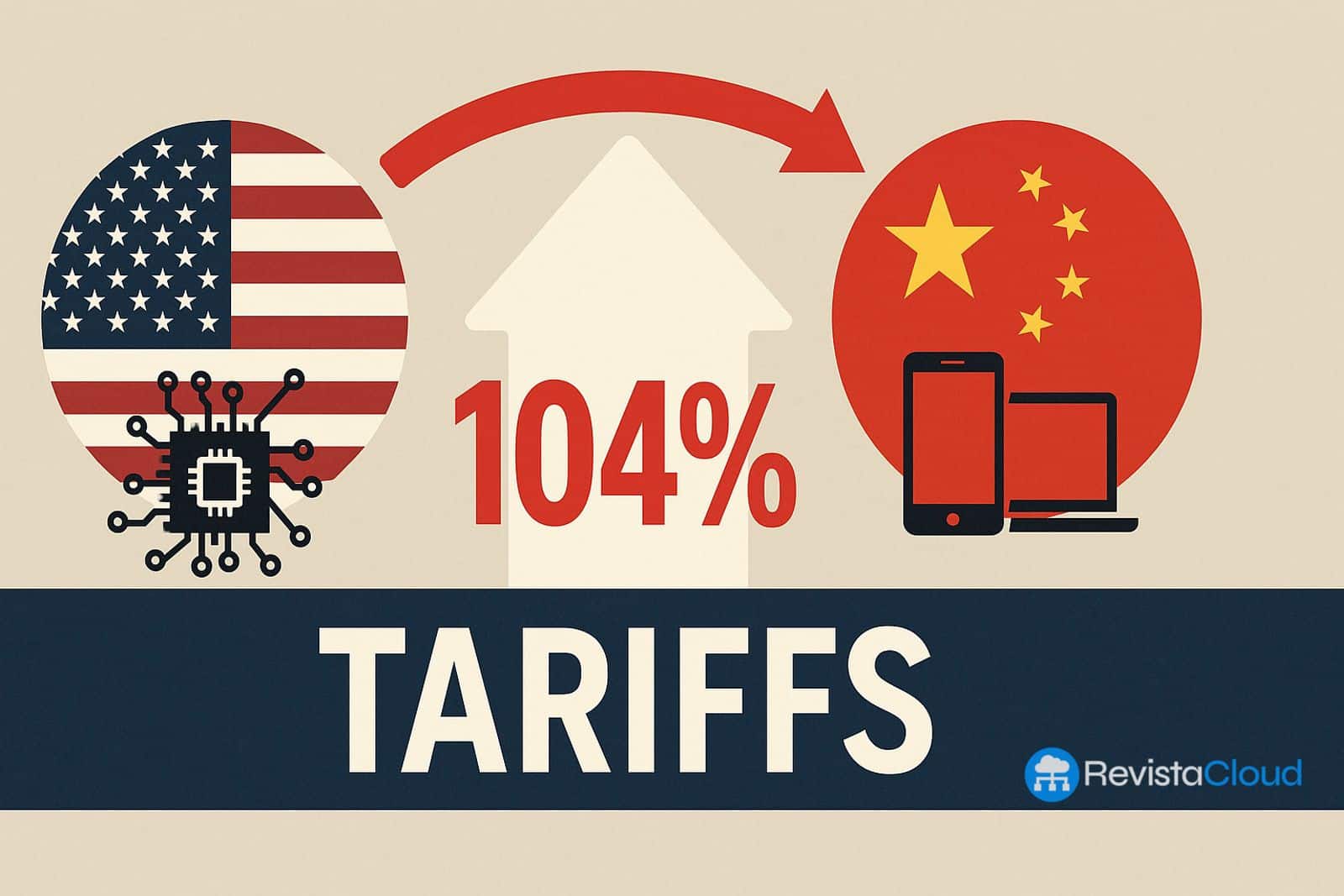
The United States’ new tariff offensive against semiconductors from China will finally happen, but not immediately. Amid heightened technological tensions between the two largest economies on the planet, the Trump administration has chosen a move that blends pressure and caution: activating the legal mechanism now, but delaying the actual impact until June 2027.
This decision carries a double message. On one hand, Washington insists that Beijing’s industrial policy distorts the global chip market through subsidies, planning, and a state strategy to gain market share in key segments. On the other hand, the White House avoids an immediate blow to a supply chain that remains delicate, especially at a time when much of the U.S. industry depends on “mature” components (the so-called foundational semiconductors) found in thousands of products.
What exactly has been announced (and why the headline may be confusing)
The announcement doesn’t mean that “there are no tariffs”: it means that a trade action has been formalized, but with a transitional period. According to the published scheme, the additional tariff starts at 0% and remains so for 18 months. The increase — with the final percentage still to be determined — is set to take effect on June 23, 2027.
Moreover, the U.S. government has indicated that the final rate will be announced at least 30 days in advance, allowing room for negotiation while also leaving the market in uncertainty.
In other words: a schedule is set, a date is fixed, but the “big number” is reserved for the final stretch.
The legal basis behind the move: an investigation initiated earlier
This measure follows a prolonged investigation under the umbrella of U.S. trade policy, begun during the previous administration and now culminating in a formal decision. The focus is mainly on the Chinese semiconductor industry and its capacity to export components at prices and conditions that, according to Washington, distort competition and erode the local industrial base.
The context is significant: the U.S. has been working for years to rebalance its technological capabilities, while China tries to reduce its external dependence on advanced chips and, at the same time, strengthen its global presence in high-volume categories.
Which chips are under scrutiny: “foundational,” not the entire iPhone
One of the nuances often lost in public debate is what is being targeted with tariffs and what is not. These actions typically focus on specific components and categories (for example, certain integrated circuits, transistors, diodes, or materials), rather than entire finished products.
This matters because much of the industrial economy — automotive, appliances, networks, machinery, medical equipment — depends on chips that aren’t “high-end,” but are critical due to volume and availability. In a tight supply environment, raising prices too early on these inputs could harm manufacturers and, ultimately, consumers.
The postponement until 2027 is precisely seen as an attempt to avoid an immediate domino effect on costs and timelines.
A fragile balance: commercial pressure without breaking diplomatic ties
The move also fits into a phase of contacts and adjustments between Washington and Beijing. Recent months have shown signs of “partial ceasefires” and cross-negotiations that aim to prevent technological rivalry from turning into a total trade blockade.
In this context, postponing tariffs allows the U.S. to keep the threat as leverage without sparking a short-term trade conflict. At the same time, it provides industry with time to diversify suppliers, renegotiate contracts, or redesign parts of their supply chains.
Market impact: temporary relief, structural uncertainty
For the market, the announcement can be seen as short-term relief: no immediate increase and thus a lower risk of sharp price reactions for components. However, the underlying message is the opposite: tension isn’t going away, it’s just changing form.
The main financial impact isn’t from the 0% tariff, but from uncertainty: electronics firms, industrial manufacturers, distributors, and companies exposed to China will have to plan with a horizon where future costs can change with just 30 days’ notice.
This could encourage early purchases, inventory shifts, or investment adjustments. Most importantly, it feeds a reality already present in the sector: geopolitics has become an integral variable in the cost of producing technology.
Frequently Asked Questions
When will the new tariffs on Chinese chips come into effect?
The announced structure entails an additional tariff that remains at 0% for 18 months and will rise starting June 23, 2027, with the final rate communicated at least 30 days before.
Do they apply to all imported tech products from China?
Not necessarily. The focus is usually on categories of semiconductors and specific components, rather than entire finished products. The details depend on the customs classification included in the action.
Why delay until 2027 if the goal is to pressure China?
Because an immediate tariff could raise costs for critical inputs and harm U.S. industries. The delay maintains political pressure and negotiating margin without causing an instant supply chain impact.
What does this mean for companies and consumers in 2026?
Likely more defensive planning: inventory adjustments, contracts with review clauses, and seeking alternatives. Even if the tariff is 0% initially, uncertainty may affect prices and purchasing decisions.
Sources:
- Office of the United States Trade Representative (USTR) — “Notice of Action… China’s Semiconductor Industry”
- Reuters (via The Star) — information on the schedule (initial 0% and increase in June 2027) and investigation context