
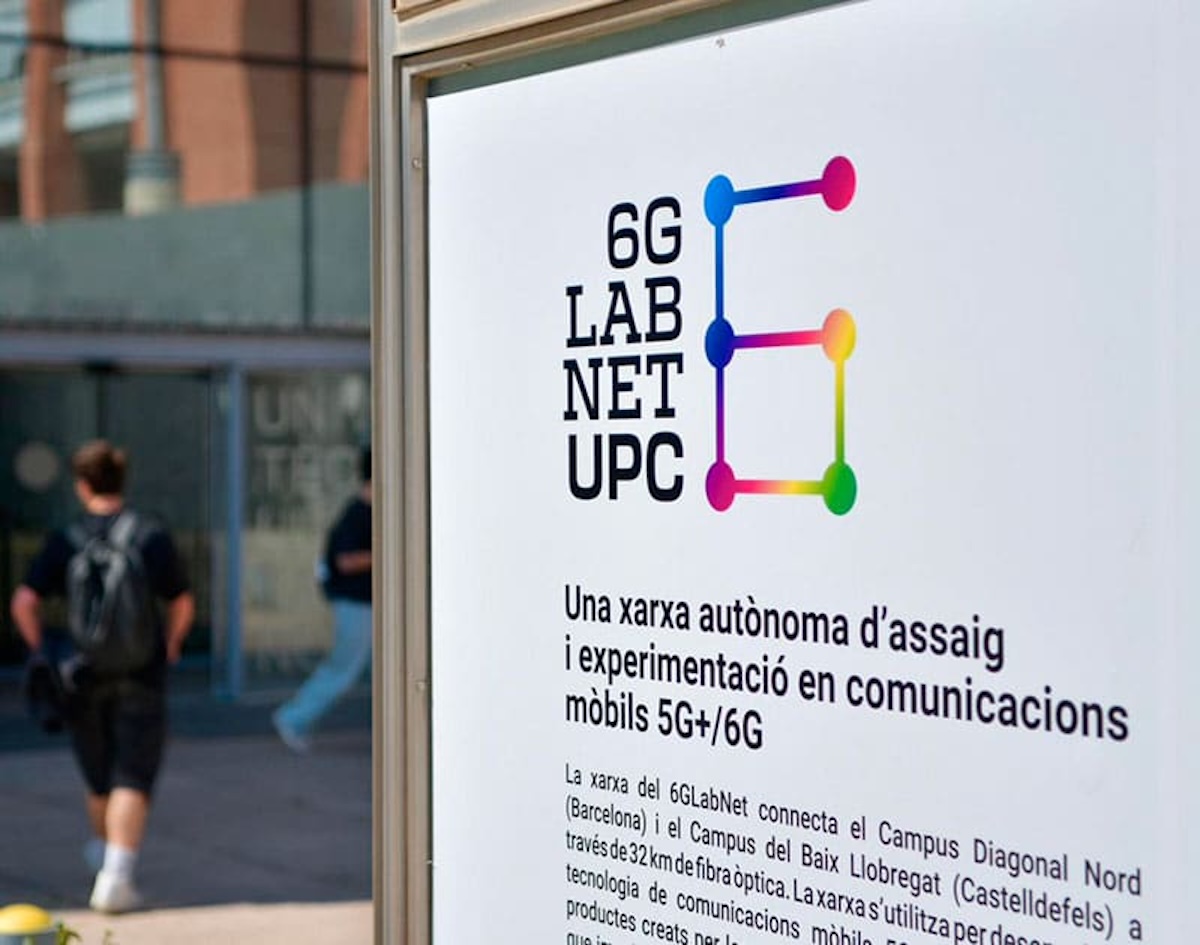
The Polytechnic University of Catalonia (UPC) has launched 6GLabNet, an experimental infrastructure designed to test 5G+ and 6G technologies in real-world conditions, not just in laboratories. The official presentation was held on April 8th, positioning the Catalan university at the forefront of the European race for the next generation of mobile communications, at a time when industry, government agencies, and research centers seek environments to validate solutions before bringing them to market.
The project also holds strategic value beyond academia. The new network is intended to serve research, education, businesses, and public administrations, with the aim of reducing the gap between technological development and practical application. In other words, it’s not just about studying 6G but creating a testing environment to verify how technologies related to autonomous mobility, drones, advanced industry, connected agriculture, or emergency services will operate in real scenarios.
A hybrid network between Barcelona and Castelldefels
The foundation of 6GLabNet is a hybrid network connecting the Diagonal North Campus in Barcelona with the Baix Llobregat Campus in Castelldefels, via 32 kilometers of fiber optic cable supplied by the Generalitat of Catalonia. Over this fixed connection, a 5G+ mobile network is superimposed, allowing experimentation with the transition to 6G using a flexible and scalable architecture.
The UPC explains that the system has been designed to offer ultra-low latency, below 1 millisecond, a key condition for applications where response time is critical. This includes autonomous driving, remote device control, collaborative robotics, or certain safety and emergency services. Additionally, the infrastructure incorporates dual 5G core networks, one at each campus, to enhance robustness and fault resilience.
One of the most notable features of the platform is that, according to the university, it is the first in Spain to include outdoor millimeter-wave base stations. Practically, this allows testing solutions in FR1 and FR2 outside the strictly controlled laboratory environment, bringing validation much closer to real operational scenarios. The combination of fiber, advanced mobile network, edge computing, and cloud capabilities makes 6GLabNet a particularly useful infrastructure for end-to-end experimentation.
AI integrated into the network itself
Another distinctive element of the project is the integration of Artificial Intelligence within the network. UPC presents 6GLabNet not only as a connectivity infrastructure but also as a platform where AI is offered as a service. To achieve this, the network combines communication capacity with computing and storage both at the edge and in the cloud, enabling certain management processes to be automated with minimal human intervention.
This approach aligns well with the direction of future 6G development. Europe has made this technology a strategic priority, and according to the European Commission, a large portion of new research projects funded for 2026 already incorporate AI and machine learning as core components. The reasoning is clear: 6G is conceived not only as a faster network but as a much smarter infrastructure capable of self-configuring, reallocating resources, optimizing routes, and adapting to context in real time.
For UPC, this vision materializes in a system of intelligent agents to self-configure and self-manage the network elements. This brings the project closer to the idea of cognitive and autonomous networks, a concept increasingly discussed in 6G debates, which may become as significant as speed or capacity improvements themselves.
More than a university laboratory
The scale of the project is also measured by its intended uses. The university is already employing this infrastructure in initiatives related to mobility and artificial intelligence such as 6G-EWOC, autonomous vehicle projects, and smart agriculture trials in Agròpolis, Viladecans. Tests are also underway with drones, cutting-edge mobile phones, advanced robotics, augmented reality, real-time vision, and Industry 4.0 applications.
During the official launch, several demonstrations showcased this potential. These included live piloting of a drone from the DroneLab in the Baix Llobregat Campus managed remotely from Barcelona, a display of an autonomous robotic vehicle developed at UPC, and an experimental vehicle equipped with optical sensors and AI to explore improvements in autonomous driving.
All of this reinforces an important idea: 6GLabNet was not designed as a closed facility for a single research group but as an open platform for industry and public administrations. The UPC rector, Francesc Torres, emphasized this point during the presentation, encouraging companies to use this infrastructure to validate prototypes and justify the public investment involved.
Public funding and European role
The development of the platform is supported by two projects, 6G-OpenLab and ELEGANT, driven by research groups from the UPC’s Center for Advanced Broadband Communications. Total funding amounts to €4 million, sourced from European funds and managed through the ÚNICO I+D 6G program of the Ministry for Digital Transformation and Public Service.
This institutional backing helps explain why the launch also carried a strong political message. Minister Óscar López highlighted the project as an example of Spain’s desire to play a role not only as a connected country but also as one capable of developing its own technology in strategic areas. La Moncloa framed 6GLabNet as a pioneering infrastructure in Spain, linking its utility to European digital sovereignty.
Ultimately, this is likely the most important takeaway. Although 6G is not yet commercially available, the race to define its standards, use cases, and industrial ecosystem is already underway. Having a real, open, industry-connected testbed positions UPC prominently in this race and reinforces Catalonia’s role as a tech innovation hub.
Frequently Asked Questions
What exactly is 6GLabNet at UPC?
It’s an experimental 5G+ and 6G communications infrastructure with integrated AI, created by UPC to test and validate technologies in real conditions between its Barcelona and Castelldefels campuses.
Why is it important for the network to have less than 1 millisecond of latency?
Because such ultra-low latency is critical for applications where response time matters most, like autonomous vehicles, drones, advanced robotics, or certain emergency services.
What makes 6GLabNet different from other telecom labs?
UPC claims it is the first infrastructure in Spain with outdoor millimeter-wave base stations and one of the few platforms in Europe allowing 6G trials in real geographical scenarios beyond the laboratory.
Besides the university, who else can use this infrastructure?
While designed for research and education, it is also meant for companies and public administrations wanting to test products, services, or prototypes over 5G+ networks and future 6G technologies.
via: upc.edu