
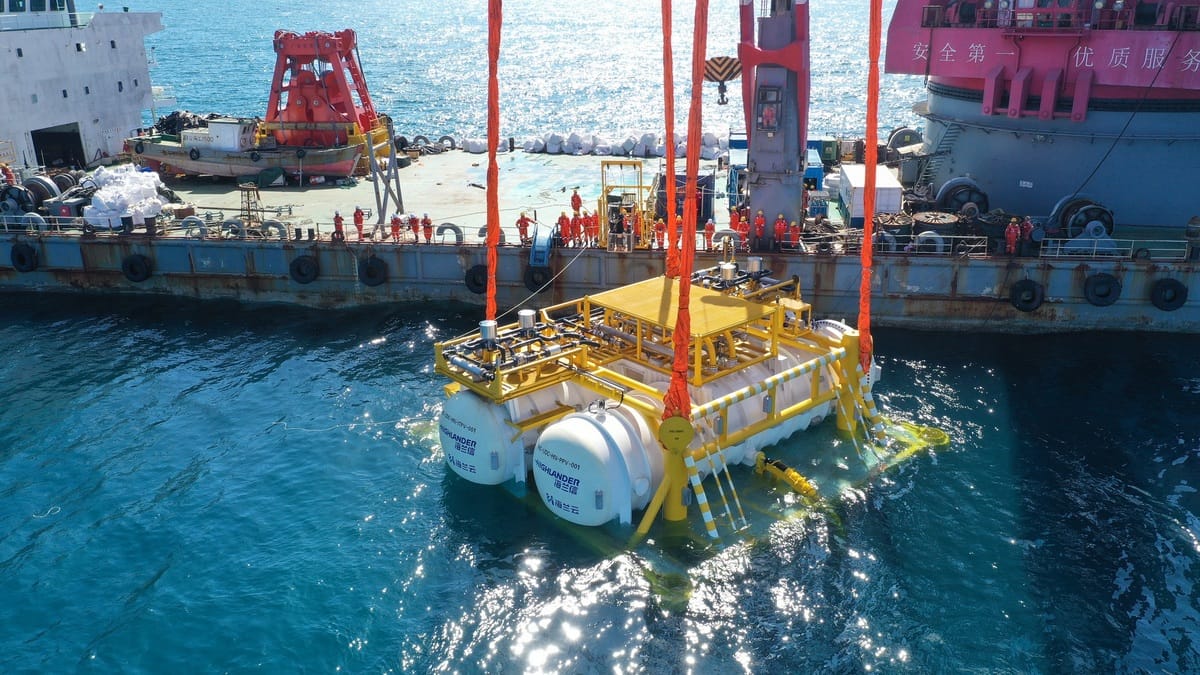
The South Korean city of Ulsan has launched one of the most eye-catching projects in the current data center industry: the development of a standard “carbon zero” undersea data center model that will use seawater as a cooling system. The initiative, driven together with the Korea Institute of Ocean Science and Technology (KIOST), has been selected by South Korea’s Ministry of Oceans and Fisheries and will receive 40 billion won in central public funding over the next five years. The total planned investment amounts to 51.1 billion won through 2030.
The proposal comes at a particularly sensitive time for the sector. The expansion of Artificial Intelligence, big data, and digital services is dramatically increasing both energy consumption and cooling needs for data centers. In this context, Ulsan aims to explore an alternative to traditional land-based data centers: leveraging the marine environment to reduce cooling costs, improve efficiency, and lay the groundwork for a large-scale commercial complex in the future.
An undersea prototype with seawater and a PUE target of 1.2
According to information published by South Korean media and supported by the project’s network of partners, the idea is to develop a submerged facility combining pressure vessel technology with a highly efficient hybrid cooling system. The technical goal is to validate operation with a PUE of 1.2 at a depth of 20 meters. Achieving this in real-world conditions would position the project as highly competitive in terms of efficiency for such installations.
One of Ulsan’s advantages is its maritime environment. The coastline facing the city maintains an average annual water temperature of 13.3 ºC, which makes seawater cooling a viable alternative to conventional surface systems that require more energy and space. Simultaneously, the project envisions the development of modular and standardized servers and electrical distribution equipment to facilitate future expansions and enhance scalability.
This point is especially important because the current plan does not envisage a large operational commercial campus from day one, but rather a design, validation, and technological demonstration phase. The official schedule aims to start this year with site analysis and basic design, complete the testing infrastructure and demonstration before 2030, and from 2031 onwards, begin constructing a large-scale undersea commercial complex.
Ulsan’s industry, academia, and telecom partnerships
The project is not solely reliant on local government. In November 2025, KIOST, Ulsan city, and other entities signed an initial cooperation agreement. In January 2026, this framework was expanded to include SK Telecom, which will handle the GPU-based AI infrastructure and the operational management of servers. KIOST explained that undersea data centers are gaining attention as a potentially more sustainable technology capable of significantly reducing total energy consumption compared to land-based facilities.
Besides KIOST and SK Telecom, the city has indicated that the project’s ecosystem includes UNIST, POSCO, GS Engineering & Construction, and other industrial, academic, and technological stakeholders. This public-private collaboration aims to lend credibility to an idea that, while striking, remains experimental and technically demanding. It’s not just about submerging servers; issues related to maintenance, sealing, pressure, cabling, power supply, redundancy, and long-term operation in a marine environment must all be addressed.
Ulsan openly acknowledges that behind this initiative also lies an industrial and territorial ambition. The city aims to strengthen its position as an innovation hub related to AI and the digital industry, using the undersea data center as a symbolic and technological pillar of this strategy. Local officials have described the project as a way to overcome the limitations of land-based data centers and to promote Ulsan as a “sustainable AI capital.”
An attractive idea but still unproven
The big question is whether the project will successfully transition from a prototype to stable commercial operation. Recent industry history shows that while undersea data center ideas garner attention, large-scale deployment remains far from being a settled reality. For Ulsan, the true value of the initiative doesn’t lie in promising an immediate revolution but in testing whether this architecture can operate efficiently, at reasonable costs, and with scalability in mind.
If successful, South Korea could position itself prominently within one of the most experimental threads of digital infrastructure. If not, at least it will have served as a barometer of how far an increasingly attractive idea can go as AI continues to strain energy, cooling, and available ground space for new data centers. In either case, what Ulsan demonstrates is a clear symptom of the current moment: the future of data centers is no longer just about computing power but also about how to cool them, where to deploy them, and their energy impact.
FAQs
What exactly does Ulsan want to build?
Ulsan aims to develop a standard undersea data center model with seawater cooling, designed to reduce energy consumption and emissions compared to a conventional land-based data center.
How much money will be invested in the Ulsan underwater project?
The total planned investment is 51.1 billion won through 2030, with 40 billion won coming from central government funding over five years.
What energy efficiency is the project targeting?
The technical goal is to validate operation with a PUE of 1.2 at a depth of 20 meters.
When might a commercial undersea data center in Ulsan be operational?
The current schedule foresees technical demonstration before 2030 and the start of commercial complex construction from 2031.
via: sedaily