
For decades, the trade landscape between the United States, China, and Taiwan remained consistent: China dominated the flow of U.S. imports across most industrial categories, while Taiwan was perceived as a critical supplier — especially in semiconductors — but with a smaller share in the overall monthly data. By the end of 2025, that picture changed abruptly.
Official data from the U.S. Department of Commerce for December 2025 reveal a turning point: U.S. imports from China fell nearly 44% year-over-year to $21.1 billion, while purchases from Taiwan more than doubled to $24.7 billion. This marks a milestone unseen “in decades”: for the first time since the early 1990s, the U.S. imported more goods from Taiwan than China in a single month.
The phenomenon results from multiple causes. According to analyses by various specialized media outlets, two forces are strengthening each other: tariffs and the race for AI infrastructure. Tariffs imposed by the Trump administration — and fears of new levies — have prompted U.S. companies to rapidly reshape supply chains. Meanwhile, the “gold rush” in AI has driven up demand for servers, racks, and complete systems—primarily produced by Taiwanese manufacturers in terms of industrial weight and assembly capacity.
From “China+1” to “AI+Taiwan”: an accelerated reshuffle
In 2025, direct trade between the world’s two largest economies contracted sharply. Chinese exporters attempted to compensate by shifting parts of production to third countries or rerouting shipments via indirect routes. However, aggregate data shows that tariff pressures and uncertainty have had a tangible effect: fewer direct purchases from China and increased dependence on other Asian industrial hubs.
Taiwan benefits from this redistribution, but its leap cannot be explained solely by “provider substitution.” The key lies in the type of goods entering the United States: advanced equipment for data centers, high-value electronics, and rack-scale systems for AI. In other words, trade is reconfiguring around infrastructure that is not optional: the computing power needed by companies like AWS, Google, Meta, or Microsoft to train and deploy models.
AI servers: the main driver of change
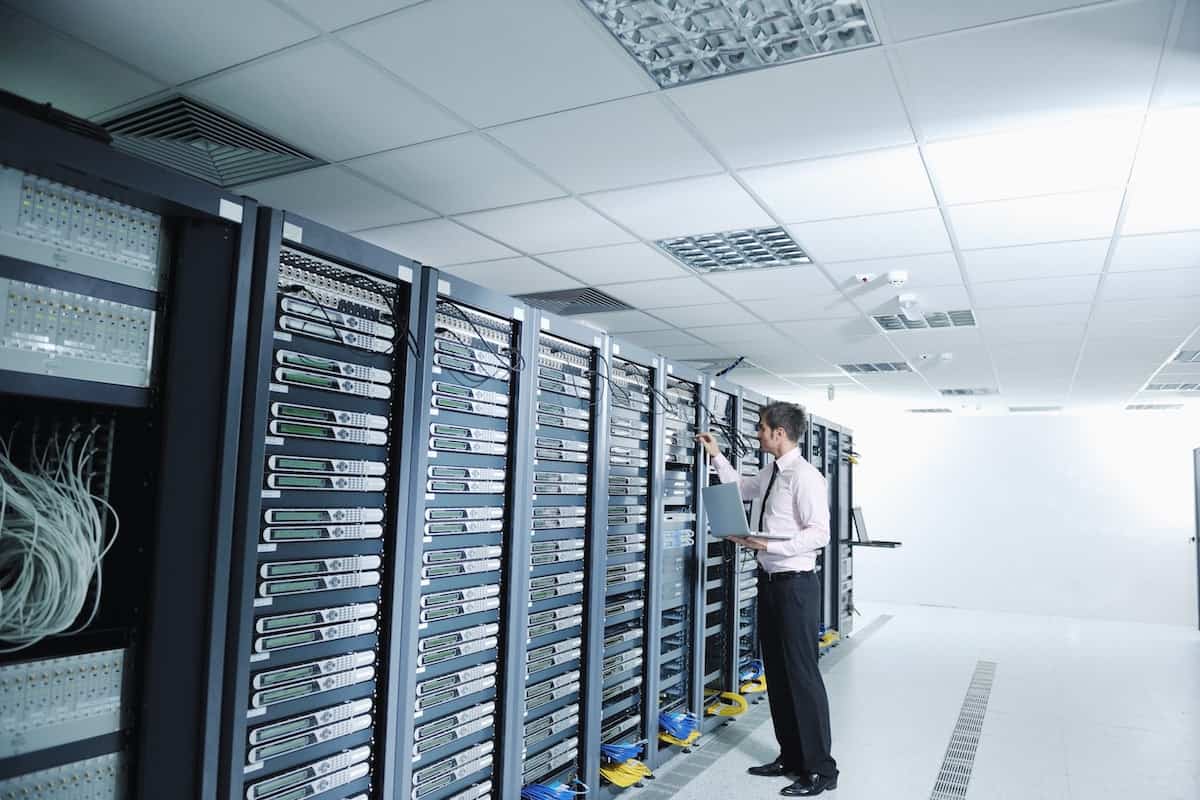
The rise of Taiwan in the monthly rankings coincides with a significant industrial fact: Taiwanese companies such as Foxconn, Quanta, and Wistron produce a substantial portion of the AI servers supporting the growth of hyperscalers today.
The “form factor” of these systems helps explain their value: many AI servers incorporate eight accelerators (for example, NVIDIA’s B200/B300 family), priced at an estimated $50,000 per accelerator. At the higher end, rack-scale systems like NVL72 configurations assemble 72 GPUs in a single unit designed for large-scale training and inference. These are not consumer products—they are strategic infrastructure, with each unit moving enough revenue to significantly influence a country’s trade profile.
Nevertheless, the industry itself expects this wave to be dynamic. Foxconn, Quanta, and Wistron are expanding production capacity in the U.S. and Mexico to serve North American markets more locally. The question is when this “local” capacity will be enough to reduce Taiwan’s export volume. Meanwhile, data from 2025 suggest that the pace of AI data center construction is absorbing all the industry can assemble.
The numbers behind the leap: “Code 84” soars
Taiwan’s export statistics reinforce that it’s not just chips — it’s complete systems. According to data from Taiwan’s International Trade Administration cited by media analysis:
- Taiwan exported approximately $198.2 billion worth of goods to the U.S. in 2025, up from $111.3 billion in 2024.
- The largest category to the U.S. was Code 84 (covering everything from PCs to AI servers and advanced systems): $145.78 billion in 2025, a 127% increase from $64.17 billion in 2024.
- In semiconductors (Code 85), U.S. sales rose to $28.79 billion in 2025 from $23.80 billion in 2024.
The global trend is even more striking: worldwide exports of “Code 84” systems reached $238.63 billion in 2025, a 93.5% increase over the $123.27 billion of 2024. By contrast, global chip exports (Code 85) also grew — from $224.31 billion to $276.7 billion, a 23.4% increase — but at a notably slower pace than complete systems. The clear conclusion is that Taiwan is not only selling more semiconductors; it is exporting more AI-ready machines.
The deficit doesn’t vanish: it shifts
There’s an irony in this trade shift: reducing direct purchases from China doesn’t automatically reduce the overall U.S. trade imbalance. The goods deficit hit a record $1.24 trillion in 2025, partly driven by tech imports related to AI investments.
In this context, the deficit with China decreased but remained large — around $202.1 billion in 2025. Simultaneously, the deficit with Taiwan doubled to nearly $147 billion, indicating that part of the flow that previously entered from China has found substitutes, but the overall balance remains strained.
Is this a stopping point or a transition?
In the short term, Taiwan surpassing China on a monthly basis serves as a symbol: trade geopolitics and AI infrastructure are steering commerce toward countries that assemble the “core” of the tech boom. In the medium term, the situation is more complex. If server production shifts somewhat to North America, Taiwan’s export volume could soften… but the growing global demand for AI systems also opens another scenario: the U.S. market could be replaced by Europe, the Middle East, or other parts of Asia without a total volume decline.
What seems incontrovertible is that AI is no longer just software — it has become a driver of international trade, capable of dramatically altering historical statistics within just a few quarters.
Frequently Asked Questions (FAQ)
Why did the U.S. import more from Taiwan than from China in December 2025?
Due to a combination of declining imports from China related to tariffs and supply chain reconfigurations, and a sharp increase in purchases from Taiwan driven by demand for semiconductors and, above all, advanced servers and systems for AI infrastructure.
What does “Code 84” include, and why is it key to understanding the AI boom?
Code 84 covers machinery and equipment like computers and servers. In 2025, it surged because much of the added value of AI is not only in the chip but in the complete system (server, network, rack, assembly) that Taiwan exports at large scale.
What role do Foxconn, Quanta, and Wistron play in increased Taiwanese exports to the U.S.?
They are major manufacturers of AI servers for hyperscalers. Their ability to produce systems with multiple accelerators and complete racks makes exported value grow rapidly as the U.S. accelerates data center construction for AI.
Could Taiwan’s share decrease if these companies expand factories in the U.S. and Mexico?
It’s possible that exports from Taiwan to North America could moderate if local production gains weight, but the global demand growth for advanced systems might also absorb Taiwanese capacity with new destinations (Europe, Middle East, or other parts of Asia).
via: Digitimes and Joey Politano on X