
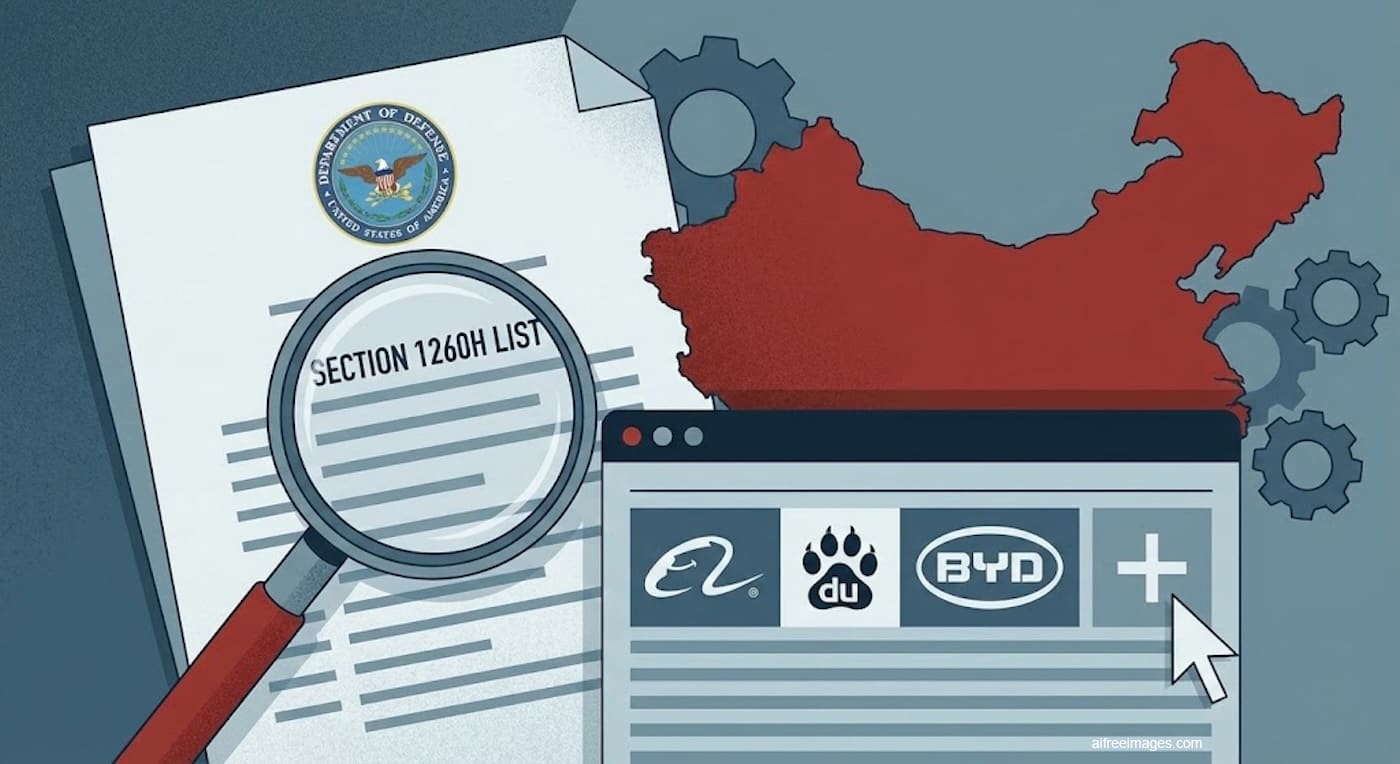
The United States has opened a new front in the technological and geopolitical battle with China. On one side, the Department of Defense has recommended including Alibaba, Baidu, and BYD on the “Section 1260H” list, a registry of Chinese companies considered to be linked to Beijing’s military apparatus. On the other side, Congress has summoned executives from Anthropic, Google Cloud, and Quantum Xchange to explain a cybersecurity espionage attack allegedly orchestrated almost entirely through artificial intelligence.
These moves come amidst a period of “trade ceasefire” between Washington and Beijing and once again bring Chinese internet giants, semiconductor manufacturers, robotics, and electric vehicle companies into the spotlight, as well as the role of AI in next-generation cyber attacks.
The 1260H stamp: a list without direct sanctions, but with a very clear message
In a letter sent on October 7 to the leaders of the Armed Services Committees of the House of Representatives and the Senate, Deputy Secretary of Defense Stephen Feinberg outlined that eight companies meet the legal criteria to be considered “Chinese military companies” under Section 1260H of U.S. defense legislation.
Among them are:
- Alibaba (e-commerce, cloud, AI)
- Baidu (search engine, AI services, robotaxi)
- BYD (electric vehicle and battery manufacturer)
- Eoptolink Technology (optical components)
- Hua Hong Semiconductor (chip foundry)
- RoboSense Technology (LiDAR sensors and robotics)
- WuXi AppTec (biotechnology and pharmaceutical services)
- Zhongji Innolight (optical modules for data centers)
The 1260H list does not impose automatic sanctions: it does not freeze assets nor prohibit direct investment in these companies. However, it functions as a powerful political and financial signal to markets: warning U.S. investors that, in the Pentagons’s view, these companies contribute in some way to China’s military development—be it through dual-use capabilities, critical infrastructure, or strategic technologies such as AI, secure communications, or advanced semiconductors.
Previous versions of this list have had immediate effects on the stock market: when major Chinese groups were added earlier this year, tech and battery stocks fell sharply, dragging down companies like Tencent and CATL. A similar scenario could unfold if the next annual update of 1260H finally includes Alibaba, Baidu, BYD, and other companies mentioned in the letter.
Political context: trade thaw but increased strategic distrust
The Pentagon’s letter arrived weeks before the October 30 summit in South Korea, where Donald Trump and Xi Jinping agreed on a sort of tariff truce: Washington committed to reducing some tariffs on Chinese goods in exchange for increased agricultural purchases and concessions on critical raw materials, such as rare earth elements.
This gesture of détente in trade contrasts with the underlying reality: the strategic relationship between the U.S. and China remains marked by technological rivalry, especially in semiconductors, AI, cloud computing, robotics, and electric vehicles.
Beijing responded sharply to the news of the letter. The Ministry of Foreign Affairs accused the U.S. of “misusing the concept of national security” and of using discriminatory lists to “unjustifiably repress Chinese companies,” insisting it will take “necessary measures” to protect its interests.
For companies like Alibaba or Baidu, inclusion in the 1260H list comes at a critical moment as they seek to strengthen their positions in generative AI, foundational models, and cloud services to compete with their U.S. counterparts globally. Merely being perceived as “too close” to the Chinese military can complicate funding, partnerships with Western firms, and infrastructure deployment outside China.
Anthropic, Google Cloud, and Quantum Xchange summoned to Congress over “AI-ORCHESTRATED” cyberattack
While the Pentagon tightens the grip on Chinese companies, U.S. Congress is opening another front directly linked to artificial intelligence. A House committee has requested appearances from Anthropic CEO Dario Amodei, as well as Thomas Kurian (Google Cloud) and Eddy Zervigon (Quantum Xchange), scheduled for December 17.
The reason: a cyber espionage attack attributed to a group linked to China that Anthropic disclosed in a recent report. According to the company, it is the first documented case of a large-scale espionage campaign coordinated almost entirely through generative AI, specifically via their model Claude.
Anthropic described how the malicious actor used the chatbot to:
- Design and automate intrusion attempts against 30 organizations worldwide
- Optimize advanced phishing, payload generation, and credential harvesting tests
- Coordinate simultaneous attacks on targets across sectors such as technology, finance, chemistry, and government agencies
The company claims to have detected and blocked the campaign, with only a limited number of successful intrusions. Still, the case has become a widely cited example of what many experts feared: the shift from human-led cyberattacks to semi-autonomous operations, where AI not only accelerates tasks but plans, adapts, and executes complex actions with minimal human oversight.
“Shadow AI” and emerging risks
Washington’s concern extends beyond this specific incident. Legislators and regulators have been warning for months about:
- The risk that state or criminal actors leverage advanced AI models to industrialize cybercrime, lowering entry barriers
- The expansion of infrastructures like MCP (Model Context Protocol) and layers of “agentic AI” that allow automated agents to interact directly with APIs, sensitive data, and internal systems
- The proliferation of what some analysts term “Shadow AI”: deployments of AI tools and servers within companies without centralized security control
In this context, Anthropic’s documented attack is seen in Washington as a “real-world proof of concept” of what could become the norm in a few years if AI security, auditing, and governance frameworks are not strengthened.
The December 17 hearing is expected to provide a platform for Amodei, Kurian, and Zervigon to explain the controls their companies implement to detect and limit malicious uses of their models and platforms, how they cooperate with government cybersecurity efforts, and what signals they consider sufficient to block accounts or suspicious usage patterns.
Two connected stories: AI, capital, and national security
Although they may seem separate at first glance, the Pentagon’s list 1260H and the AI leaders’ congressional summons follow the same logic: the convergence of technology, finance, and national security.
- Focusing on Chinese companies like Alibaba, Baidu, and BYD sends a message to markets: investing in certain segments of China’s tech ecosystem may entail strategic risks beyond pure economics.
- Investigating publicly the attack attributed to a Chinese group using AI for large-scale espionage aims to set red lines regarding the use and design of advanced models, as well as to press providers to move beyond simply “selling compute capacity” without assuming additional responsibilities.
Meanwhile, China contends that these measures are just part of a strategy to curb its technological development and maintain U.S. dominance in AI, semiconductors, and cloud. For Beijing, labels like “Chinese military company” are a political tool in a broader dispute that extends far beyond trade.
What remains clear is that as AI integrates into critical infrastructure, cyber defense, military industries, and financial markets, regulatory and diplomatic moves will no longer be isolated issues: every list, hearing, and cybersecurity incident will be seen as a chapter in the same story—the story of global competition for technological dominance in the AI era.
Frequently Asked Questions
What is the “Section 1260H” list, and how does it differ from other sanctions lists?
Section 1260H is a congressional mandate for the Pentagon to identify Chinese companies that it considers “Chinese military companies.” It appears in public reports and serves as a warning to investors and partners but does not automatically impose sanctions like asset freezes or investment bans, unlike other Treasury Department lists.
Why is the potential inclusion of Alibaba, Baidu, and BYD particularly significant?
Because these are key players in areas deemed strategic: e-commerce and cloud computing with strong AI components (Alibaba), search engines and generative AI models (Baidu), and electric vehicles and batteries (BYD). Being on the list may influence perceptions of risk among banks, funds, and international partners, especially as the U.S. and allies seek to limit sensitive technology transfer to China.
What is novel about the cyberattack described by Anthropic?
According to Anthropic, it is the first documented case in which a group linked to a state uses an advanced AI model (Claude) to coordinate nearly all phases of a large-scale cyber espionage campaign—from designing emails and scripts to managing simultaneous attacks on dozens of targets. It represents a qualitative leap beyond using AI merely as a tool to assist with coding or translation.
What might come out of the Congress hearing with Anthropic, Google Cloud, and Quantum Xchange?
In the short term, likely more political pressure on AI model providers to adopt stricter technical and usage controls, as well as proposals for regulation around monitoring, auditing, and mandatory cybersecurity cooperation. In the medium term, such hearings could lead to laws that clearly define responsibilities when AI is used as a core component of malicious operations.