
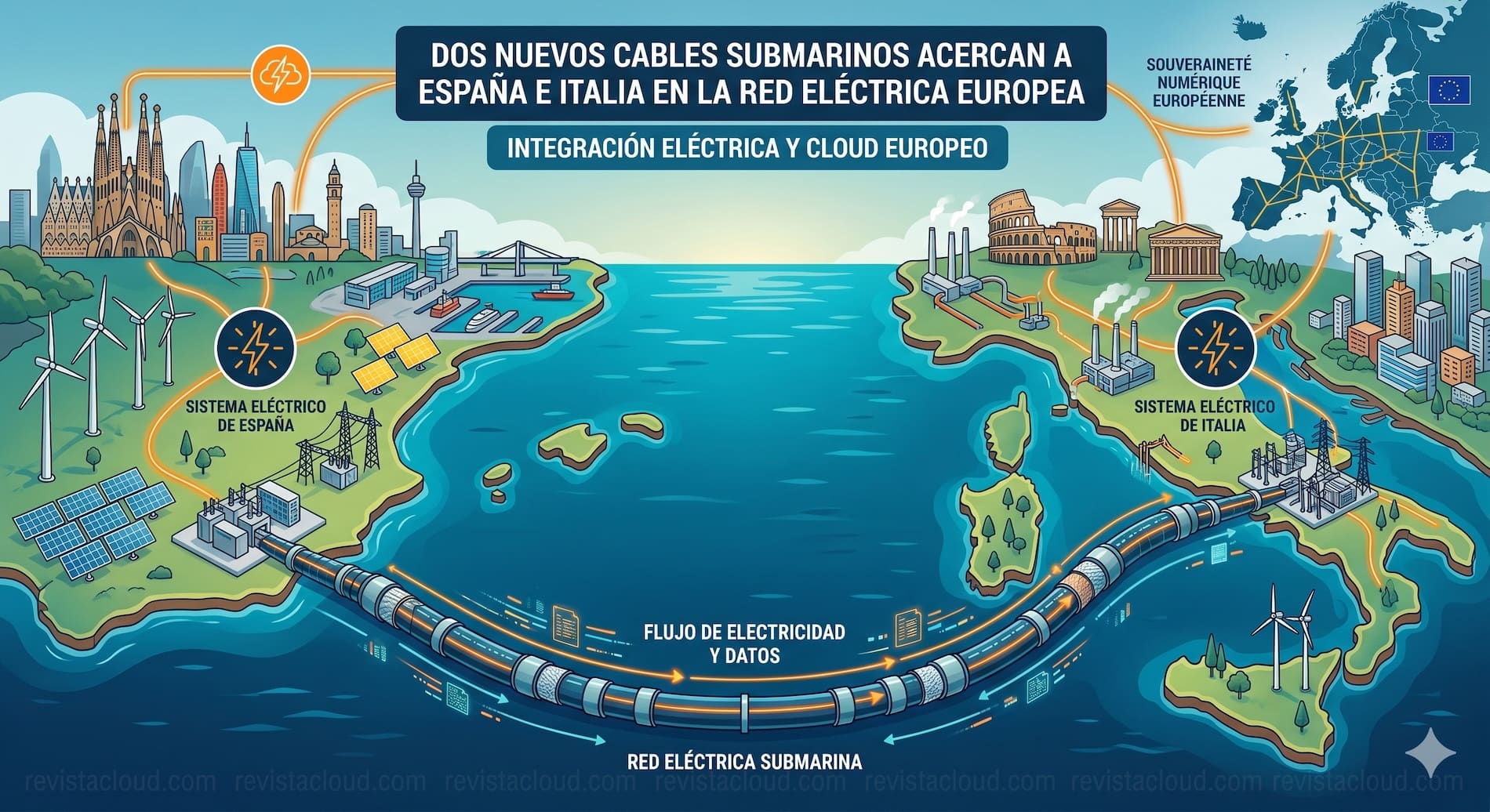
Europe aims to strengthen its electrical grid with more interconnections, and the Mediterranean is now emerging as one of the most ambitious corridors. The new project pipeline in the TYNDP 2026, the ten-year development plan for the European grid coordinated by ENTSO-E, includes two submarine connections between Spain and Italy: Apollo Link and Iberia Link. Both initiatives share the same goal: to open a new energy exchange pathway between the Iberian Peninsula and northern Italy at a time marked by electrification, renewable growth, and the need for greater flexibility in the European system.
The significance of this movement extends beyond maps. Spain remains one of Europe’s major renewable growth hubs, but the Iberian Peninsula has faced a longstanding structural issue: its low level of interconnection with the rest of Europe. The European Commission itself aims for member states to reach 15% electricity interconnection by 2030, and Red Eléctrica emphasizes this threshold as a community benchmark. In this context, any new high-capacity corridor between Iberia and other European markets gains strategic importance.
Apollo Link, the most developed project
Of the two links, Apollo Link currently has the clearest public development outline. Its documentation defines it as an HVDC interconnection between Italy and Spain, included in the European TYNDP and Italy’s national planning, with an estimated commissioning date in 2032. The project envisions a capacity of 2 GW and relies on bipolar HVDC technology with VSC converters, a common choice for long-distance submarine links due to its ability to reduce losses and improve flow control. The project’s website places the connection between Vandellòs in Spain and Marginone in Italy.
Apollo Link is also presented as a privately financed infrastructure—an important detail in a sector where large interconnections often involve lengthy regulatory and tariff debates. According to its promoters, the goal is to enhance supply security, stabilize markets, and better harness renewable potential, especially during surplus hours in the Iberian system. This is the technical and economic promise of the project, though it remains to be seen how permits, regulatory coordination, and material execution will progress for a project of this scale.
Iberia Link, less mature but highly ambitious
The second project, Iberia Link, is also included in the TYNDP 2026 portfolio, though with considerably less official publicly available detail. Sector references published recently suggest a submarine interconnection of about 1.2 GW, also based on bipolar HVDC technology at 525 kV, with an approximate length of 1,034 kilometers. This would place it among Europe’s major submarine electric links. Unlike Apollo Link, there is no publicly announced date for commissioning or a detailed public profile yet.
This maturity difference matters because it prevents mixing projects at different stages. Apollo Link currently appears as a more structured proposal with its own technical narrative; Iberia Link remains more in a preliminary phase regarding publicly available info. Still, the fact that both names are already in the European portfolio indicates that the Mediterranean corridor between Spain and Italy is no longer an exotic hypothesis but a route that the European system is beginning to consider seriously.
More resilience for an electrified Europe
The rationale for these infrastructures becomes clearer when viewed in the context of the European electricity system. The major blackout in Spain and Portugal on April 28, 2025, reignited the debate over grid resilience and the importance of increasing exchange capacity with the rest of the continent. ENTSO-E published its final report on that incident in March 2026, emphasizing the need to reinforce the robustness of the interconnected European system. While a new cable with Italy wouldn’t have automatically prevented that event, the political and technical conclusion was clear: interconnections matter.
Another factor is renewable growth. Spain is developing increasingly significant solar and wind capacity, but much of that potential loses value when it cannot be exported easily during high-production hours. The European Commission has long maintained a high-level group for interconnections in southwestern Europe precisely because the integration of the Iberian Peninsula remains a key challenge within the European electricity market. Additionally, ongoing projects like the Biscay Gulf interconnection between Spain and France aim to increase exchange capacity from 2.8 GW to 5 GW once operational, expected in 2028.
Viewed together, the future connections with Italy are not an isolated anomaly but a piece of a broader strategy: to break the relative electrical isolation of the peninsula and provide more options for the European system to move energy where needed. This flow doesn’t always have to be unidirectional. Spain could export renewable surpluses to Italy at times, but the link would also facilitate reverse exchanges when system conditions require. In an increasingly electrified and variable market driven by renewables, that flexibility is highly valuable.
Energy, industry, and the digital economy
These interconnections also carry broader implications for the European digital economy. While submarine cables are typically associated with telecommunications, electric infrastructure is increasingly playing an equally strategic role. The availability of abundant, stable, and lower-carbon energy increasingly influences industrial decisions, electrification hubs, and the growth of digital infrastructure-intensive sectors like data centers and AI services. This is a logical inference considering the growing importance of energy in industrial competitiveness and the EU’s electric integration strategy.
Therefore, more than just two cables lying at the bottom of the sea, Apollo Link and Iberia Link represent a directional shift. Europe needs more grid, more meshing, and greater exchange capacity to sustain its energy transition without multiplying territorial inefficiencies. And Spain, with more renewable capacity than much of the continent, stands to benefit greatly if connected better. The issue is no longer purely technical; it’s also industrial, geopolitical, and economic.
Frequently Asked Questions
What are Apollo Link and Iberia Link?
They are two submarine electric interconnection projects between Spain and Italy included in ENTSO-E’s TYNDP 2026 portfolio. Both aim to strengthen the energy exchange between the Iberian Peninsula and northern Italy.
Which of the two projects is more advanced?
Currently, Apollo Link is the one with a clearer public development profile. Promoters talk about a 2 GW capacity, HVDC technology, and an estimated commissioning in 2032. Iberia Link appears in the European portfolio but with less publicly available detail.
Why are these interconnections important for Spain?
Because the Iberian Peninsula still has limited interconnection with the rest of Europe. More links would facilitate better export of renewable surpluses, strengthen supply security, and increase system flexibility.
Will these connections replace the interconnection with France?
No. They are complementary. In fact, the Biscay Gulf project between Spain and France remains key, aiming to increase exchange capacity from 2.8 GW to 5 GW once it’s operational.
