
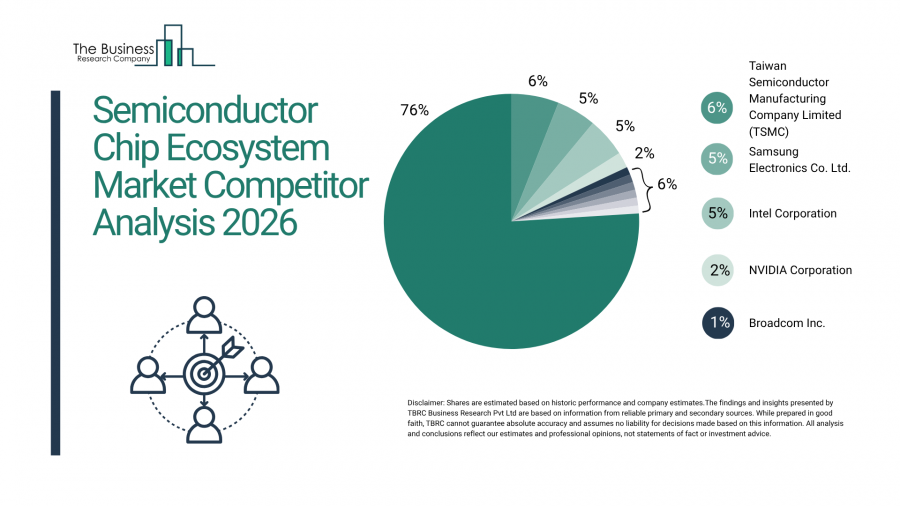
The new competitive map of the semiconductor business reveals a striking insight: there are very visible giants, but the market remains much more distributed than headlines about NVIDIA, TSMC, or Samsung suggest. According to an estimate from The Business Research Company (TBRC) released this week, TSMC is projected to lead the so-called “chip ecosystem” market in 2024 with a 6% share, ahead of Samsung Electronics and Intel, both with 5%. Further back are NVIDIA with 2% and Broadcom with 1%, within a top ten that collectively accounts for only 24% of the market.
The first conclusion is that this is not a market dominated by a single company or even by a small group. In fact, the chart included in TBRC’s material assigns 76% of the total to the rest of the ecosystem, indicating strong dispersion among manufacturers, foundries, memory companies, fabless firms, analog providers, design specialists, and IP providers. This aligns with TBRC’s own broader definition, which far exceeds just chip sales: its “semiconductor chip ecosystem” also includes wafer manufacturing equipment, testing and inspection tools, packaging machinery, and thermal management components.
A useful ranking, but with a broader market definition
This nuance is important to avoid misinterpreting the percentages. When the Semiconductor Industry Association (SIA) estimated global semiconductor sales at $627.6 billion in 2024, it referred to the more traditional chip market. TBRC, in contrast, places the size of its “ecosystem” market at $693.46 billion in 2025, $756.92 billion in 2026, and $1.062 trillion by 2030, because its scope includes more parts of the supply chain. Therefore, it is notable that TSMC appears with only a 6% share: the report is measuring a wider universe, not just foundry or finished chip sales.
However, the competitive landscape it portrays is still insightful because it reflects sector diversity well. TSMC leads as a major specialist in manufacturing for third parties; Samsung combines memory, logic, and foundry; Intel remains a key player in CPUs, processes, and vertical integration; NVIDIA dominates the AI narrative but not necessarily the entire expanded ecosystem; and Broadcom, SK hynix, Micron, Texas Instruments, AMD, and MediaTek serve very different segments, from interconnection and memory to analog, CPU/GPU, or mobile SoC.
Estimated TBRC market shares for 2024
| Company | Estimated Share |
|---|---|
| TSMC | 6% |
| Samsung Electronics | 5% |
| Intel | 5% |
| NVIDIA | 2% |
| Broadcom | 1% |
| SK hynix | 1% |
| Micron | 1% |
| Texas Instruments | 1% |
| AMD | 1% |
| MediaTek | 1% |
| Rest of the Market | 76% |
AI brings visibility to a few, but the real business remains much broader
The great paradox today is that the public discussion about chips seems almost entirely centered on AI, GPUs, and a few very specific names, while the actual business continues to rely on a much wider base. NVIDIA closed fiscal 2025 with $215.9 billion in revenue, a record figure illustrating how much the AI boom has transformed the scale of some players. Broadcom, meanwhile, increased its fiscal revenues in 2024 to $51.6 billion, with $30.1 billion from the semiconductor business and strong growth in AI-related areas.
But this prominence does not diminish the importance of other segments. Intel reported $53.1 billion in 2024; AMD hit an annual record of $25.8 billion; Texas Instruments maintains a strong position in automotive and industrial sectors; MediaTek recovered with revenues of NT$530.6 billion in 2024; and SK hynix has become a key player in HBM memory for AI. Collectively, these figures explain why the sector remains competitive and why, despite high concentration in some layers, the market is not monolithic.
More fragmented doesn’t mean fewer barriers
The fact that the top ten accounts for only 24% of the market does not imply an easy conquest. TBRC describes an environment as “moderately fragmented,” but with very high barriers: enormous capital investments, technological complexity, supply chain dependency, design capabilities, intellectual property, advanced packaging, and long-term relationships with OEMs and large clients. In other words, there is room for many players, but not necessarily for new entrants without muscle or specialization.
This aligns with industry observations. On one hand, AI and high performance are driving investments in advanced nodes, packaging, HBM, and interconnection. On the other, less-publicized markets like industrial analog, automotive, connectivity, microcontrollers, or consumer chips remain crucial. In this landscape, TSMC can lead, NVIDIA can capitalize on AI enthusiasm, and Samsung can stay decisive in memory and manufacturing, but none alone captures the entire sector’s reality.
The practical takeaway for 2026 is clear: the chip business is becoming more strategic, more costly, and more vital to the digital economy, but not simpler. Competition occurs across multiple layers — foundries, memory, design, IP, packaging, tools, software, and end systems. And perhaps the most revealing data point from the chart is not that TSMC is #1, but that the rest of the market remains so broad.
Frequently Asked Questions
Is TSMC truly the strongest company in the chip market in 2024?
According to TBRC’s estimate for the “semiconductor chip ecosystem,” yes, with a 6% share. But this market has a broader definition than just pure semiconductor sales, so this figure should not be seen as an absolute ranking of the entire global chip industry.
Why does NVIDIA only appear with a 2% share if it dominates the AI conversation?
Because TBRC’s report includes a broader view of the industrial ecosystem, not just GPUs or AI accelerators. Moreover, the semiconductor business encompasses foundries, memory, analog, equipment, and many other layers where NVIDIA does not hold the same weight as in generative AI.
What is the actual size of this market?
TBRC estimates it at $693.46 billion in 2025 and $756.92 billion in 2026, projecting over $1.062 trillion by 2030. In comparison, the SIA estimated global semiconductor sales at $627.6 billion in 2024, but that figure is based on a narrower sector definition.
Is this market concentrated or fragmented?
The short answer: both. There are clear leaders in certain layers, but the top ten only account for 24% of the market according to TBRC, indicating significant fragmentation across the entire ecosystem.
