
In the world of cybersecurity and digital privacy, the word “transparency” often sounds like a complicated promise. Many organizations claim trust while hiding key data behind corporate communication walls. The Tor Project — the nonprofit organization behind Tor Browser and part of the Tor ecosystem — has chosen a different approach: publicly sharing detailed accounts for the 2023-2024 fiscal year, accompanied by their Form 990 (the U.S. tax return for 501(c)(3) entities) and audited financial statements by an independent third party.
The organization frames this as a core idea: transparency does not conflict with privacy because privacy is about choice. In their case, they choose to show where the funding comes from and how it is used to support a project based on open-source software, regular reports, and collaboration with researchers. At a time when trust in anonymity tools is debated both technically and politically, this move sends a clear message: reinforcing legitimacy through documentation and figures.
A “fiscal year” bridging two calendar years with two total income figures
The covered period runs from July 1, 2023, to June 30, 2024, since Tor Project does not operate on the calendar year. Within this framework, the organization publishes two income figures that may seem contradictory at first glance:
- In the audited statements, “Revenue & Support” amounts to $8,005,661.
- In the Form 990, income is listed as $7,287,566.
Tor emphasizes this is not an error but an accounting difference: audited statements include in-kind contributions (non-monetary donations) as revenue, while the Form 990 reflects them as expenses. For 2023-2024, these non-monetary contributions are estimated at $768,413 and include approximately 7,614 hours of software development, 1,894,720 words translated, hosting services for 23 servers, and 26 certificates. Tor also acknowledges that it still struggles to accurately measure another vital component: the time and cost borne by relay operators, and they plan to improve this estimation in upcoming years.
From a “tech” perspective, this detail is not trivial: in privacy projects, volunteer work is not just an adornment but a significant part of the actual budget, even if it does not always pass through the books.
Where the money comes from: less dependence on the U.S. and greater diversification
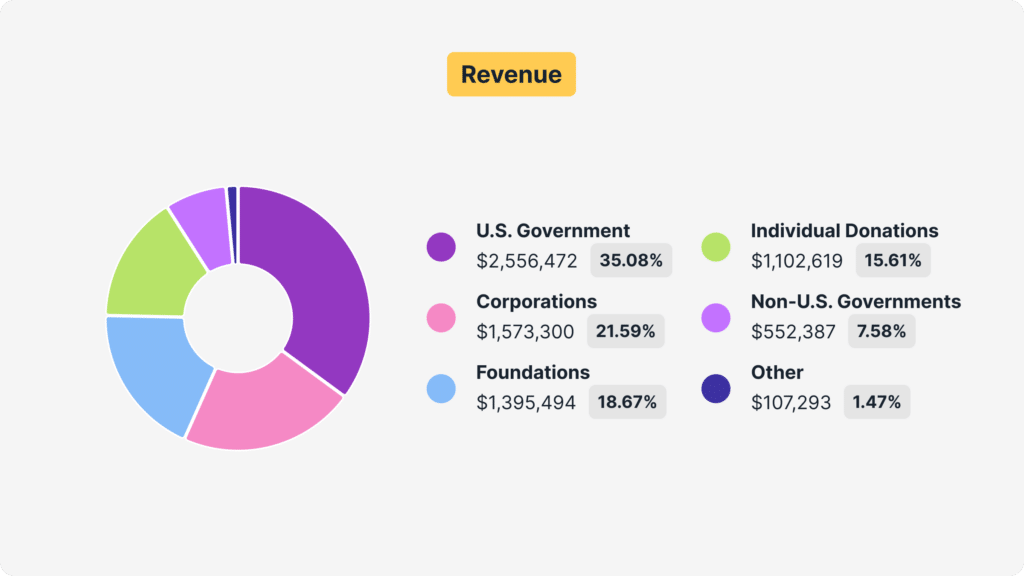
To explain their funding structure, Tor uses the total income from the Form 990 ($7,287,566) and divides it into six categories:
- U.S. government: 35.08% ($2,556,472)
- Corporations and organizations: 21.59% ($1,573,300)
- Foundations: 18.67% ($1,395,494)
- Individual donations: 15.61% ($1,102,619)
- Non-U.S. governments: 7.58% ($552,387)
- Others: 1.47% ($107,293)
The big headline here is political and reputational: the Tor Project highlights that their dependence on U.S. government funding has decreased compared to previous years. For perspective, they note that in 2021-2022, this dependency was about 53.5%, compared to 35.08% in 2023-2024. In an ecosystem where “FUD” (fear, uncertainty, doubt) is often used to discredit anonymity tools, Tor responds with a straightforward message: the numbers are published, along with documents verifying them.
Which projects are financed by the U.S. government and why does it matter technically
The organization provides details on who finances and what they fund. The most significant portion comes from the Bureau of Democracy, Human Rights, and Labor of the U.S. State Department, with $2,121,049. These projects have concrete technical implications:
- Improving censorship circumvention within the Tor ecosystem, with a focus on China.
- A “Tor VPN” client for Android aimed at privacy and anti-censorship at the device level.
- Combating malicious relays, a critical front for network health.
- Migrating components to Rust via Arti, to enhance security and robustness.
Other funding avenues include support from the National Science Foundation (through Georgetown University) for network simulation and experimentation; backing from the International Republican Institute for localization (languages like Arabic, Chinese, Swahili) and training materials; and funds from the Open Technology Fund for onion services, quick responses to censorship, and sustainability efforts for Tails.
Translated into a tech context: these funds are not just “blank checks” but project-based financing with clear deliverables, aligned with areas where Tor has invested engineering efforts over the years: anti-censorship, network integrity, and progressive stack modernization.
The private sector’s push: more partners, more memberships, more influence in the mix
The second largest category, corporations and organizations, totals $1,573,300. Tor considers this a strategic success: a 68% increase compared to the previous year, and a 154% jump over two years. They attribute this growth to increased investment in partnerships and diversification, including collaborations and support from privacy ecosystem organizations. Membership fees from entities like DuckDuckGo and Proton are also included, along with their relationship with Mullvad for developing Mullvad Browser and Tor Browser improvements.
This segment is especially vital for Tor because, the more diverse the revenue sources are, the less debate there is about the independence of their roadmap.
Individual donations and “unrestricted funds”: the oxygen for quick reactions
Individual donations reach $1,102,619, and Tor emphasizes an often overlooked nuance: these are unrestricted funds, meaning money that allows rapid response to censorship surges, quick product updates without rigid contracts, and emergency reserves. In the privacy field—where blocking can escalate in hours demanding urgent changes (bridges, distribution, support)—this flexibility is almost as valuable as the total volume.
Meanwhile, the “foundation” category contributes $1,395,494, combining restricted (linked to specific roadmap projects) and unrestricted grants. The non-U.S. government funding includes support from Sida (Sweden) for user research, localization, support, and training.
Where the money goes: 84% to “product” and the network
In expenses, Tor again reports two numbers due to the same accounting reason. According to the Form 990, expenses total $7,343,602; in audited statements, $8,112,015, including in-kind contributions.
Using the Form 990 as a baseline, the breakdown is straightforward:
- 84%: program services (developing and maintaining Tor, user support, UX, metrics, community, IT costs, technical hiring).
- 10%: administrative costs.
- 6%: fundraising.
For a privacy infrastructure project, the “program services” figure is especially relevant to a technical audience: it indicates how much of the budget directly funds engineering, operation, maintenance, and ecosystem support. Tor emphasizes that their budget is modest relative to their global impact and that their distributed design reduces per-user costs, relying on thousands of relay operators.
Frequently Asked Questions
What is the Form 990, and why does it matter in a cybersecurity project?
It’s the annual tax return filed by nonprofit 501(c)(3) organizations in the U.S., providing a structured snapshot of income, expenses, and funding sources. In privacy projects, it serves as documentary evidence against rumors and biased interpretations.
Does accepting U.S. government funding mean Tor is “dependent” on it?
Tor acknowledges public funding but highlights that reliance has decreased (from 53.5% in 2021-2022 to 35.08% in 2023-2024). They are working on diversifying income streams and detail specific projects tied to these funds.
What are “in-kind contributions,” and why does Tor quantify them?
These are non-monetary contributions (development hours, translations, hosting, etc.). Tor quantifies them to reflect the real community effort’s cost, even though they appear differently on financial documents.
Which technical areas is Tor focusing on with its current funding?
In anti-censorship, network health (including malicious relays), user tools and support, localization, and progressive modernization of the stack—particularly work related to Arti and components in Rust.
Sources:
- Tor Project Blog: “Transparency, Openness, and Our 2023-2024 Financials”
- Tor Project: Tax and Financial Reports (official document list)
- Tor Project: “2023-2024 IRS Form 990” (PDF)
- Tor Project: “2023-2024 Audited Financial Statements” (PDF)