
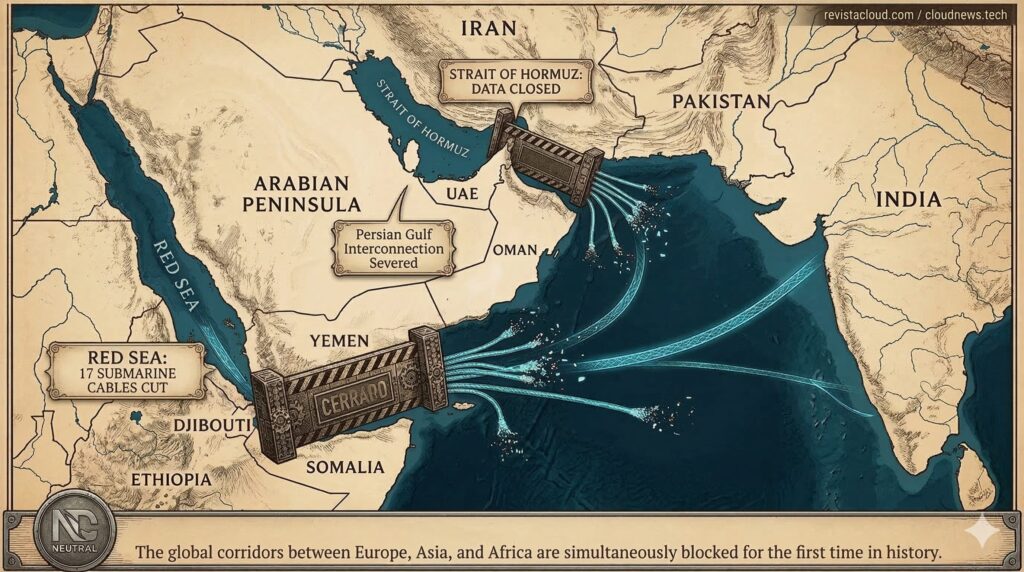
The war between the United States, Israel, and Iran has exposed a vulnerability that has been overlooked for years in favor of debates about chips, data centers, and cloud technology: the internet also depends on narrow geographic chokepoints. The Red Sea and the Strait of Hormuz have simultaneously become high-risk zones, an unprecedented situation for modern digital infrastructure and particularly delicate for the traffic connecting Europe, Asia, Africa, and the Gulf.
That said, it’s important to cut through the noise. It’s not accurate to say that “the internet has gone dark” or that all cross-continental global traffic has been blocked. The truly critical corridor for Europe-Asia connectivity remains the Red Sea, while the Strait of Hormuz mainly affects Gulf cables and connectivity routes. TeleGeography emphasizes that beyond Gulf countries, the risk to Europe-Asia traffic from Hormuz is significantly lower because those major cables pass through the Red Sea and are not just a few kilometers from the strait.
Nevertheless, the current moment is extraordinary. Reuters reported on March 1 that major shipping companies like Maersk, Hapag-Lloyd, and CMA CGM began rerouting away from the Suez Canal, Bab el-Mandeb, and the Strait of Hormuz following the military escalation and closure of Hormuz. Concurrently, Rest of World summarized the situation as the first time both chokepoints have effectively been closed to commercial traffic simultaneously — a development that drastically redefines the perceived risk to the region’s digital infrastructure.
The problem isn’t solely maritime. Reuters also confirmed that Amazon Web Services acknowledged damage to facilities in the United Arab Emirates and Bahrain following drone attacks amid regional unrest. This means that we are no longer just concerned with the theoretical risk of submarine cables being exposed; a war has already impacted physical infrastructure linked to cloud services.
The Red Sea remains the real major bottleneck
The most critical component of this scenario is located in the Red Sea. Rest of World points out that 17 submarine cables pass through this corridor, carrying the majority of traffic between Europe, Asia, and Africa. TeleGeography also notes that Red Sea cables are vital not only for the Middle East but also for eastern Africa and the connectivity between Europe and Asia.
This is not an abstract risk. TeleGeography reports that in 2024, three cables were damaged in the Red Sea and took six months to repair. In September 2025, four cables were damaged again, with three of them returning to service after five months, while one remained offline as of March 2026. The firm attributes these delays to Houthi attacks and restrictions on repair permits.
This helps explain why the industry is so concerned today. A submarine cable can fail due to common causes like anchors or fishing activity, but in a war zone, the problem worsens for two reasons: increased risk of collateral damage and, most importantly, the difficulty of repairing it. TeleGeography explains that maintenance vessels need to obtain permits, locate the fault, and remain nearly immobile while working — a process that is especially vulnerable in hostile waters.
Hormuz doesn’t move all global traffic but is vital for the Gulf
The second sensitive point is the Strait of Hormuz. Here, too, it’s important to avoid over-dramatization and prefer precision. TeleGeography identifies four active submarine cables crossing Hormuz: AAE-1, FALCON, Gulf Bridge International Cable System, and Tata-TGN Gulf. It also explains that Gulf countries are not entirely dependent on these cables since they have terrestrial routes to Saudi Arabia, Iraq, and other neighbors. However, it warns that these routes would not be sufficient to fully absorb a major dislocation of traffic if multiple submarine systems were damaged.
This means that Hormuz is not an exact equivalent to the Red Sea for global connectivity, but it is a critical piece of the Gulf’s digital ecosystem. That ecosystem is no longer minor. In recent years, Amazon, Microsoft, Google, Oracle, G42, and OpenAI have increased investments in infrastructure and AI in the region. Rest of World last week warned that these investments depend on submarine routes now situated in or very close to a war zone.
TeleGeography adds another important point: if Hormuz becomes inaccessible, repairs within the Gulf would rely on a single vessel from e-Marine positioned in the area, while the rest of the fleet’s ships are spread across the Red Sea and Indian Ocean. This doesn’t mean “no repairs are possible,” but it does indicate capacity is highly strained with much less margin for response than usual.
The industry is already seeking alternative routes to reduce dependence on the sea
The sector’s reaction proves this is no passing alarm. Bloomberg reported on March 12 that Meta has halted part of the 2Africa project in the Gulf due to the war, and TeleGeography adds that systems like 2Africa, India Europe Xpress, Raman, SeaMeWe-6, and Africa-1 remain affected by delays or frozen plans because of regional instability.
Meanwhile, Rest of World reported that Saudi Arabia, Qatar, and the UAE are accelerating projects on terrestrial corridors to route data to Europe without relying heavily on the two major maritime pathways. The message is clear: just as the region developed alternative oil routes over decades, it is now trying to create a “Plan B” for data transmission.
This is arguably the most significant takeaway. The global digital infrastructure was designed with awareness that certain chokepoints were vulnerable but operable. What has changed in 2026 is that two of these points have simultaneously come under crisis. While the internet hasn’t completely run out of routes, the combination of war, attacks on data centers, delays in new cables, and highly restricted repairs has turned a known risk into a strategic problem of the highest importance.
The uncomfortable but clear lesson for operators, hyperscalers, and European governments is that protecting the infrastructure now requires more than just securing data centers or expanding capacity inside them. It also involves protecting, diversifying, or redesigning routes connecting them globally. Because the biggest surprise in these weeks has not been the existence of cables but how fragile they remain — one of the internet’s most vulnerable points.
Frequently Asked Questions
Is internet completely blocked between Europe and Asia?
No. The situation is very serious for regional infrastructure and route resilience, but it does not mean a total blackout of internet between continents. The Red Sea remains the main bottleneck for Europe-Asia, while Hormuz mainly impacts Gulf connectivity.
How many submarine cables pass through the Red Sea?
Rest of World estimates there are 17 cables traversing the Red Sea and describes this corridor as the primary route for much traffic between Europe, Asia, and Africa.
What cables run through the Strait of Hormuz?
TeleGeography identifies four active cables crossing Hormuz: AAE-1, FALCON, Gulf Bridge International Cable System, and Tata-TGN Gulf.
Have data centers in the region already been attacked?
Yes. Reuters reported that AWS confirmed facilities in the United Arab Emirates and Bahrain were affected by drone attacks amid regional conflict.