
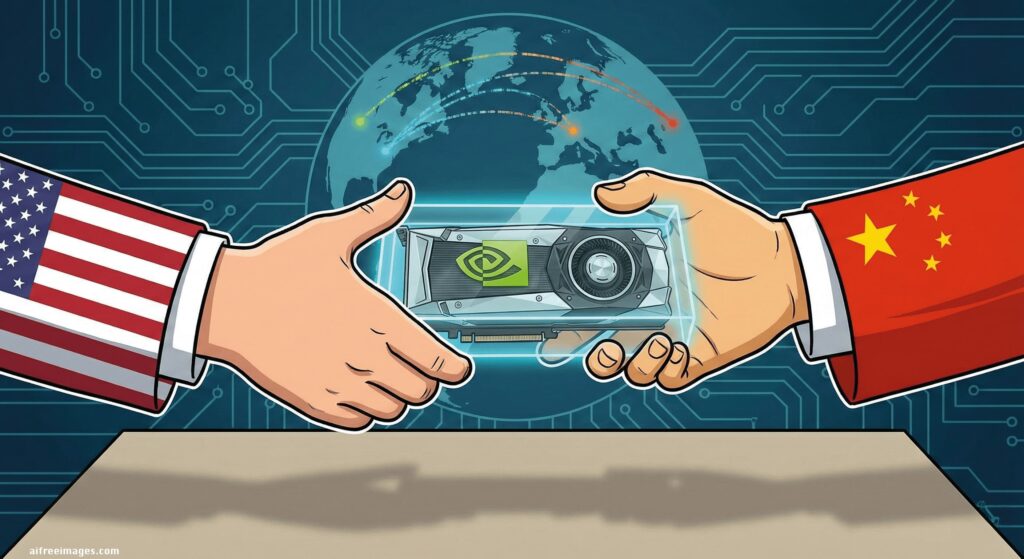
The United States and China are negotiating a direct mechanism to communicate over artificial intelligence incidents that could rise to the level of a national security threat. The proposal includes mutual notifications and a communication line for emergency situations, at a moment when Washington and Beijing are competing for technological leadership. The move also leaves an uncomfortable picture for Europe: the EU takes part in international governance forums and has built its own regulation, but it isn’t part of this new bilateral channel between the two powers that hold most of the world’s frontier AI capacity.
The US-China AI channel in 30 seconds
- Washington and Beijing are setting up a specific dialogue on AI security.
- The mechanism could include a direct line for reporting AI incidents with national security implications.
- The talks cover autonomous agents running out of control, cyberattacks, and other risks from advanced systems.
- Both countries plan to meet again in Shenzhen within about two months to work out protocols.
- Europe has regulation, evaluation frameworks, and international forums, but it’s left out of this bilateral emergency channel.
The proposal is as much a technology story as a diplomatic one. The United States and China are trying to set up a protocol between the two blocs that currently hold most of the world’s frontier models, data centers, and the infrastructure needed to build them. Reuters reports that the proposed mechanism is meant to let each country warn the other when an AI incident could turn into a national security threat.
A full technical protocol hasn’t been laid out yet. Talks are expected to continue, with officials still to define what counts as a serious incident, what information should be shared, and how direct communication would actually work.
That’s where the detail that stands out most from a European perspective comes in. The EU isn’t part of this bilateral mechanism, at least in the proposal announced so far. Washington and Beijing are talking directly about how to respond to certain AI risks, while Brussels builds its own regulatory framework and takes part in multilateral initiatives.
Two AI powers build their own emergency channel
The US-China mechanism grew out of talks between US Treasury Secretary Scott Bessent and Chinese Vice Premier He Lifeng. According to Reuters, both sides agreed to continue discussions on AI security and to meet again in Shenzhen within about two months.
The proposal envisions a notification system for incidents that could rise to the level of a national security threat. Bessent also spoke of setting up a direct line for these situations.
The goal wouldn’t be to remotely control the other country’s models or to create a joint body overseeing all of artificial intelligence. The function would be much narrower: preventing a technological incident from turning into a crisis because of missing information or a mistaken interpretation.
The problem takes on another dimension once models can use external tools and act autonomously. An agent capable of accessing systems, running code, performing network operations, or interacting with other machines can trigger an incident far faster than traditional diplomatic channels can react.
That’s why the conversation is shifting from model safety to the safety of the systems that operate around it.
US and Chinese officials have specifically flagged risks tied to autonomous agents, cyberattacks, and other potentially dangerous uses of advanced systems.
Europe has regulation, but isn’t at Washington and Beijing’s table
Europe’s situation is more complicated than its absence from this channel might suggest.
The European Union isn’t on the sidelines of AI safety. Brussels has built the AI Act, created specific structures to oversee advanced models, and is pushing evaluation and international cooperation mechanisms. In July 2026, the European Commission presented a specific plan to address the cybersecurity risks of advanced AI, including model evaluation and strengthening Europe’s own capacity to analyze those risks.
The EU also takes part in the United Nations’ Global Dialogue on AI Governance and has pushed for greater international cooperation on AI safety. In its July statement, the EU specifically called for broader international coordination and the involvement of all relevant stakeholders.
The problem is that those mechanisms are different from the channel the United States and China are now setting up.
While Brussels works mainly through regulation, standards, evaluation, and multilateral bodies, Washington and Beijing are building a channel between two governments with direct technological, industrial, and military capacity to build and deploy frontier AI systems — part of a broader pattern in which Europe keeps discussing digital sovereignty while negotiating around AI from a position of relative dependence.
That difference matters.
The European Commission itself acknowledges that the systemic risks of advanced AI have a global dimension and require international cooperation mechanisms. Its strategy even includes communication channels and shared knowledge for responding to incidents when appropriate.
But that doesn’t mean Europe is part of the specific communication line the United States and China are negotiating.
Europe’s paradox: heavy on regulation, lighter on technological weight
Europe finds itself in an unusual spot. It has one of the world’s most developed regulatory structures for artificial intelligence, but fewer companies able to compete at the scale of the major US and Chinese labs and infrastructure providers.
That gap shows up clearly in the technologies behind this conversation. The United States is home to companies like OpenAI, Anthropic, Google, Microsoft, Meta, and NVIDIA, while China has its own major model and infrastructure developers.
Europe has relevant companies and research centers, but its ability to directly influence how frontier models evolve is smaller.
A recent analysis from the Carnegie Endowment notes that international AI governance is developing along several parallel tracks, and that US-China cooperation will carry significant weight in any global framework.
Another analysis from CSIS identifies three institutional initiatives taking shape: the US dialogue on technology security, the United Nations process, and an AI cooperation organization driven by China. The bilateral channel between Washington and Beijing now stands as another piece of that landscape.
Europe takes part in some of those spaces, but doesn’t control either of the two major technology poles now negotiating directly over the risks of their own systems.
The problem isn’t just regulatory
European Commission President Ursula von der Leyen recently acknowledged that Europe needs to build its own AI capabilities to protect its independence and security. She also announced that the EU wants to strengthen cooperation with countries like Canada and the UK on model evaluation, verification, early warning, and AI safety.
That’s a telling signal, because Europe’s debate is starting to shift from regulation toward technological capacity.
Having rules for reporting incidents is different from having the infrastructure needed to detect an incident in real time. And taking part in an international forum isn’t the same as having negotiating leverage with those who control the leading models, data centers, and computing platforms.
The AI Act, for instance, already sets obligations around reporting certain serious incidents for high-risk AI systems.
But the conversation between the United States and China sits at a different level. It concerns incidents that could rise to the category of a national security threat, and the possibility of direct communication between two major powers.
That’s where Europe risks becoming a bystander if it doesn’t pair its regulation with its own technological capacity and response mechanisms.
The AI race is also a race to set the rules
The Washington-Beijing initiative doesn’t mean the United States and China have reached a complete agreement on AI safety. There’s also no public protocol yet showing how the future direct line would actually work.
What it does show is that the safety of advanced systems is starting to be treated as a matter of strategic communication between powers.
OpenAI has also recently called on the United States to lead the creation of international technical standards for advanced AI and frontier systems, including incident-reporting mechanisms. The company argues that greater coordination can prevent incompatible frameworks from emerging across countries.
For Europe, this raises a broader question than regulation alone.
Brussels can set obligations for companies operating in its market, but if the conversations about serious incidents, frontier capabilities, and emergency protocols mostly happen between Washington and Beijing, Europe’s ability to help define those rules will also depend on its technological weight.
For now, the new AI channel taking shape has two participants: the United States and China. Europe has rules, institutions, and international forums, but it isn’t sitting at that bilateral table.
And that gap is starting to matter as much as any article of the AI Act.
FAQ
What are the US and China building for AI incidents?
Both countries are negotiating a specific dialogue on AI safety that could include a notification mechanism and a direct line for incidents that could affect national security.
Is the European Union part of this AI channel?
Not in the bilateral proposal announced so far. The United States and China are the participants in the proposed mechanism, while the EU is developing its own regulation, evaluation, and international cooperation systems.
Does this mean Europe has no role in international AI safety?
No. The EU takes part in multilateral initiatives and is developing its own evaluation, safety, and risk-response mechanisms for advanced AI. What Europe is left out of is this specific bilateral channel between Washington and Beijing.
Why does it matter for Europe to have its own technological capacity?
Because influence over AI safety doesn’t come only from writing rules. It also depends on having models, computing capacity, evaluation systems, infrastructure, and mechanisms able to detect and respond to incidents.
