
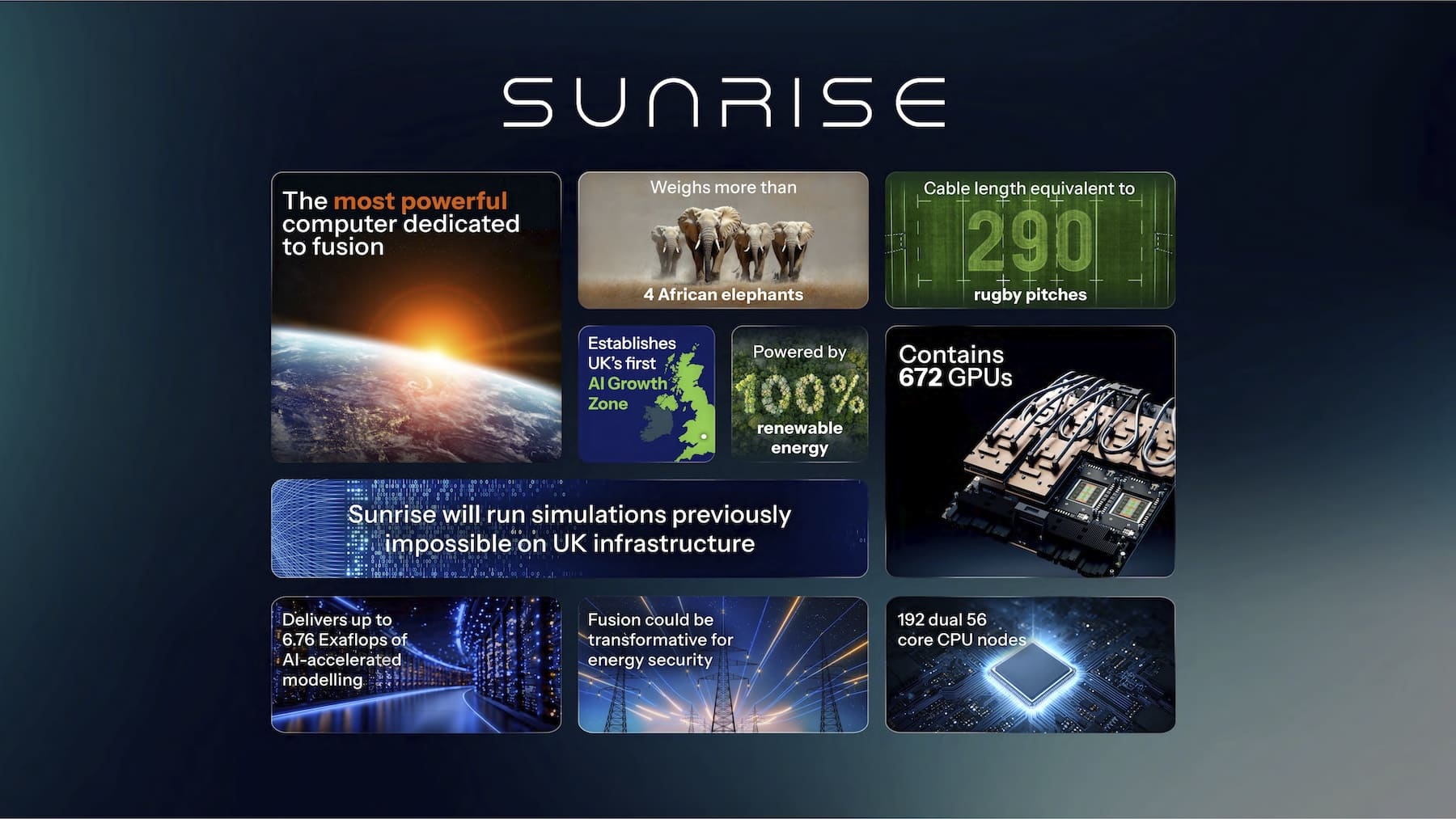
The United Kingdom has decided to strengthen its commitment to fusion with a key piece of digital infrastructure. The British government has announced an investment of £45 million to launch Sunrise, a 1.4 MW supercomputer specifically designed for fusion research and conceived as the first step toward creating the country’s first AI Growth Zone on the Culham campus, home of the UK Atomic Energy Authority (UKAEA) in Oxfordshire. The official announcement was published on March 16, 2026, with Sunrise scheduled to become operational by June 2026.
According to the UK government, Sunrise is designed to become the most powerful AI-driven fusion supercomputer in the world. The system will be funded by the Department for Energy Security and Net Zero (DESNZ) and will primarily aim to tackle some of the major technical challenges still hindering commercial fusion viability, including plasma turbulence, the development of advanced materials, and tritium breeding for the fuel cycle.
The infrastructure is envisioned not only as a computing machine but as a tool to build digital twins and high-fidelity simulations that will reduce time, costs, and risks in research. UKAEA explains that Sunrise will combine physical simulation and artificial intelligence to accelerate virtual iterations before moving to complex, costly real-world testing—a methodology likened to how the Apollo program used test environments to learn faster.
In terms of capacity, the British government states that Sunrise will deliver up to 6.76 exaflops of AI-accelerated modeling, a significant figure for a platform focused on science and energy. This computational power will support both broad research programs and specific initiatives outlined in the UK fusion roadmap, including LIBRTI—focused on tritium self-sufficiency technologies—and STEP Fusion, the UK’s major project to demonstrate fusion energy in the 2040s.
Sunrise also carries a strategic significance. It not only bolsters fusion research but also serves as the inaugural component of the future AI Growth Zone at Culham and as part of the UK’s efforts to build sovereign capacity in scientific computing. The UK’s Fusion Energy Strategy 2026 describes this investment as a means to accelerate the design, modeling, and operation of fusion systems using AI, while fostering a more robust national infrastructure for supercomputing and applied AI research in science.
The project involves a broad partnership including industry and academia. The official announcement lists AMD, Dell Technologies, Intel, WEKA, University of Cambridge, along with UK government departments DESNZ and DSIT. UKAEA also highlights the roles of Cambridge and other UK-based software and infrastructure partners in co-designing and operating the system in the future.
From an industrial perspective, the announcement underscores a growing trend: the race in AI now extends beyond generative models or general-purpose data centers into highly specialized supercomputers tailored for critical sectors like energy, climate, or materials. In this case, the UK aims to leverage AI and HPC not only to be more competitive in computing but to save time on one of the most complex and strategic energy technologies of the 21st century. This ambition was reinforced a day later when the government released its new Fusion Energy Strategy 2026, linking Sunrise to energy security, economic growth, and the creation of skilled jobs.
The context helps explain the significance of this announcement. In January 2026, the UK government had already allocated £36 million to the Cambridge supercomputing center to expand capabilities for modern AI loads and simulations. Sunrise builds on that effort, contributing to a broader strategy that combines public investment, sovereign infrastructure, and collaboration with major tech providers to make advanced computing a national industrial and scientific asset.
The promise of fusion remains long-term, but the political and technological message is clear: London wants the next phase of the race to be decided not just in laboratories and tokamaks but also in supercomputers capable of more precise modeling, faster learning, and bringing fusion closer from research to practical application—Sunrise was created precisely for that purpose.
Frequently Asked Questions
What is Sunrise?
A new 1.4 MW supercomputer funded by the UK government and UKAEA to accelerate fusion research through advanced simulation and AI. It is scheduled to start operation in June 2026.
How much is the UK investing in this project?
The announced investment is £45 million. The project is funded by the Department for Energy Security and Net Zero.
What will Sunrise be used for practically?
It will address issues such as plasma turbulence, materials development, and tritium breeding, as well as support digital twins and high-fidelity simulations for programs like LIBRTI and STEP Fusion.
What is the system’s capacity?
The UK government states it will deliver up to 6.76 exaflops of AI-accelerated modeling.
Who is involved in the project?
Partners include AMD, Dell Technologies, Intel, WEKA, UKAEA, and the University of Cambridge, along with UK public agencies DESNZ and DSIT.