
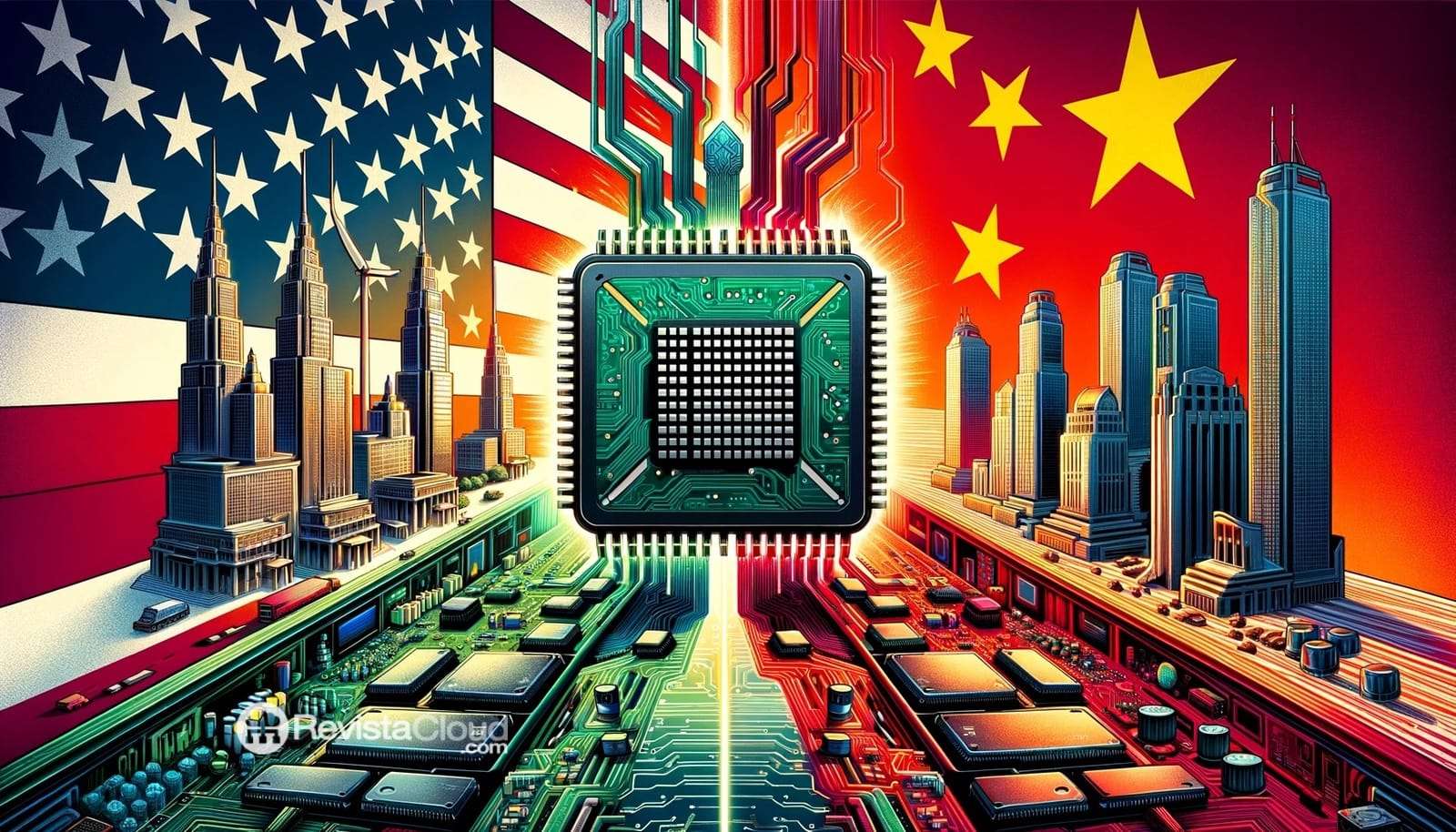
The United States is preparing to tighten its international strategy on artificial intelligence, which could force dozens of countries into an uncomfortable choice: align with the technological ecosystem promoted by Washington or maintain an equivalent cooperation with China. According to an internal draft from the State Department, known to Reuters, the US administration considers it incompatible to participate simultaneously in Pax Silica and certain Chinese AI initiatives, a stance that could accelerate the formation of two major tech blocs.
The key points of the US-China AI battle in 20 seconds
- Washington is setting new conditions for countries linked to Pax Silica and its international AI cooperation.
- The US sees it as incompatible to participate simultaneously in certain technological projects promoted by China.
- Kazakhstan has become the most visible case, being connected to both blocs.
- China has just established WAICO with 29 founding countries and its headquarters in Shanghai.
- The dispute involves chips, models, data centers, critical minerals, investment, and technological standards.
This information is significant because the competition between the United States and China is increasingly extending beyond China’s access to Nvidia accelerators or restrictions on advanced semiconductor manufacturing.
The US goal is broader: to build a trustworthy technological supply chain spanning from raw materials to AI models.
This includes critical minerals, chip manufacturing and packaging, energy infrastructure, data centers, computing capacity, and models. It also involves deciding which countries, companies, and suppliers can participate in this chain.
China is responding with its own international architecture. On July 16, in Shanghai, an agreement was signed to create the World Artificial Intelligence Cooperation Organization (WAICO), an intergovernmental organization that from its inception includes 29 founding countries and will be headquartered in the Chinese city.
The AI race thus enters a new phase. It’s no longer just about producing the best model or securing more GPUs. It’s also about deciding which infrastructure, standards, and supply chains will support AI worldwide.
Pax Silica ceases to seem like a simple tech alliance
Pax Silica began as a US-led initiative focused on enhancing the security of supply chains related to AI and advanced technologies.
However, the draft leaked by Reuters presents a much more demanding interpretation.
Washington wants to convey to its partners that participation in Pax Silica is not just about joining another international organization. The US expects a strategic commitment and considers it difficult to regard a country as a reliable tech partner if it simultaneously collaborates with a Chinese initiative centered on a competing AI vision.
This distinction is crucial.
Until now, many countries attempted to maintain technological ties with both powers. They could buy US infrastructure, receive Chinese investments, use models from both sides, and sustain trade agreements with companies in both markets.
That balance may now be at risk.
The draft appears aimed at signatories of the June AI cooperation declaration and seeks to strengthen the conditions for belonging to the Pax Silica environment.
Kazakhstan’s case illustrates much of US concern.
The US valued its engagement with Pax Silica partly because of the country’s importance in mineral supply chains. Yet, Kazakhstan also appears among the 29 countries that signed the founding agreement of WAICO in July.
Official Chinese documents confirm that Kazakh Vice Prime Minister and Minister of Artificial Intelligence and Digital Development, Zhaslan Madiyev, participated in the signing.
For the US, this dual affiliation poses a problem: a country embedded in Western strategic projects could also maintain close technological cooperation with Beijing.
China’s response with its own international AI organization
China’s alternative is now more than just commercial.
WAICO is officially presented as an independent intergovernmental organization dedicated to promoting global cooperation and governance of AI.
Beijing claims it will be open to all countries and advocates a model based on cooperation, shared development, and greater access to AI for developing nations. The Shanghai conference declaration calls for cooperation in industrial and supply chains and criticizes fragmentation in international AI governance.
This aligns with China’s official stance and also reflects its strategic rivalry with Washington.
During the July World AI Conference, President Xi Jinping announced several international commitments. Over the next five years, China will offer 5,000 training slots and seminars on AI for developing countries, establish cooperation centers with organizations such as ASEAN, the African Union, Arab League, BRICS, and the Community of Latin American and Caribbean States, and allow 30 countries to use its AI-enabled weather system, MAZU.
Additionally, an especially interesting technological tool involves open models.
China is producing a growing number of models whose weights can be downloaded and deployed on domestic infrastructure. According to Chinese authorities, open models developed domestically had over 10 billion downloads by July 2026.
This enables Beijing to compete differently.
A country doesn’t necessarily need to contract American platforms to develop AI services. It can download Chinese models, deploy them on local infrastructure, and build services around them.
For governments interested in technological sovereignty or with limited economic resources, this approach can be very attractive.
Europe faces a particularly difficult decision
The US strategy raises a key question for the European Union.
Europe is a political and military ally of the US but maintains significant trade links with China and is also trying to build its own technological sovereignty.
A strict separation of ecosystems could impact decisions that currently seem purely commercial.
Can European infrastructure use US accelerators and Chinese models?
Could a company working with Chinese suppliers participate in US-funded projects?
How broadly does the concept of a trusted provider extend?
Would this apply only to governments or also to data center operators, manufacturers, cloud providers, and developers?
The draft known so far doesn’t answer all these questions. It’s important to underline that this is an internal proposal, not an internationally accepted set of conditions.
Nevertheless, the political signals are hard to ignore.
The US has spent years trying to limit China’s access to advanced semiconductor technologies. The next step would be to prevent that capacity from being rebuilt indirectly via third countries.
This transforms export policy into a bloc-based policy.
From GPUs to the entire AI infrastructure
AI requires a much broader industrial supply chain than just Nvidia GPUs.
Before running models, minerals, semiconductors, memory, advanced packaging, servers, networks, fiber optics, energy, cooling, data centers, and capital are needed to build all this infrastructure.
Then come software, models, applications, and standards.
Both Washington and Beijing are extending their competition across nearly all of these levels.
The result could be an increasing incompatibility between two technological chains.
This doesn’t necessarily mean separate Internets or that all countries will immediately abandon foreign technologies. The leaked draft also doesn’t imply that cooperation with a Chinese company would automatically lead to exclusion.
But a trend towards decreased neutrality is evident.
Countries will increasingly have to weigh not just technological quality or cost, but also the origin and geopolitical dependencies involved.
This decision could also influence companies.
Cloud operators might need to consider the origin of their accelerators. Data centers will ponder who funds their facilities. Manufacturers will evaluate their supply chains. Governments will scrutinize where models are developed that process their data.
The choice between the US and China might be made well before running the first prompt.
AI could end up divided into two major trust chains
Washington argues that it makes no sense to share investments, minerals, industrial capacity, or strategic technology with partners who might later help develop a competitor.
China offers a different approach. In July, Xi Jinping advocated for open cooperation and explicitly criticized expanding the concept of national security to AI, while WAICO presents itself as an open organization to any country.
Both positions are driven by their own strategic interests.
Therefore, the most important takeaway from this week’s news isn’t just Pax Silica.
It’s that artificial intelligence is developing a geopolitical structure similar to that which sectors like energy, telecommunications, or defense have had for decades.
Technology is beginning to define alliances.
For many countries, especially emerging economies needing investment, data centers, and affordable models, choosing only one side may be unattractive. Maintaining ties with both Washington and Beijing offers competition, funding, and negotiating leverage.
Kazakhstan exemplifies this model.
The US seems willing to reduce this margin.
If Reuters’ approach becomes official policy, the biggest AI battle will be decided not just among OpenAI, Anthropic, Google, Nvidia, DeepSeek, Alibaba, or Zhipu, but also country by country.
Then, chips, minerals, data centers, and models may no longer be chosen solely based on price and performance. Technological provenance could become a matter of foreign policy.
Frequently Asked Questions
What is Pax Silica?
It’s a US-led initiative to bolster international cooperation and supply chains related to AI, semiconductors, and other strategic technology resources.
Does the US already force all allies to choose between China and the US?
Not exactly. The Reuters report derives from an internal draft of the State Department. The known approach aims to prevent certain simultaneous participations but is not yet a definitive or universal obligation for all US allies.
What is WAICO?
The World Artificial Intelligence Cooperation Organization is a new intergovernmental body launched from China to promote AI cooperation and governance. Its founding agreement was signed in July 2026 by representatives from 29 countries, and its headquarters will be in Shanghai.
Why is Kazakhstan important in this dispute?
Because it maintains ties with Pax Silica and is also among the founding members of WAICO. Its situation highlights the difficulties faced when demanding countries with diverse economic relations to fully commit to a single technological ecosystem.
via: Reuters and elchapuzasinformatico
