
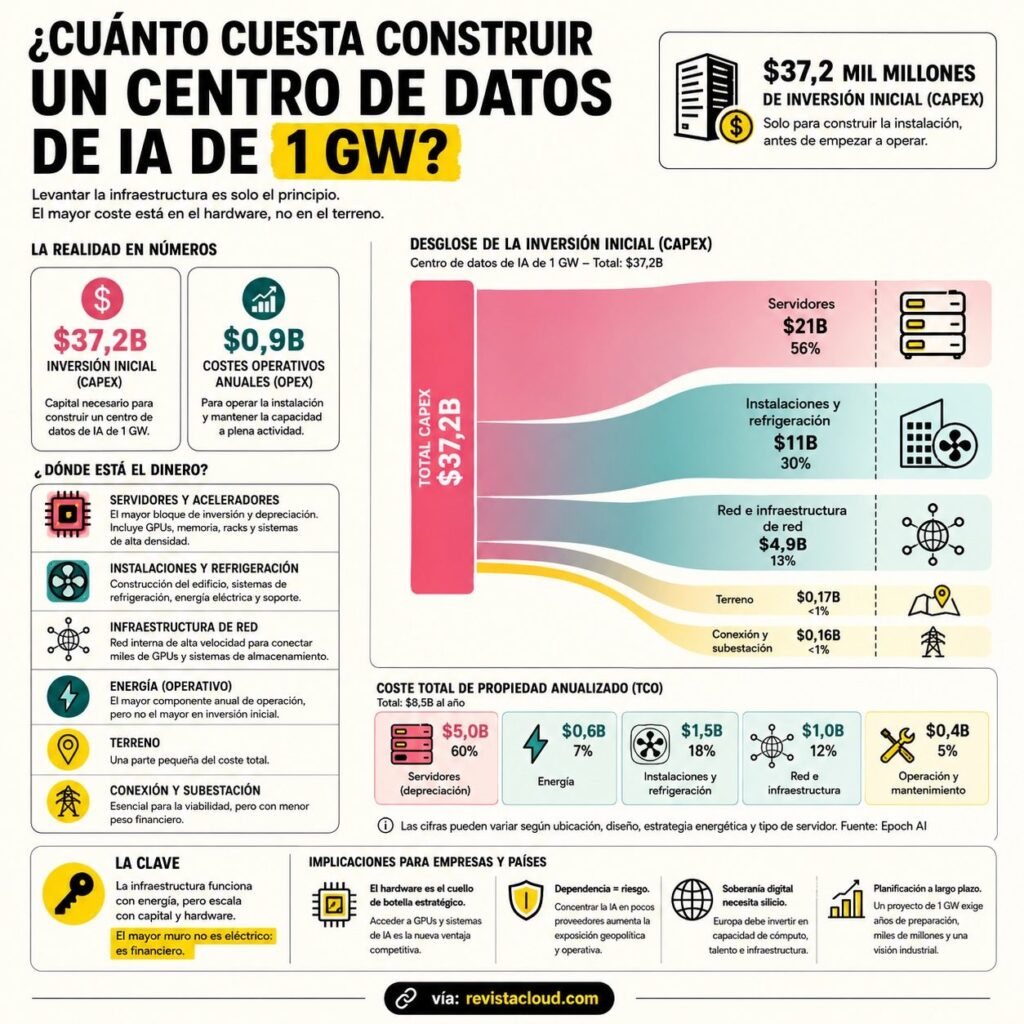
Building a 1 GW AI data center is no longer like hauling a tech ship with servers inside. At that scale, the facility becomes a top-tier financial, energy, and industrial operation. The figure that helps understand this is hard to ignore: according to Epoch AI’s model, a 1 GW AI data center requires around $38 billion in initial investment and about $900 million annually in operational costs.
The visualization attributed to Epoch AI places the initial CapEx at $37.2 billion, a figure that’s rounded up to $38 billion in the analysis itself. The difference doesn’t change the core message: the biggest capital hurdle isn’t land or even grid connection. It’s the computing hardware, especially AI accelerators servers. In Epoch’s model, servers dominate the total annualized cost, amounting to about $5 billion per year, roughly 60% of the total ownership cost annually.
AI scales not just with energy: it scales with capital
In public debates about AI data centers, there’s much talk of electricity, permits, land availability, water, grid access, and local opposition. All of that matters. Without power, there’s no AI cluster. Without permits, no construction. Without cooling, no stable operation. But when examining the economic structure of a 1 GW installation, a more uncomfortable reality surfaces: the most expensive component depreciates the fastest.
Epoch AI models a hypothetical 1 GW data center operated by a US hyperscaler, with a nominal capacity of 1 GW for IT equipment. The organization cautions that this isn’t a specific installation estimate and costs can vary depending on location, design, financing, energy strategy, and server type.
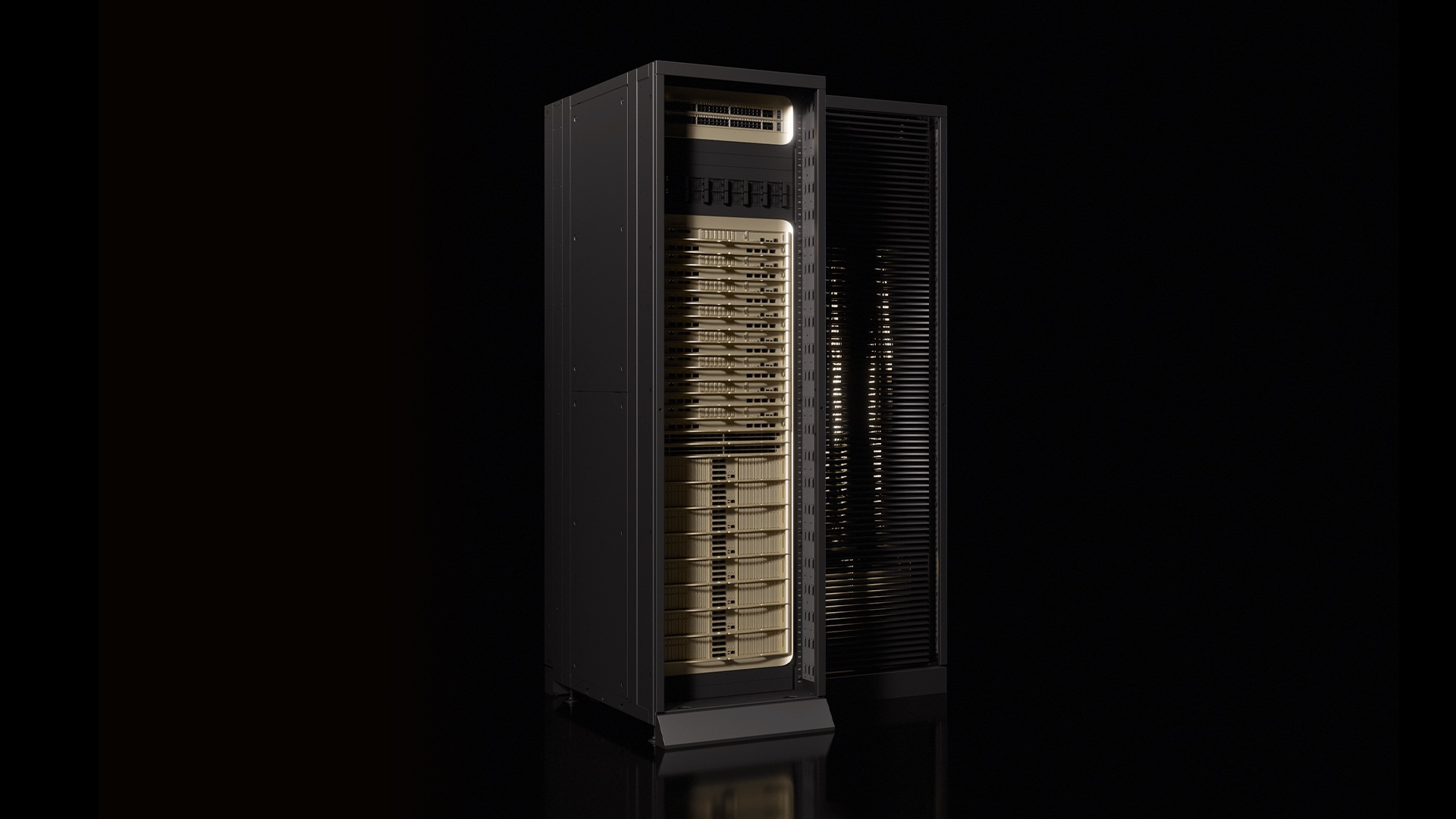
The central assumption is also important: the model is based on NVIDIA GB200 NVL72 systems, which are associated with high-performance AI workloads. Changing the server type also alters costs related to hardware, networking, cooling, density, power, and operation.
The financial takeaway is straightforward. A data center of this scale demands tens of billions upfront before generating any revenue. It’s not just about constructing the building and powering it; it’s about buying and installing a vast array of servers, GPUs, internal network, storage, cooling, electrical supply, and auxiliary systems. Physical infrastructure is expensive, but silicon weighs even more.
Hardware is the silent bottleneck
The breakdown shared from Epoch AI’s model indicates that servers account for more than half of the initial investment. In the annualized view, this becomes even clearer: servers amount to around $5 billion per year out of a total ownership cost of $8.5 billion. Energy, despite being the largest operational component, stays around $600 million annually—substantial, but well below the hardware’s annualized cost.
This shifts how we interpret the AI race. Scarcity isn’t just about megawatts. It’s also about the capacity to buy, finance, receive, and amortize specialized hardware at enormous scale. AI chips, HBM memory, switches, interconnection systems, and high-density racks are what turn a data center project into a high-capital investment.
| Category | Economic Insight |
|---|---|
| Servers and accelerators | Main block of investment and depreciation |
| Internal network | Necessary for thousands of accelerators to operate together |
| Installation and cooling | High cost, but less than hardware |
| Energy | Main OpEx, though not the dominant factor in TCO |
| Land | Small compared to total cost |
| Connection and substations | Important for feasibility, but less impactful financially |
The internal network infrastructure deserves a special mention. In AI, it’s not enough to just accumulate GPUs. They must be connected with low latency and high bandwidth for large-scale training and inference to be efficient. That’s why network costs aren’t optional—they are part of the cluster’s actual performance.
Land isn’t the major cost, but it can block projects
That land and connection represent a small part of total cost doesn’t mean they’re irrelevant. Cheap land is of little use if it lacks access to energy, fiber, water, or permits. A grid connection might be a minor entry in the spreadsheet, yet it could become the bottleneck that delays a project by years.
The nuance is crucial. Financially, the biggest expense is in hardware. Operationally and regulatorily, electricity availability and permitting can decide whether the data center ever comes into being.
That’s why the industry talks so much about energy. Not because it’s always the priciest line item, but because it’s a prerequisite. A gigawatt isn’t built on the fly. It requires grid planning, substations, supply agreements, evacuation capacity, permits, cooling, and coordination with electrical operators.
Epoch’s model assumes that the facility is fully grid-powered and doesn’t include behind-the-meter generation. The organization cautions that adding dedicated generation would likely increase installation costs and could also impact energy expenses.
Hardware lifespan reshapes the economy
The most useful insight from Epoch AI’s analysis is its sensitivity to equipment lifespan. The organization assumes five years for IT hardware and 14 years for the facility itself. If the hardware lifespan shortens to three years, the total annual cost rises to about $12 billion; if extended to seven years, it drops to roughly $7 billion.
This point is critical for understanding AI’s competitive pressure. Buildings and substations can last longer. But AI accelerators age quickly if each new generation offers more performance, more memory, better efficiency, or lower cost per token. Hardware depreciation thus becomes a strategic variable.
For a hyperscaler, it’s not enough to just buy GPUs. They must be kept busy profitably for as many hours as possible before the next hardware cycle diminishes their competitive value. That’s why utilization, workload assignment, scheduling, power consumption, software efficiency, served models, and the capacity to sell or internally repurpose the computing matter are vital.
AI requires not just CapEx—it’s about CapEx rotation.
Why this benefits hyperscalers
An investment of around $37-38 billion per installation is out of reach for almost any actor other than a major hyperscaler, a financial-industrial consortium, or a partnership backed by substantial government or corporate support. The result is a natural concentration: those with strong balance sheets, access to debt, supply contracts, chip manufacturer relationships, and energy capacity have an advantage.
The funding discussion is increasingly resembling large infrastructure projects rather than traditional tech. The industry no longer just finances servers; it finances gigawatts, supply chains, energy agreements, land, substations, fiber, liquid cooling, and hardware refresh cycles.
This explains why debates over tariffs, export controls, semiconductor restrictions, or memory prices are far from secondary. If hardware is the main part of the cost, any disruptions in the supply chain directly impact AI deployment costs.
It also clarifies why many companies will opt for smaller models, optimized inference, quantization, specialized hardware, private clouds, shared accelerators, smart routing, and software efficiency. Not every AI challenge justifies the most expensive infrastructure.
The missing metric: cost per useful capacity
While 1 GW sounds impressive, it doesn’t tell the whole story. What truly matters is how much useful capacity is gained per dollar invested. A data center might be highly powered but underperform if internal network limitations, cooling constraints, low utilization, or software inefficiencies hinder optimal hardware use.
In the coming years, focusing solely on megawatts or GPU counts will be less useful. Metrics like cost per token, per task, per training cycle, per hour of GPU usage, performance per watt, actual utilization, latency, and hardware amortization will become increasingly relevant.
The AI race is turning into a competition of industrial efficiency. Success will go to those who can convert capital into useful capacity faster and with less waste.
Epoch AI’s report helps bring clarity to a debate often stuck on energy headlines. Energy matters. Land matters. Permits matter. But in a 1 GW AI data center, the key question comes earlier: who can finance tens of billions in hardware before knowing if that capacity will be filled with profitable work for its entire lifespan?
Frequently Asked Questions
How much does it cost to build a 1 GW AI data center?
According to Epoch AI’s model, roughly $38 billion in initial CapEx, with about $900 million in OpEx annually.
What’s the most expensive component?
Server and accelerator hardware. In annualized terms, servers account for about 60% of the total ownership cost.
Is energy the biggest cost?
It’s the largest operational expense, but not the primary total cost if the investment is annualized. Epoch AI estimates around $600 million per year in energy versus about $5 billion for servers.
Why is GPU lifespan so critical?
Because AI hardware depreciates quickly. If lifespan shortens from five to three years, the total annual cost rises significantly.
Can a mid-sized company build infrastructure at this scale?
At 1 GW, it’s very challenging. The volume of capital, electrical supply, chip access, and operational capacity favor hyperscalers and large financial or industrial alliances.
