
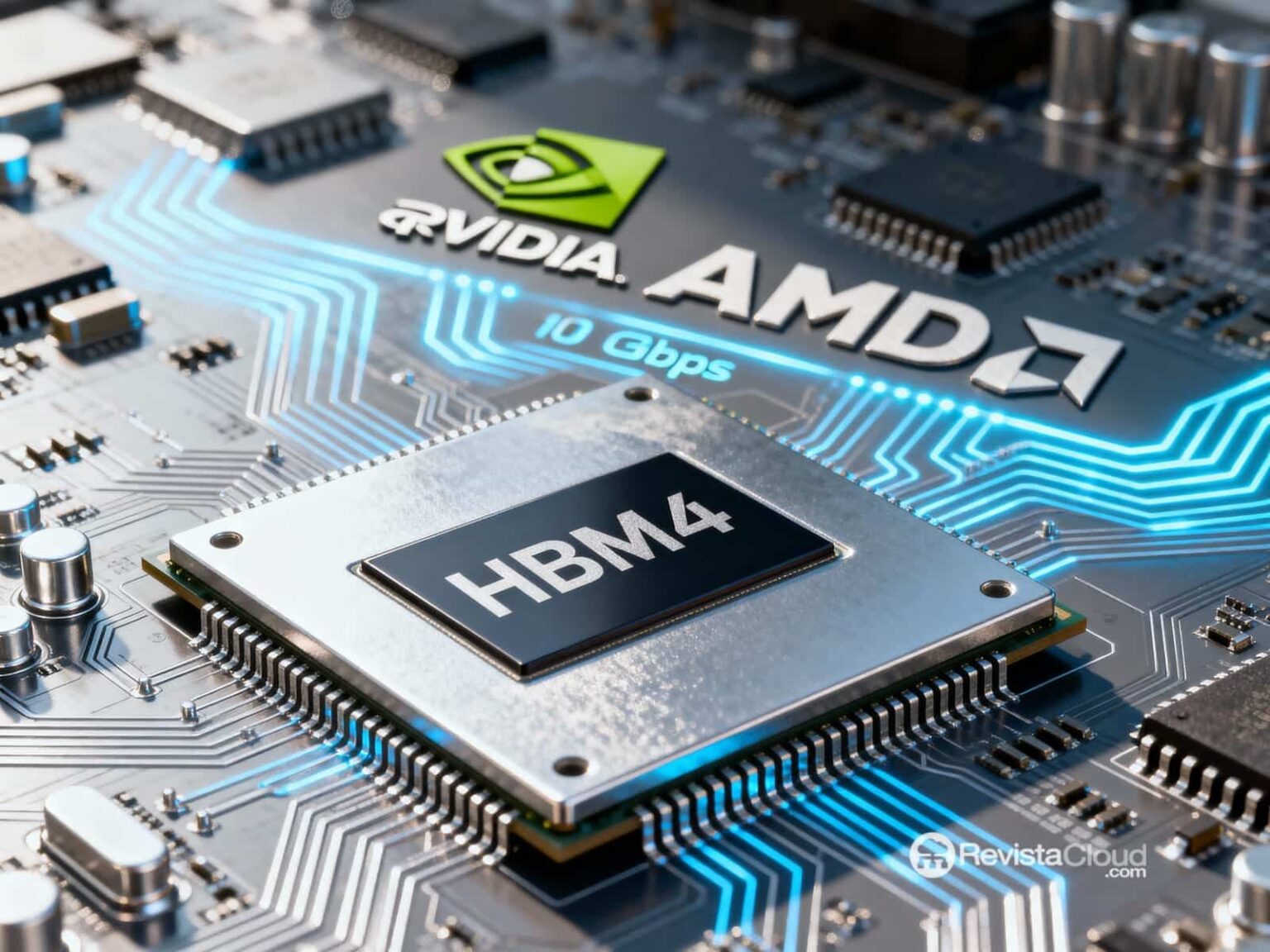
The global memory market is experiencing a situation that the industry is openly calling “mad mode.” The boom in artificial intelligence has skyrocketed demand for DRAM, NAND Flash, and especially high-bandwidth memory (HBM) to the point that the projected production capacity for 2026 is practically sold out in advance.
According to early reports from DigiTimes, major cloud service providers (CSPs) in the United States and China have launched a race to sign long-term agreements (LTAs) of 1 to 2 years with key memory manufacturers, aiming to secure supply through 2027–2028 and to position themselves at the forefront of an increasingly tense value chain.
2026, a nearly lost year for those who arrive late
The industry’s clear diagnosis is:
- DRAM and NAND capacity for 2026 is almost committed through contracts and reservations with major clients.
- Shortages are not a theoretical risk but an assumed scenario: there is no margin to “fix” it with short-term increased production.
CSPs are not only purchasing to meet their forecasted data center demand. They are aggressively increasing their inventory levels, buying much more than they currently use to stay ahead in the AI race. This pushes all other buyers back: server manufacturers, OEMs, integrators, and companies operating on-premise or in colocation facilities.
The result is a sudden shift in balance:
- The bargaining power shifts to memory manufacturers, who can choose whom to sell to, under what conditions, and with what priority.
- The industry expects that contract prices will continue rising throughout 2026, with no classical downward correction in the second half of the year.
- Some segments are seeing accumulated increases of up to 50% in the next 6–9 months compared to current long-term contract levels.
To secure their position, large cloud clients are willing to accept conditions that would have been unthinkable a few years ago:
- Price premiums (“overpricing”) for priority supply.
- Prepayments to guarantee capacity.
- Co-financing of equipment or even new factories, tying in part of their future production for several years.
Only one or two “top” CSPs might secure truly long-term, advantageous contracts. The rest will settle, at best, for one-year agreements. For many smaller buyers, the reality will be quite different: quarter-to-quarter or even month-to-month negotiations, without firm supply guarantees.
It’s not just DRAM under pressure. NAND Flash is also at its limit, with manufacturers warning of scenarios where, even accepting price hikes, there’s simply no product available at certain times. Signs of this are already appearing in the end market:
- Small PC and server manufacturers raising prices or reducing maximum RAM and SSD configurations.
- OEMs and assemblers pre-purchasing components “out of fear” of stock shortages.
- Paradoxical situations where a complete PC or gaming console costs less than a high-end DDR5 RAM kit.
How did we reach this bottleneck?
The perfect storm in memory is explained by the combination of four main factors:
- Explosion of generative AI and large models
Training and inference nodes with high-end GPUs (such as H100, H200, B200, MI300 series, and successors) incorporate hundreds of gigabytes of DRAM and/or HBM, along with large volumes of NAND in NVMe SSDs for datasets, checkpoints, and logs.
Projects like OpenAI, Anthropic, Meta, or Google don’t deploy just a few servers: they build entire GPU farms, multiplying memory demand by several orders of magnitude. - Manufacturers focusing on higher-margin products
Companies like SK hynix are deciding to channel most of their investment into HBM and high-value-added DRAM, while expanding capacity for “conventional” DRAM or NAND grows much more slowly.
Building new factories and ramping them to maximum output takes years and billions in investment, so there’s no quick fix for the current demand peak. - Shift in model: from overcapacity to “build-to-order”
After a decade of cycles of excess supply and falling prices, the memory industry seems to have learned its lesson. Major manufacturers are moving toward a “secure orders first, then expand production” model.
In practice, this means they prefer to run at a shortfall but with higher prices rather than returning to oversupply with depressed margins. - CSPs with abundant cash and strategic urgency
Hyper-scale players have capital and competitive pressure: they must continue deploying AI infrastructure to stay ahead of other global players.
Stopping projects due to lack of memory is not an option, so they are willing to pay more today rather than lose market share or delay launching new AI services.
A near future of high prices and “politicized” memory
If significant new capacity isn’t added, the reasonable forecast is that high prices and volatility will persist at least until 2027.
During this period, new destabilizing factors may emerge:
- Geopolitical tensions affecting the supply chain.
- Delays in bringing new factories online.
- New generations of GPUs that are even more memory-intensive.
For companies outside the elite of hyper-scalers, this translates into more expensive servers, enterprise PCs with higher costs when a lot of RAM is needed, and less room for “generous” configurations in workstations or developer setups, internal AI, or in-memory databases.
If long-term contracts solidify, the industry could become less cyclical, but also more concentrated and unequal:
- Manufacturers will have part of their production sold years in advance.
- Major CSPs will secure memory at relatively predictable prices.
- The rest of the clients will be in a sort of “queue,” more exposed to price spikes and uncertain availability.
Impact on infrastructure design and companies
With more expensive and scarce memory, system architects will have no choice but to maximize the use of every gigabyte:
- Increased adoption of model compression, quantization (4-bit, 8-bit), and memory optimization in training and inference.
- More complex memory hierarchies, with growing use of technologies like CXL to disaggregate memory and share it across nodes.
- Orchestration platforms that enable partitioning GPUs and memory and improving effective utilization rates, as some advanced orchestrators already promise.
For a “typical” company purchasing infrastructure — whether on-premise, colocation, or private cloud — the scenario entails:
- Higher initial investment in servers: the combination of CPU/GPU + large RAM + high-capacity SSDs will be significantly more costly.
- Need for 2–3 year capacity planning: aligning hardware purchases with potential price hikes.
- Review of resource usage practices: consolidating loads, eliminating over-provisioned infrastructure, and optimizing data retention and caching policies.
- Close monitoring of DRAM and NAND price trends to leverage any relief window that may open around 2027–2028.
Frequently Asked Questions about Memory Shortages Due to AI
Why does artificial intelligence impact RAM and NAND prices so heavily?
Because modern AI systems require servers with high-end GPUs that demand enormous amounts of DRAM, HBM, and flash storage. Each new training or inference cluster adds hundreds or thousands of memory modules, stressing a supply chain not scaled for this growth rate.
How will this memory shortage affect server and enterprise PC prices?
The pressure on DRAM and NAND will translate into higher prices for equipment needing large memory capacities. It’s likely that servers with high-density RAM and enterprise SSDs will become more expensive, and some “enthusiast” PC and workstation configurations will be much less affordable during 2026 and most of 2027.
What can companies do to prepare for rising memory costs?
Experts recommend planning capacity upgrades earlier, negotiating full packages with vendors (server + RAM + SSD), optimizing resource utilization (more efficient virtualization, load consolidation, better data and cache policies), and prioritizing investment areas where memory adds the most direct value.
When might the memory market normalize after the AI demand peak?
Normalization depends on the ramp-up of new DRAM, NAND, and HBM factories and whether AI demand sustains its current pace. Some relief may be seen from 2028 onward, but many analysts believe memory prices are unlikely to revert to the very low levels seen between 2019 and 2022, especially if long-term contracts between manufacturers and major cloud providers become mainstream.
Sources:
DigiTimes; market intelligence and sector analysis on DRAM, NAND, and AI demand.