
After months of nearly unprecedented tension, the memory market is beginning to show something many buyers thought was lost: a first sign of change. It’s not a return to normalcy or a global “crash,” but a shift in momentum clear on two very different fronts. On one side, DDR5 in Europe seems to have left behind the highs from early February and is starting to move slightly downward in retail. On the other side, DDR4 in China is experiencing much more volatility: the adjustment there is sharp, with clear signals that part of the previous rise was driven more by speculation and stockpiling than real demand.
Nevertheless, the interpretation requires nuance. The market remains constrained by capacity shortages, competition among segments (PC, server, and high-value AI memory), and a supply chain functioning in waves. But when a curve stops rising day after day, the message is simple: demand is resisting high prices.
Europe: DDR5 stops hitting new highs and breaks the upward inertia
The most repeated image in hardware communities over the past six months has been 32 GB DDR5 kits skyrocketing to prices that just a short time ago seemed absurd. In the aggregated tracking across forums and social networks, the pattern is easy to see: relatively stable prices during summer, acceleration starting in October, and a very sharp peak at the end of January and early February.
This graph — with lines for minimum and average — suggests that the “average” 32 GB kit in the EU reached highs of around €430–470, with some lows slightly below that, before beginning a visible decline in the final stretch. The correction isn’t huge, but it’s significant for what it signifies: the market stops climbing and begins to retreat, even if only gradually.
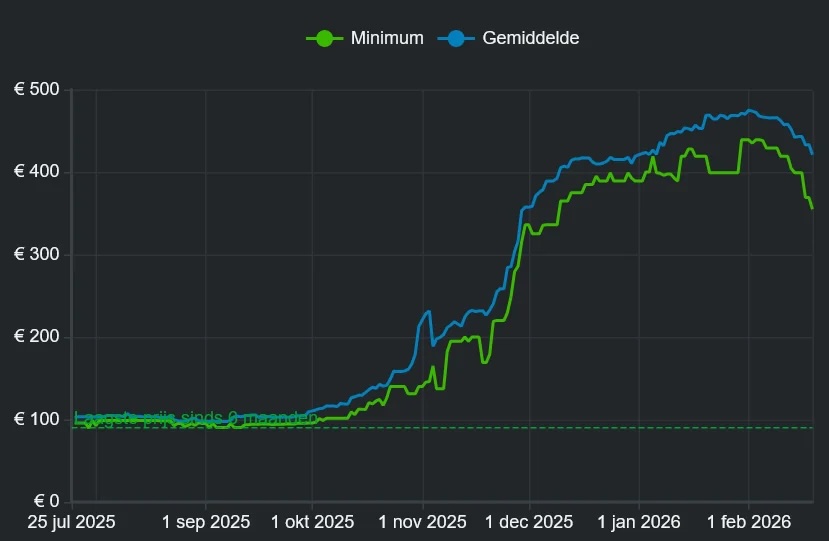
Price revisions in specific stores point in the same direction. For example, in Germany, several popular kits have seen price drops, with more noticeable reductions on certain models, fitting a typical scenario after a peak: initially, those with thinner margins or higher stock retreat first, followed by an adjustment in others.
Table — Signs of correction in DDR5 (32 GB) in Europe
| Observation | Implication |
|---|---|
| Peak at late January / early February | Maximum retail tension phase |
| Subsequent decline in minimum and average | Correction following a steep rise |
| More noticeable drops in some specific models | Selective adjustment due to stock and competition among stores |
| Prices still high despite correction | Not “normalization”: a first breather |
The key here is psychological and practical: when a core PC component becomes prohibitive, consumers postpone purchases, integrators adjust configurations, and the channel must react. Availability might still be limited, but prices cannot keep rising indefinitely without harming demand.
China: DDR4 changes direction more sharply
If Europe shows a mild correction, China presents the perfect contrast. In the Chinese market, DDR4 has experienced months of rises and tension… and now it’s showing a much sharper turn. Here, the driver isn’t just demand but also inventory dynamics: when products pile up out of fear of further increases, prices are artificially held up; when that expectation breaks, the adjustment comes quickly.
Meanwhile, manufacturers like CXMT are intensifying pressure on the “legacy” segment. The company has been noted for offering DDR4 at significantly lower prices, in some cases close to half the market level, adding an extra factor to the balance between supply, margins, and regional competition.
Table — Why DDR4 can move faster than DDR5
| Factor | DDR4 | DDR5 |
|---|---|---|
| Market maturity | More mature, highly sensitive to inventory | More dependent on current platforms and “premium” demand |
| Replacement ease | Easier in some systems and longer upgrade cycles | More tied to new PCs and current configurations |
| Price elasticity | High: demand stalls if prices spike too much | High as well, but with fewer alternatives in the current range |
| Bubble risk due to stockpiling | Higher | Lower (but exists in retail) |
Still, don’t confuse “China lowering DDR4” with “the world returning to 2023 levels.” The correction might be real but also could be local or temporary. Memory markets are influenced by many factors, stretching and contracting with production decisions, shifts in product mix (more DDR4/DDR5, server modules, or high-value memories related to AI surge), and other dynamics.
Context: actual demand versus expectations and margins
This episode leads to an uncomfortable conclusion for the sector: the steep rise was so aggressive that it ended up depriving part of the channel of oxygen. When profitability depends on inflated prices, any demand slowdown becomes a problem for retailers, assembly companies, and cascadingly, the entire ecosystem.
Additionally, cost pressures in memory have been so serious that some PC manufacturers have had to publicly update DDR5 module prices, citing the scarcity and sustained high costs. This helps explain why even a mild correction is perceived more as a “symptom” than a solution.
Is this the start of a cycle shift?
The big question remaining is whether this is just a pause or a phase change. With current information, the prudent message would be: there are signs of cooling, but the market has yet to demonstrate it can sustain reasonable prices again.
In Europe, DDR5 seems to have entered a correction phase after the peak. In China, DDR4 shows a sharper reversal, amplified by competition and inventory adjustments. What happens next will depend on two levers: how much PC demand at high prices can hold out and what decisions major manufacturers make for their production mix.
Frequently Asked Questions
When will the price of 32 GB DDR5 RAM in Europe truly drop?
The first decline after the peak indicates a correction, but it doesn’t guarantee a rapid decrease. If demand remains weak and stock appears in more countries, downward pressure could solidify; if tension reemerges, prices may stabilize at high levels.
Why can DDR4 fall faster in China than DDR5 in Europe?
DDR4 is a more “mature” market, highly sensitive to inventories and price competition. Changes in expectations or more aggressive supply can cause abrupt adjustments.
Is it worth buying RAM now or waiting if I’m building a PC in 2026?
For current platforms, DDR5 remains the standard choice. If you have a tight budget, many are watching weekly trends: if prices keep dropping, waiting might save money; if they stabilize, the savings could be limited.
Can the decline in China drag down prices of DDR4 and DDR5 in Europe?
It could have an influence, but it’s not automatic. It depends on how much volume reaches international channels, compatibility, market confidence, and reactions from major manufacturers and distributors.
via: Reddit